CDN NEWS |
  US NEWS







How Kanata LNG and the landmark cooperative prosperity agreement are shifting the nation toward energy superpower status
By Jim Rushton
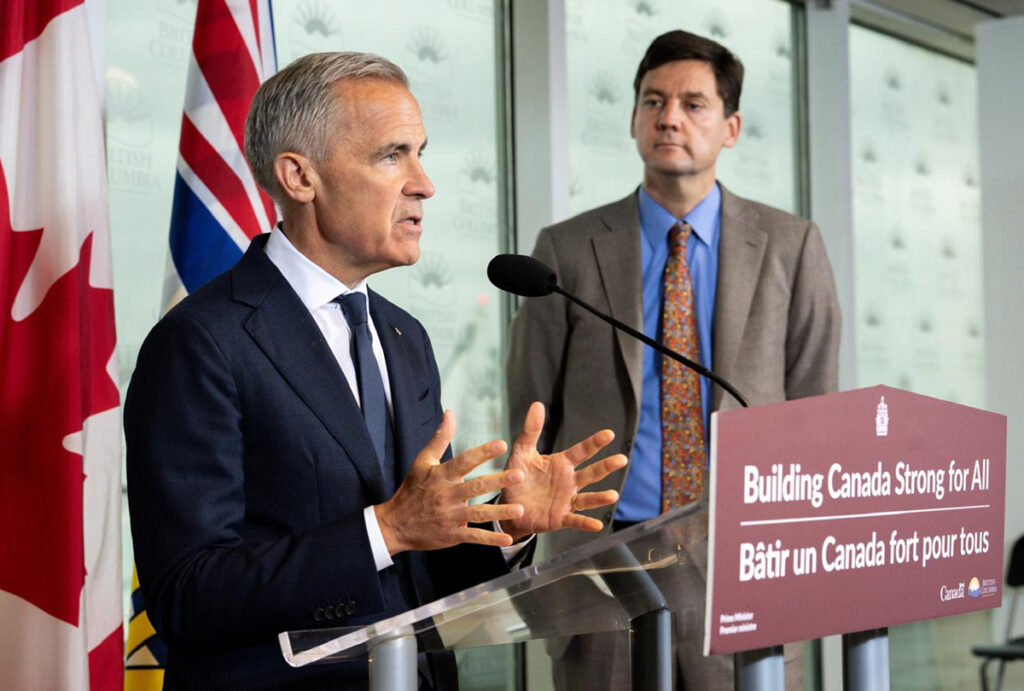
Two weeks ago, Kanata LNG was announced for the Prince Rupert area—an ambitious new floating LNG project with Korean and First Nations partners behind it. Ambitious on its own. But in the two weeks since, the situation started to look like something bigger: a preview of what Canada as an Energy Superpower could actually look like.
At the end of June, Prime Minister Mark Carney’s forward guidance on Canada’s energy future. Then, on July 2, came the Canada-British Columbia Prosperity Agreement and suddenly a single LNG project was standing inside a much larger national story.
First off, because Carney’s Forward Guidance address is so impactful, we start with it.
“The truth is, nobody knows how long the global economy will rely on conventional energy. But while it does, as much of that energy as possible should come from Canada.”
Source: Mark Carney
Forward Guidance: Canada’s Energy Future
It’s a powerful, clear-headed statement—and it’s true. There’s never been a consensus on how long the world stays on conventional energy, or what role Canada should play as a major oil and gas exporter. Carney’s contribution is admitting that uncertainty out loud, then drawing the obvious conclusion from it: while the world still needs it, Canada should be supplying it.
For more than thirty years, Canada denigrated its own resource economy and it cost us. Unnecessary divisions between regions, between rural and urban, and a slower economy than we should have had.
The idea of Canada being an Energy Superpower isn’t new. Prime Minister Harper first raised it in 2007. Prime Minister Trudeau buried it in 2017. Prime Minister Carney revived it in 2025 in his Forward Guidance Address.
Nineteen years of false starts and reversals. No matter which side of this debate you’re on, that’s plenty of frustration to go around.
The Prosperity Agreement
The prospects of a new oil pipeline from Alberta to the BC Coast are now much better following the July 2 signing of the Canada & British Columbia Prosperity Agreement.
Included in the Agreement is the putting forward of a new pipeline to the south coast of BC by Canada and Alberta, tacitly supported by the NDP government of British Columbia.
The southern route has been accepted—a decision with real political and economic weight, whatever the critics say. And there are critics: many are calling the agreement too general, short on the specifics that would actually get shovels in the ground. Fair enough. But whether or not you agree with the southern pipeline route, or with the North Coast Tanker Ban staying in place, the door has now opened for British Columbia to concentrate on getting its natural gas to market through the north.
The real strength of the agreement lies in two things. First, Premier Eby’s own words: he “commits to acting in good faith to engage in the necessary routing and permitting discussions, within its jurisdiction, as long as Ottawa follows through on promises such as compensation.”
Second, the builders. Trans Mountain Corp and Pembina Pipeline Corp—both experienced with BC pipelines—are taking on construction, a first step toward a broader consortium of investors. Together, and bolstered by the surprising success of the Trans Mountain Expansion, they’ve done a lot to restore investment confidence.

New pipeline to the West Coast
The choice of a southern oil pipeline route from Alberta to the BC Coast following the Canada & British Columbia Prosperity Agreement has increased the chances of success.
A southern pipeline route terminating at Delta Port will allow even more concentration on the Haisla’s Cedar LNG buildout and getting the Nisga’a-led Ksi Lisims project through to a final investment decision.
Oil terminal at Delta Port
The Delta Port terminal will be capable of handling Very Large Crude Carriers (VLCCs), a significant jump from the Westridge Terminal in Burnaby, which handles vessels of up to 750,000 barrels. The capacity at Delta Port will be 1.9 to 2.2 million barrels with direct access to the Georgia Strait. This moves double the volume with half the vessels.
Kanata LNG
The Kanata LNG project was announced for the Prince Rupert area. A general understanding of the project, the company, and the First Nation behind it can be found on the Resource Works podcast, Power Struggle.
When a project is first made public, there is much First Nations consultation, community engagement, and the lining up of commodity suppliers, customers, and engineering on the path through permitting to a final investment decision. There remains much work on this project.
The Korean partner Hanwha Ocean has “successfully executed more than 280 offshore and onshore energy projects worldwide.” The Frog Lake Nation is involved in upstream oil and gas, midstream research and development, and solar and wind projects. Kanata Clean Power & Climate Technologies Corp is the organization leading Kanata LNG.
This project is ambitious; it doesn’t stop with the floating LNG facility.
Robert Delamar, spokesperson for the Kanata Projects, has spoken on this in interviews with Resource Works, with columns by Nelson Bennett and Ian Biana, along with a Power Struggle Podcast hosted by Stewart Muir.
Energy Nodes
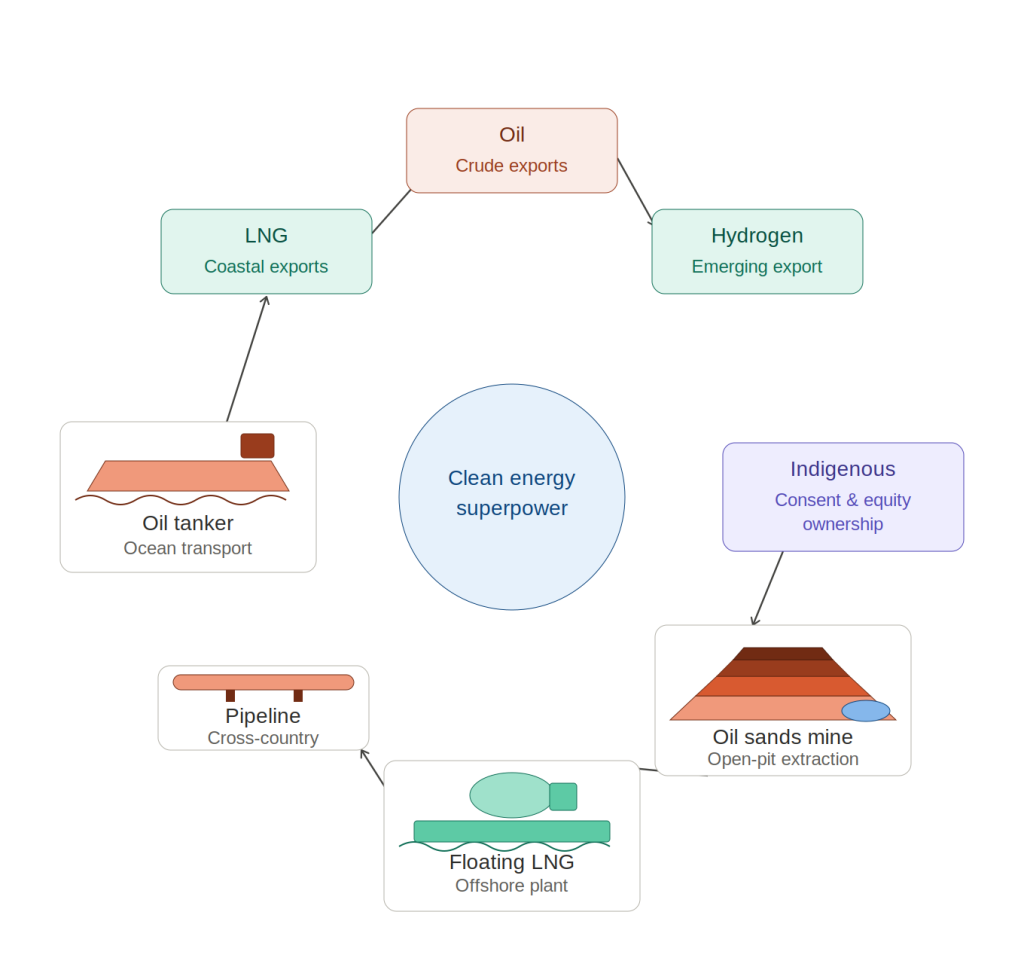
The concept is an Energy Node. A suite of energy projects that are integrated and supportive of each other. Over time, it would produce LNG, blue hydrogen, and electricity, and support a data centre.
The broader benefit is that the Port of Prince Rupert and communities in the region will have more access to locally produced electricity.
This all might seem overwhelming. But look around the world. This is what energy export nodes look like today.
Energy Nodes lower collective costs and increase the collective workforce, from engineering to security. Modern modular build-outs also improve the monitoring and maintenance of large, powerful processors and the infrastructure that goes with them.
In rural British Columbia, this is what “Future Jobs” really looks like.
Emerging energy superpower—Could be?
Clearly, the past couple of weeks have been a huge win for British Columbia, Alberta, and Canada and a large stride toward the goal of Canada emerging as an Energy Superpower.
Prime Minister Carney’s forward guidance, the MOU itself, and Premier Smith and Premier Eby’s statements have all moved the needle on investor confidence.
Being a clean energy superpower would provide the jobs of the future—for real this time. That means delivering on these projects, but also more hydrogen, more wind, and losing our aversion to nuclear. Why? Because oil and gas will pay for our environmental, economic, and social dreams. Ontario took the bet on nuclear power in the 1960s, and it is still paying off today.
Jim Rushton is a 46-year veteran of BC’s resource and transportation sectors, with experience in union representation, economic development, and terminal management. Reach him at [email protected].
Share This: