CDN NEWS |
  US NEWS









A Macdonald-Laurier Institute study argues that if British Columbia wants to keep attracting resource investment, it first needs to measure what the consultation process actually costs—and where reform would do the most good.
By Ian Biana
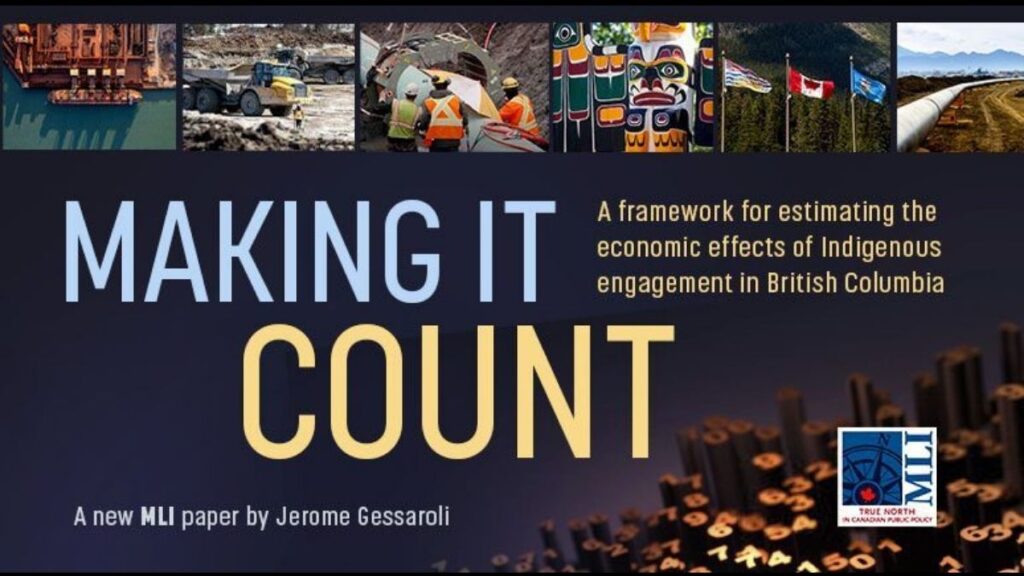
Making it Count. Image courtesy of the Macdonald-Laurier Institute.
For years, British Columbia has argued about Indigenous consultation in words. Is the process fair? Is it too slow? Does it respect rights? Does it scare off investment?
A new report from the Macdonald-Laurier Institute tries to do something different. It puts numbers to the conversation.
Released in July 2026, Making It Count: A framework for estimating the economic effects of Indigenous engagement in British Columbia comes from MLI senior fellow Jerome Gessaroli. It turns a hard political question into economic variables that investors, governments and Indigenous nations can all read from the same page.
The premise is simple. Mishandle consultation and the cost multiply. The report notes that “the consequences extend well beyond regulatory delays: projects can face costly litigation, years of uncertainty, lost investment, or even cancellation. Billions of dollars of economic activity and thousands of jobs can hinge on these outcomes.”
“When a good project’s odds of getting to yes fall from nearly 90 per cent to under 40 per cent just by crossing a provincial boundary, that’s not a detail—it’s a warning. BC can respect Indigenous rights and still give proponents timelines they can plan around. Right now we’re doing neither well enough.”
Stewart Muir, President & CEO, Resource Works
Five channels where engagement shows up in the numbers
The framework doesn’t treat consultation as a single cost. It breaks engagement into five channels that shape a project’s value.
The channels are legal and constitutional risk, the complexity of bargaining with many nations, the extra time engagement adds beyond a baseline schedule, ongoing benefit-sharing obligations, and the risk that signed agreements get reopened or challenged.
Each channel is measured against a baseline. That baseline is a comparable project subject to normal environmental assessment, permitting and community consultation, but stripped of Indigenous-specific delay, cost, risk and obligations. The gap between that baseline and a real BC project is what the model calls the incremental effect.
Why B.C.? The report calls the province “currently the epicentre of national debate over Indigenous consultation.” The framework points to a legal landscape still in motion: the Tsilhqot’in title decision, the more recent Cowichan and Gitxaała rulings, and the province’s Declaration on the Rights of Indigenous Peoples Act (DRIPA), whose promised amendments remained pending as of spring 2026.

Most of B.C. is not covered by historical treaties. That leaves unresolved title questions and overlapping claims. Alberta, next door, largely avoids them.
A $680-million mine, two provinces
To show the framework in action, Gessaroli runs a hypothetical mid-sized mining project worth $680 million through the model, comparing B.C. with an Alberta version of the same mine. The results are striking.
In B.C., the project faces roughly six affected nations. Three of them caught up in overlapping claims. Pre-approval consultation costs come to about $2.16 million, against $0.50 million in Alberta. Indigenous-related delay runs to 1.60 years in B.C. versus 0.50 years next door. The probability of securing durable agreements with every party sits at about 39 per cent in B.C., compared with roughly 87 per cent in Alberta.
Those differences compound. The “consultation effect” is the share of project value absorbed by delay and direct spending. It comes to 16.8 per cent in B.C. against 5.0 per cent in Alberta. Once approval risk and pre-approval spending are folded in, the project’s expected net present value falls from about $47 million to about $17 million in BC, while in Alberta it slips only from about $62 million to about $54 million.
The model finds the biggest driver is agreement-formation risk, not the paperwork or the cheques. The odds of a durable deal with each nation, and the number of nations at the table, swamp every other variable. As the report warns, low approval probability “can cause companies to forgo investments entirely, even when a project’s underlying economics are sound.”
A tool for everyone at the table—not a verdict on rights
The study is careful about its own limits. The framework “makes no judgment about the legitimacy of those rights.” It treats uncertainty over how consent applies purely as an investment risk factor for analytical purposes.
The report pitches the tools as a shared instrument. Policymakers, investors and Indigenous governments alike can all use it. They can see, early and clearly, which projects carry the greatest economic risk and where process changes would help most.
The report offers reform levers in that spirit. Reduce title uncertainty. Clarify how DRIPA applies. Develop pre-agreed benefit-sharing templates. Predictable outcomes raise the odds that agreements hold over time.
The bottom line Gessaroli lands on is one Resource Works has long argued in different terms: clarity is good for everyone. The report concludes that “a workable process must account for Indigenous rights while giving proponents clear and competitive timelines, costs, and decision rules.”
Measuring the effects, rather than merely debating them, is how B.C. can “focus reform where it is most likely to improve economic outcomes and make the approval process more reliable.”
For a province betting its prosperity on responsible resource development, that is a number worth making count.
Ian Biana writes for the Resource Works Accelerate team and can be reached at [email protected].
Making It Count: A framework for estimating the economic effects of Indigenous engagement in British Columbia, by Jerome Gessaroli, was published by the Macdonald-Laurier Institute in July 2026.
Share This: