


 CDN NEWS |
  US NEWS







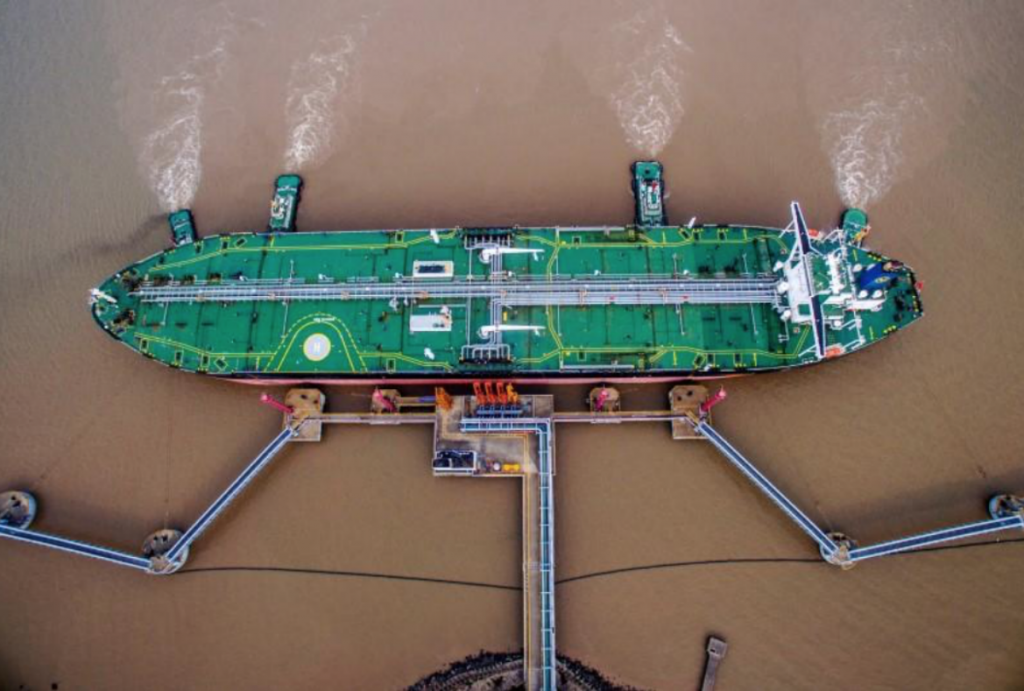
(Reuters) – Explosions tore through a natural gas port on Egypt’s Mediterranean coast on Wednesday, with maritime security firm Ambrey reporting a U.S.-owned floating storage tanker there had been hit by a drone. The strike on Damietta, for which there was no claim of responsibility, came hours after Washington and Saudi Arabia hit Iran-backed paramilitary groups in Iraq, and after Iran fired ballistic missiles at U.S. forces overnight.
President Trump, whose administration had only days earlier halted its air strikes against Tehran, vowed to “beat the fucking shit” out of Iran for firing on U.S. troops, underscoring how fragile the recent pause in hostilities had become. As the theatre of war widens, the strain on the oil and gas routes keeping the global economy running intensifies.
That strain is this week’s theme as we look at how Beijing is quietly working to protect its own crude lifeline, from reported outreach to Yemen’s Houthis over safe passage through Bab el-Mandeb to Chinese air-defence hardware flowing to Tehran. We also chart Oman’s now-rejected proposal for voluntary Hormuz transit fees, the Houthis’ parallel scheme for Bab el-Mandeb fees, and a Pentagon plan to confiscate troops’ cellphones in the region.
Meanwhile, our graphic of the week tracks Saudi Arabia’s dramatic pivot to the Suez Canal as its primary Asia-bound export route, a path it hasn’t relied on this heavily since the 1970s and 1980s, while our closing section highlights the political cost in the U.S., where support for the Iran war among Americans has fallen to just one in three.
NEWS BRIEFING
- Oman presented Iran a Gulf-backed plan for voluntary Strait of Hormuz fees, modeled on a system in the Malacca Strait where Indonesia, Malaysia and Singapore ask ships to pay voluntary contributions to fund navigation, environmental protection and search-and-rescue operations. A U.S. official rejected tolls or fees for the strait, insisting it remain free of Tehran’s control, while a senior Iranian official separately ruled out the plan, saying Iran and Oman must manage the waterway between them without outside involvement.
- Yemen’s Houthis are considering fees on ships transiting the Bab el-Mandeb strait, sources say, a week after declaring a Red Sea blockade on Saudi Arabia. Iran reportedly discussed the plan with Houthi officials, with Chinese vessels exempted. The move, aimed at pressuring the U.S., threatens Saudi Arabia’s alternative shipping route.
- The U.S. military may confiscate some troops’ cellphones in the Middle East over security concerns, sources say, a move that would add a new dimension for thousands of troops who rely on phones to message loved ones. In a letter, CENTCOM’s Admiral Cooper warned that Iran was benefiting from being able to see the success or failure of its strikes in near real-time by searching news reports or online posts by journalists referencing “reactions, photos, and footage from the cellphones of our troops.” Jordan-based troops face imminent seizure.
BEHIND CHINA’S IRAN NEUTRALITY, A BALANCING ACT
China’s neutrality in the Iran war raises questions. Public calls for peace. Private efforts to secure oil routes. A reported arms deal for the Iranian military whose survival affects both.
Two Reuters reports raise larger questions: Is Beijing running a deliberate strategy to insulate its energy supply from the war? Is it improvising fixes to a crisis it didn’t start and can’t control? One report concerns Iran’s expected receipt of up to 400 Chinese-made shoulder-fired air-defence missile launchers, potentially worth $60 million to $70 million. If completed, the deal could help Tehran restore short-range protection exposed or depleted during months of U.S. and Israeli strikes. China has called the report groundless. The other points to a more immediate Chinese concern: direct talks with Yemen’s Houthis to secure passage for Chinese tankers through Bab el-Mandeb. Beijing is seeking to keep Saudi crude moving from Red Sea terminals to China as Iran’s effective closure of Hormuz constrains Gulf exports.
Energy stakes are high for Beijing. China has been Saudi Aramco’s largest crude buyer for years and is Qatar’s top LNG customer, having sourced nearly 30% of its LNG supply from the Gulf exporter last year. That flow has since collapsed. China also ranks among the UAE’s top crude destinations, behind only Japan.
For the world’s largest crude importer, securing oil routes and maintaining contacts with actors able to disrupt them may be simple commercial self-preservation. Nor is a reported arms transaction, denied by Beijing and not yet implemented, proof of a broader Chinese decision to arm Tehran.
But the combination is awkward for China’s portrayal of itself as an impartial advocate of de-escalation.



China may not be choosing Iran over its rivals. But is Beijing prepared to stretch its professed neutrality to protect its supply chains and preserve privileged access as the war reshapes the region’s energy routes?
GRAPHIC OF THE WEEK
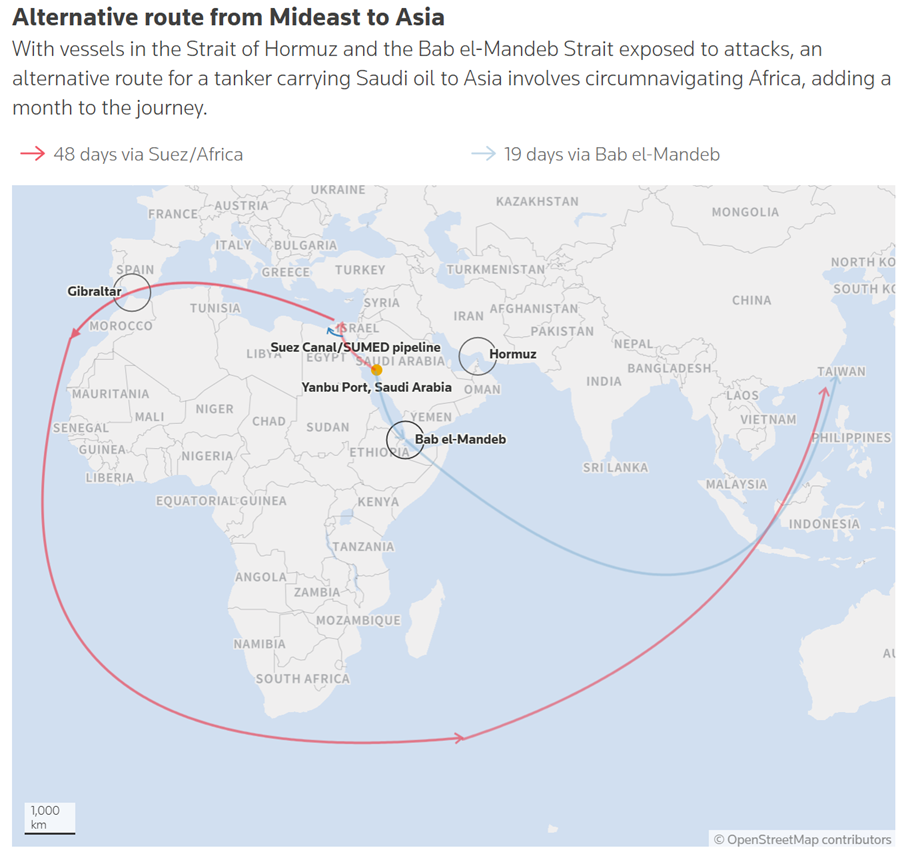
With Iran and Iran-backed Houthi militants disrupting its two key oil export routes, the Strait of Hormuz and Bab el-Mandeb, Saudi Arabia is starting to export Asia-bound oil via Egypt’s Suez Canal.
While the kingdom has previously used the Suez route to export some of its oil, it has not tested it as the main export outlet since the 1970s and 1980s, when Saudi Arabia’s top oil buyers sat in Europe and the United States. Most of its customers today are in Asia. To get to Asia via Suez, Saudi tankers must circumnavigate much of Africa, adding around a month to their journey. Read more about what it costs oil tankers to flee Hormuz and Bab el-Mandeb.
Source: Kpler, LSEG data Shadia Nasralla
LAST WAVE: IRAN WAR SUPPORT SLUMPS TO 1 IN 3 AMERICANS
Just one in three Americans now support the Iran conflict — a new low, according to a Reuters/Ipsos poll conducted over the weekend.
The survey found 69% of Americans think Trump hasn’t clearly explained his goals for U.S. military involvement in Iran. “It’s not clear why we started a war with them. I have no idea,” said Alex Womack, a retired turbine repair specialist and Marine Corps veteran from Georgia. “I don’t think he’s doing very well, personally.”
Others want eyes back home. “My biggest thing is just focus on the people who are actually in the country,” said Rhyan Anderson, an independent from Fairburn, Georgia. “I know we have allies and things like that, but there’s a lot of people here that really need help.”
Editing by Alexander Smith
Share This:






















INSIGHT: Canada’s Economy Falling Behind Despite Misleading Headlines – Fraser Insitute