


 CDN NEWS |
  US NEWS







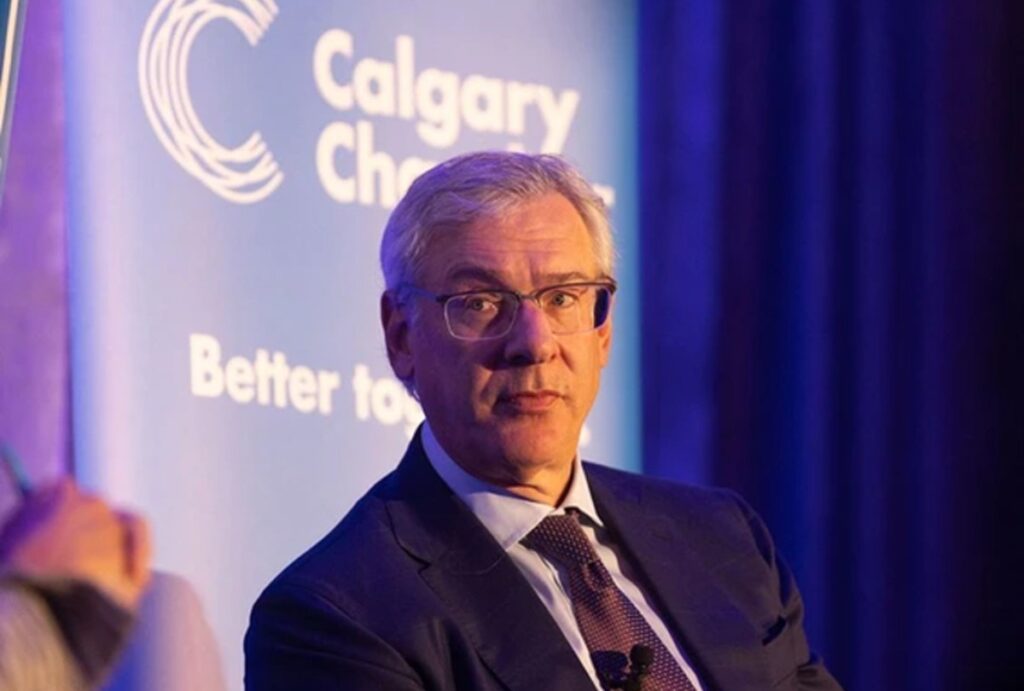
McKay has argued that Canada needs to move away from a cautious, risk-averse culture to a pro-growth mindset
Bloomberg News
Royal Bank of Canada chief executive Dave McKay said he expects announcements related to major Canadian energy projects in the “coming weeks” while warning that the country needs to move fast to secure capital.
“I think you’ll see some announcements coming soon, particularly on a number of pipelines, but we have to expedite that approval process because this capital that’s excited about Canada will not wait,” McKay said Tuesday at a Bloomberg Newsmakers event in Toronto. “The capital is impatient and it will move where things can get the most sure and fastest return.”
McKay sees a “risk on” environment for investing in Canada at the moment, with catalysts such as $80 billion in additional government spending on defence, “construction of at least, I think, two pipelines,” and infrastructure such as ports and rail systems.
The Canadian government is partnering with two of its largest pension funds — Canada Pension Plan Investment Board and the Public Sector Pension Investment Board — to host a summit for global investors in Toronto this September. McKay has previously argued that Canada needs to move away from a cautious, risk-averse culture to a pro-growth mindset to compete for global investment.
He said foreign investors are more interested in Canada now and has touted the recent move by U.K.-based Shell Plc to acquire Canadian oil and gas producer Arc Resources Ltd. as evidence.
Calgary-based South Bow Corp. is also exploring an expansion of its oil-export capacity to the U.S., a revival of a project similar to the Keystone XL pipeline that was ended during U.S. President Joe Biden’s administration. And Shell and other partners are moving closer to a final investment decision on building the second phase of a large liquefied natural gas plant on the coast of British Columbia.
On the Canada-United-States-Mexico Agreement, or CUSMA, McKay said he believes negotiators are “making progress” and noted that none of the parties has mentioned canceling it outright.
“I’m confident we’ll find that agreement over time, but it is a protracted process,” he said.



McKay has previously described the Canadian economy as resilient, having absorbed the significant shocks of sectoral tariffs and inflation, but noted that policy uncertainty around the CUSMA is the primary factor in restrained business investment. Gross domestic product contracted slightly in each of the two most recent quarters.
“We don’t really believe we’re in recession,” McKay said Tuesday. “I would say you’re going to see a positive print coming out in the next quarter.”
Growth fund
Royal Bank itself launched a $1 billion growth fund to help Canadian companies scale and remain in the country. The firm’s first two investments through the fund were in Vancouver quantum-computing company Photonic Inc. and Ontario healthcare platform League Inc., McKay said.
RBC Thought Leadership research published in April argued that Canada has the chance to become a global growth leader among Group of Seven nations, with investments of $1.8 trillion over the next 10 years in six strategic industries: oil and gas, electricity, mining, defense, agriculture and space.
The challenge isn’t capital, according to the report, but a overcoming a persistent shortage of project execution, policy certainty and risk taking. McKay has said Canada needs to seize a “once-in-a-generation moment” to address issues like that and turn the country’s economic prospects around.
Royal Bank’s venture fund follows JPMorgan Chase & Co.’s pledge in October to spend as much as US$10 billion on equity and venture capital investments. That’s part of a broader push by America’s largest bank to funnel US$1.5 trillion over the next decade — through financing and handling stock and bond sales — into industries that bolster national security and resiliency.
With assistance from Lisa Abramowicz
Bloomberg.com
Share This:






















COMMENTARY: Here’s How to Help Secure Canada’s Energy Sovereignty – Fraser Institute