


 CDN NEWS |
  US NEWS







B.C. faces a power crunch that only natural gas power may address
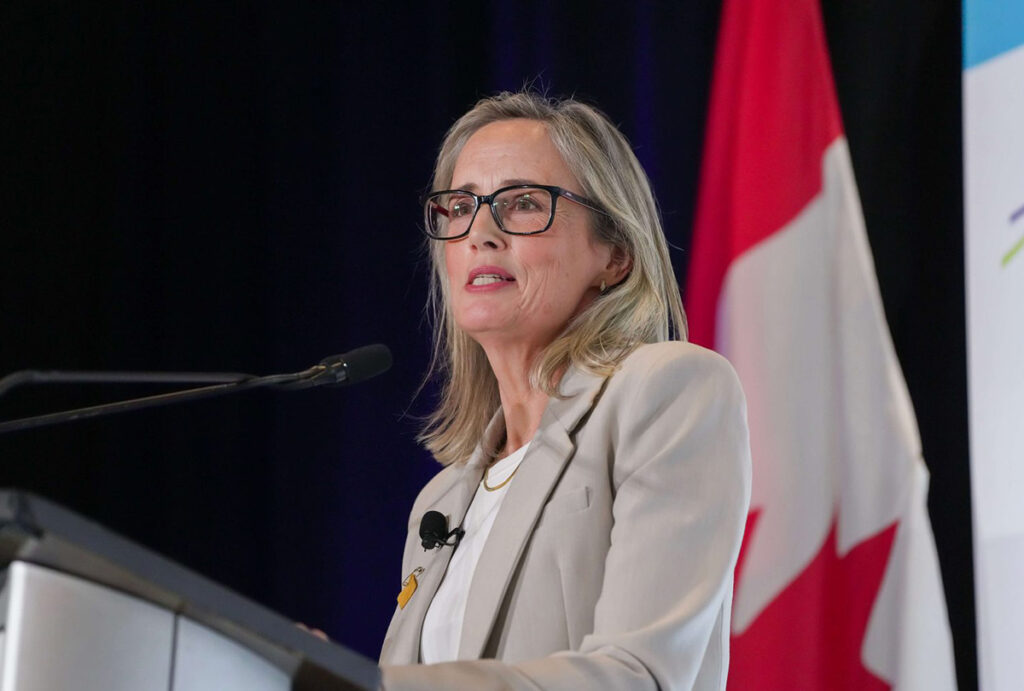
BC Hydro CEO Charlotte Mitha speaking to GVBOT. | Matt Borck The One Group Agency | GVBOT
By Resource Works
More News and Views From Resource Works Here
I’m going to go out on a limb here and predict that the next new dispatchable power plant built in B.C. will be fired by natural gas.
It’s unavoidable, I think. Recent revelations that BC Hydro now wants to extend the life of two natural gas power plants that were slated for cancellation underscore why.
BC Hydro now acknowledges what Barry Penner and others have been saying for a few years now: B.C. could be facing a looming electricity shortage, thanks largely to CleanBC policies of electrifying everything, including homes currently heated with natural gas, LNG plants, new mines and your car.
Add in AI data centre demand, and our electron bank is quickly headed into the red.
B.C.’s electrification ambitions are increasingly looking mismatched to our generating capacity.
“We are expecting demand to grow by about 20% by the end of this decade, and by roughly 50% by 2050,” BC Hydro CEO Charlotte Mitha told the Greater Vancouver Board of Trade last week.
“We’re seeing that growth really clearly on industrial demand, like mining and LNG, both in number and in size of projects.”
The largest industrial customer on the system today demands 150 megawatts (MW) of power, Mitha noted.
“Now we’re seeing projects come forward between 300 megawatts and 600 megawatts…half the size of Site C,” Mitha said. “So it’s a very different planning environment for us.”
BC Hydro recently updated its 2025 Integrated Resource Plan, which is its long-range forecast for electricity needs.
“By fiscal 2030, forecast system energy is 2,700 GWh higher under the 2026 Reference relative to the 2025 Reference Load Scenario and forecast system peak demand is 500 MW higher.”
Translation: We’re going to need a lot more power.
That 500 MW of peak power demand is the crucial number to keep in mind.
For most days of the year, B.C. should have more than enough generating capacity to keep the lights on.
“BC Hydro will always meet our obligation to have enough supply of reliable clean electricity to support B.C.’s growth,” Mitha assured the GVBOT crowd.
But there can be spikes in power demand in wintertime during prolonged cold snaps, and it is during times like these when you need backup power.
Mitha said BC Hydro now projects that peak load demand will increase 44% by 2050.
For these peak demand episodes, you need natural gas peaker plants. Which we have. And which the government has been planning to shut down in order to meet CleanBC purity tests.
But BC Hydro recently applied to the BC Utilities Commission (BCUC) to extend contracts for two natural gas power plants: Capital Power’s 275-MW Island Generation in Campbell River and the 120-MW McMahon cogeneration plant in Taylor.
As Penner recently quipped, B.C.’s CleanBC policies “appear to have crashed headlong into economic reality, as many have predicted.”
In its new National Electricity Strategy, the Mark Carney government acknowledges that natural gas power will need to be part of Canada’s future energy mix.
B.C. needs to pay attention to this. If it doesn’t, we are all going to be paying more than we need to for power in the future.
The new national strategy aims to double Canada’s electrical grid by 2050, while lowering energy costs.



“Realising these savings will require a willingness to use a wide range of energy – including natural gas,” the strategy states.
Why renewables don’t cut it
BC Hydro’s strategy to meet demand growth includes lowering the demand through a $1-billion investment in PowerSmart conservation and optimization efforts that would deliver 800 MW in capacity savings.
The B.C. government and BC Hydro also plan to fill some of the gaps of our growing electricity needs with new wind farms. The government recently approved four new large-scale wind farms that, combined, will provide 1,158 MW of nameplate capacity.
That sounds like a lot of power – equal to the Site C Dam. But the wind doesn’t always blow. The actual capacity factor of wind in B.C. is 30 to 40%. So 1,158 MW of nameplate capacity for wind will actually deliver only about 350 to 460 MW of power.
It’s a perfectly rational strategy to meet some of our growing electricity needs with renewables like wind power. They are relatively cheap in terms of capital costs and can be stood up relatively quickly.
But no amount of new wind, solar and battery farms will meet peak power demands in the winter. Renewables need firm dispatchable power behind them.
Also, you don’t want to overdo it with renewables. Too much intermittency can wreak havoc on the grid, as the Iberian Peninsula blackout in Spain and Portugal last year demonstrated.
At the time the grid collapsed, 71% of electricity on the Iberian Peninsula generation was from intermittent power (59% solar, 12% wind) and just 16% firm (nuclear and natural gas).
Mitha referred to the blackout when explaining the need for firm, dispatchable power.
“They help us avoid problems like those experienced in… Spain and Portugal, when their grid collapsed during a period of very high levels of solar and wind — intermittent power. You need those firm, dispatchable supplies on top of that.”
It is reassuring to know that BC Hydro understands the limitations of renewables, and the importance of firm baseload power. It’s less reassuring that the David Eby government doesn’t.
No dam way
B.C.’s power grid has excellent bones: hydro-electric dams, which provide the firm dispatchable power needed. And we could build another hydro-electric dam to meet our future baseload power needs. Site E has been recently floated.
But that would take about 20 years to get built, and would cost about 10 times more than a combined cycle gas power plant for the same generating capacity.
Site C Dam cost $16 billion, while the Shepard Energy power plant in Alberta was completed in 2015 at a cost of about $1.5 billion.
We could consider nuclear power, but B.C. is pretty pigheaded about that. Current policies forbid B.C. from ever building a nuclear power plant.
Asked if nuclear power could ever be in the cards, Mitha said: “Policies can be changed.
“I think we have lots of other alternatives before we get into nuclear.”
Following her talk to GVBOT, I asked Mitha if one of those alternatives could be natural gas power, given the federal government’s new stance on it.
“I think peaking plants that provide five days of support a year – very low GHG emissions – are needed in a lot of jurisdictions,” she told me.
“Is BC Hydro about to build a new baseload gas plant? No. But I fully support the concept of gas peaking plants that need to fill in the 10 days a year for the peak loads on the system.”
I suspect BC Hydro may be updating its plans again in a couple of years, and may be giving natural gas power a second look.
By then, a new Conservative government will likely be in power here in B.C. and some of the curbs on nuclear and natural gas power will likely be removed.
The answer to meeting future power needs in B.C. is staring us straight in the face.
We have an abundance of natural gas, and we have LNG and natural gas processing plants that use natural gas to produce power. Cogeneration from natural gas power is the answer to our peak power needs.
It’s a no-brainer.
Nelson Bennett’s column appears weekly at Resource Works News. Contact him at [email protected].
Share This:






















On The Verge: Energy Sector Primed for New Wave of Growth – ATB Economics