CDN NEWS |
  US NEWS







By EnergyNow Insights Staff
LNG Canada is moving closer to one of the most important investment decisions in Canada’s energy sector. Project partners are expected to decide by the end of 2026 whether to proceed with Phase 2, an expansion that would double the liquefied natural gas export facility’s capacity at Kitimat, British Columbia. Recent agreements between LNG Canada, the federal government, the Province of British Columbia, and Coastal GasLink have strengthened the framework needed to support a final investment decision (FID).
If approved, Phase 2 would add two additional liquefaction trains and increase total export capacity from 14 million tonnes per year to approximately 28 million tonnes annually. Federal officials have described the project as a key component of Canada’s ambition to become a leading global LNG supplier, while project proponents point to strong Asian demand and Canada’s competitive access to low-cost natural gas.
Phase 1: From Construction to First Exports
The LNG Canada project reached a positive FID in 2018 after years of regulatory reviews, engineering work, Indigenous consultation, and commercial negotiations. Construction created thousands of jobs, with peak workforce levels exceeding 9,000 workers at the Kitimat site.
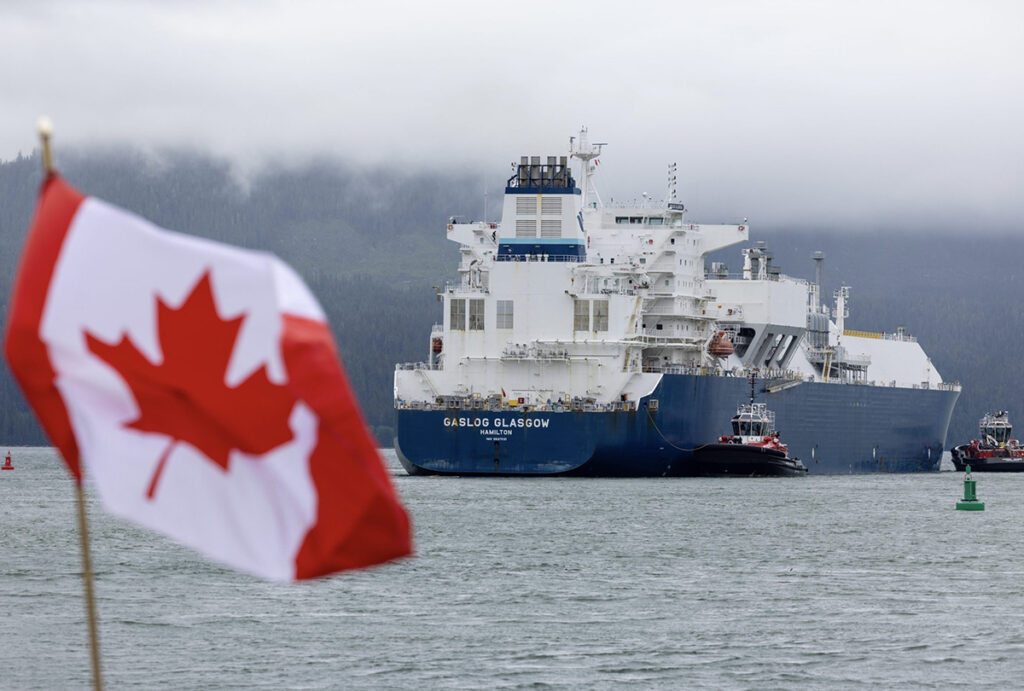
A major milestone was achieved in June 2025 when LNG Canada produced its first LNG and loaded its inaugural export cargo. The first shipment departed Kitimat aboard the LNG carrier Gaslog Glasgow on June 30, 2025, marking Canada’s entry into the global large-scale LNG export market.
Train 1 entered service in mid-2025, while Train 2 began production in November 2025. The facility has continued ramping up operations throughout 2026.
Current Export Performance
Phase 1 is designed to export up to 14 million tonnes of LNG annually. As operations have stabilized, export volumes have steadily increased. In April 2026, LNG Canada surpassed one million tonnes of LNG exports in a single month for the first time, approaching its nameplate capacity. By early May 2026, the facility had already delivered roughly 80 cargoes to international markets.

The project’s location on Canada’s Pacific Coast provides a significant shipping advantage for customers in Asia. Cargoes can reach key Asian markets more quickly than many shipments departing from the U.S. Gulf Coast, avoiding congestion and transit costs associated with the Panama Canal.
Who Buys LNG Canada’s LNG?
LNG Canada is owned by a consortium consisting of Shell (40%), Petronas (25%), PetroChina (15%), Mitsubishi Corporation (15%), and KOGAS (5%). These shareholders are also the primary off-takers of LNG produced from the facility, using their global trading and marketing networks to supply customers throughout Asia.
While individual cargo destinations vary depending on market conditions, the project was designed primarily to serve Asian demand centres, including Japan, South Korea, China, and other Pacific Basin markets. The first cargo departed for Asia, reflecting the project’s strategic focus on supplying the world’s largest LNG-consuming region.
Why Phase 2 Matters
Supporters argue that Phase 2 would significantly increase Canada’s presence in global LNG markets at a time when many countries are seeking secure and diversified energy supplies. Government estimates suggest the expansion could help position Canada among the world’s top LNG-exporting nations while leveraging Canada’s relatively low-emissions LNG production profile.
The expansion would also require additional natural gas transportation capacity from the Coastal GasLink system. Agreements announced in 2026 establish a commercial framework for potentially doubling pipeline throughput, allowing more Western Canadian natural gas to reach the Kitimat export terminal.
Although the final decision has not yet been made, recent cooperation agreements and engineering work suggest momentum is building toward a year-end determination. If approved, Phase 2 would represent one of the largest private-sector energy investments in Canadian history and further establish British Columbia as a major gateway for LNG exports to Asia.
Share This: