


 CDN NEWS |
  US NEWS







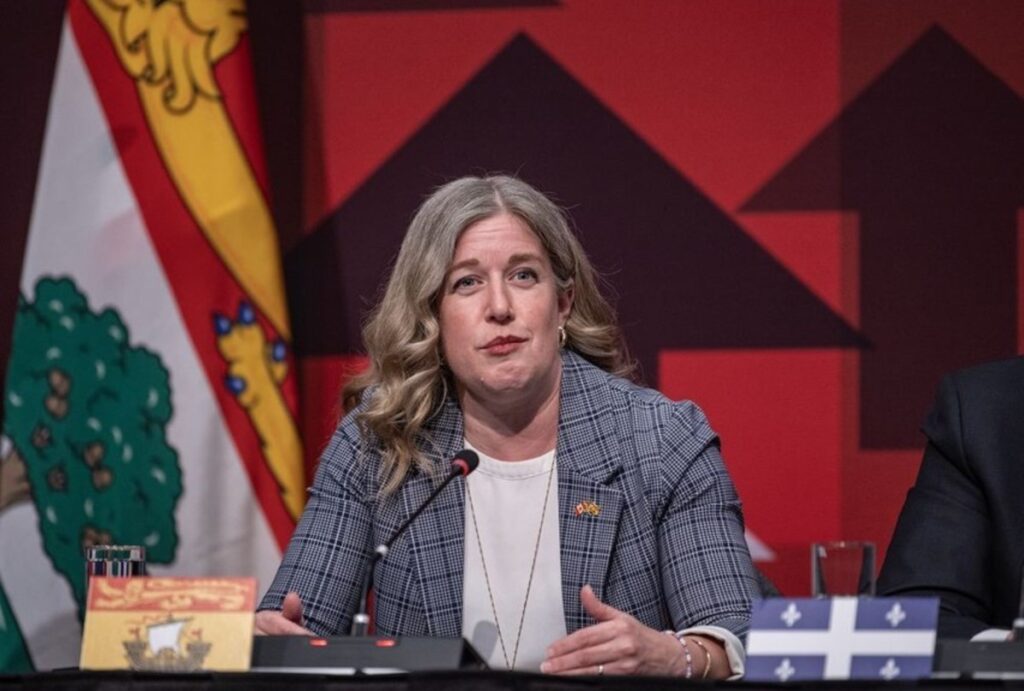
Premier Susan Holt has officially abandoned her election commitment to make New Brunswick’s largest industrial plants pay more to emit greenhouse gases that contribute to climate change.
Holt welcomed news that the federal government is giving all provinces a break on its industrial carbon price standard to match a deal signed with Alberta.
“We were pleased to see that the federal government didn’t just do a special deal for Alberta and extended that program across the country so that we would have the same playing field for competitiveness,” she told reporters.
During the 2024 election campaign, Holt said the industrial carbon price on the province’s 15 biggest emitters “needs to be robust.”
But applying the new Alberta pricing standard in New Brunswick will make the system less robust, not more.
Asked about her campaign commitment, Holt said, “We’re comfortable with what the federal government has proposed for Alberta and for all provinces, so we’re going to see that implemented here, and that’s where we are today.”
Prime Minister Mark Carney signed an energy agreement with Alberta Premier Danielle Smith that lowers the industrial carbon price the province must reach, and gives it an additional 10 years to get there.
Carney said on May 20 that he would extend the same terms to other provinces.
“We’ll do it fast so we have one consistent, predictable approach,” he said.
In fact, the new rates and timelines took effect for all provinces May 15, according to the federal government’s carbon pricing website.
“As soon as I heard the deal with Alberta, I started to despair, because I knew that that would spread like a contagion across the country,” Green Party Leader David Coon said.
“It’s already a pretty weak system. That’s why the premier, during the campaign, in trying to sound green, said she was going to create a more robust system. But clearly she’s going to be very pleased with an even weaker system.”
The federal pricing standard required all provinces to reach a carbon price equal to $170 per tonne of greenhouse gas emissions by 2030.
Under the Alberta agreement, its price only has to hit $140 per tonne by 2040.
The same terms now apply to all provinces.
The federal change also immediately lowered this year’s per-tonne price to $95 from $110.
“New Brunswick, like every other province, is going to slow down the rate at which its carbon price goes up, and it’ll have to recalibrate its system a little bit,” said Ross Linden-Fraser, a researcher with the Canadian Climate Institute, a policy think-tank.
Holt suggested a lower price on emissions will help her government achieve its energy goals of keeping power rates affordable and promoting economic growth.
“That’s what we’re hearing from New Brunswickers as their priorities,” she said. “Right now that’s our focus.”

Irving Oil’s Saint John refinery was the province’s largest emitter of carbon dioxide in 2024, followed by three N.B. Power generating stations: the Belledune coal plant, the Coleson Cove plant that burns fuel oil, and the Bayside natural gas plant.
“N.B. Power’s carbon compliance costs were higher in 2024 compared to 2023,” utility spokesperson Tracey Stephenson said in an email.
She did not provide a dollar figure but said the higher costs were in part due to the carbon price hitting $80 per tonne in 2024.
According to federal data, emissions were down at the Irving refinery in 2024, but increased at Belledune, Coleson Cove and Bayside.
Under New Brunswick’s output-based pricing system, created by the Higgs government to comply with federal requirements, each of the 15 biggest emitters in the province is given a performance standard linked to its rate of emissions relative to its production output.
Emitters that stay below that standard earn carbon credits they can sell in a trading market, while emitters that exceed the standard must pay a charge to the province or purchase credits in the market.
The latest data from 2024 shows that the number of carbon credits issued jumped to 80,346 from 25,319 the previous year.
“That’s good news for the facilities that are performing well because it means they’re getting some kind of reward from other facilities for performing well,” Linden-Fraser said.
At the same time, the total emissions from the 15 big industrial plants increased from 5.9 million tonnes in 2023 to 6.4 million in 2024.
Because the pricing standard is based on production output, the performance standard can move if the plant’s output grows, allowing it to emit more greenhouse gases.
The province does not release the individual performance standards for each plant and does not disclose which plants earned and bought carbon credits, making it hard to tell exactly how the system is working.
“Emissions are going in the wrong direction but the system is satisfied at some level with the performance we’re seeing, and that might be a sign that there’s some good news behind the headlines,” Linden-Fraser said.
“That might also be a sign the system is not that stringent.”
N.B. Power’s fossil-fuel-emitting power plants had to generate more electricity in 2024 because of a long shutdown of the Point Lepreau nuclear generating station and lower hydro generation, Stephenson said.
That drove the utility’s emissions up to 3.3 million tonnes from 2.7 million.
That may explain why overall emissions were up even as some emitters like the Irving Oil Refinery reduced their emissions and potentially earned credits, Linden-Fraser said.
Alberta’s deal has three different ways of calculating the price in that province — the “headline” price of $140, an “effective” price based on how Alberta’s system works and a price floor for its credits.
Those don’t necessarily translate easily into other provincial systems and could compromise the predictability of New Brunswick’s carbon market that emitters rely on, Linden-Fraser said.
“There’s a huge number of unanswered questions raised by the terms of the agreement and that lack of clarity will be tricky for any province that’s trying to figure out what to make of the agreement,” he said.
“It will be tricky for facilities that are trying to figure out what they should expect from carbon pricing systems in the future.”
Share This:























OPINION: The Iran War Energy Crisis is Just Getting Started: Bousso