CDN NEWS |
  US NEWS







B.C. Utilities Commission signals shift to “fossil gas,” inverting historical reality
By Stewart Muir

1940s gas display at the Pacific National Exhibition | City of Vancouver Archives
By Resource Works
More News and Views From Resource Works Here
The term “natural gas” has long been criticized by climate activists as a marketing ploy. History shows the opposite: the adjective “natural” was added to distinguish a cleaner product from the dirty, manufactured alternative that preceded it.
This week, news emerged that the B.C. Utilities Commission (BCUC) has taken the unprecedented step of not only dropping “natural” but mandating its replacement with “fossil gas.” This linguistic shift inverts reality. The BCUC stated in a news release that in “future applications or filings to the BCUC, public utilities are expected to use the term ‘fossil gas’ rather than ‘conventional natural gas’ to describe natural gas that is formed from fossils and extracted from rocks within the earth’s surface.”
From coal gas to natural gas
Before widespread drilling, gas was manufactured from coal in gasifiers. Marketers simply called it “gas” or “town gas.” In British Columbia and elsewhere, the term “natural gas” (sometimes “nature’s gas”) emerged to highlight the shift to cleaner, naturally occurring deposits from underground reservoirs.
This distinction mattered. The City of Vancouver Archives and a 2015 Resource Works article document this transition visually – from polluting coal gas plants to modern natural gas infrastructure.
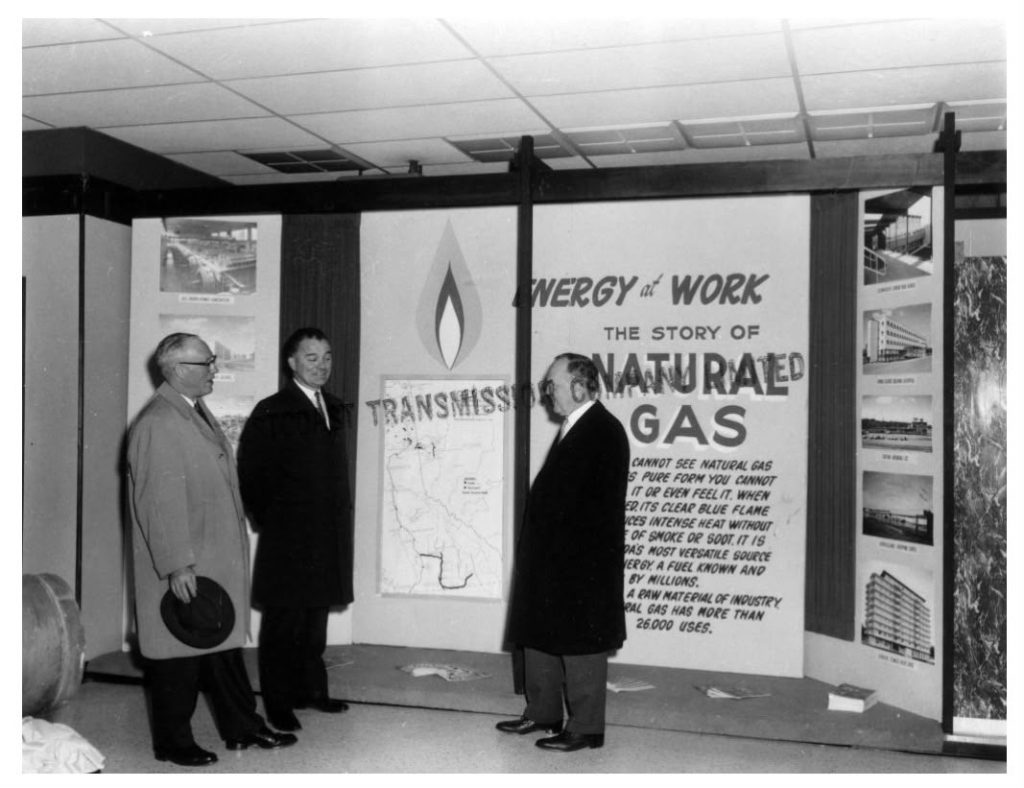
By the 1960s, PNE exhibit focused on “natural” gas – signaling transition to cleaner era for the product. | City of Vancouver Archives
Cleaner chemistry, lower emissions
Coal gas was roughly 50% hydrogen, 25-30% methane, plus significant carbon monoxide, carbon dioxide, sulphur compounds and particulates. It was energy-intensive to produce and left behind contaminated brownfield sites.
By contrast, pipeline-quality natural gas is typically 95%+ methane after processing. It burns far cleaner, producing about half the CO₂ per unit of energy compared to coal, with minimal sulphur and particulates.



Today, natural gas provides critical reliability in British Columbia, supplying up to two-thirds of power needs on the coldest days and supporting a growing LNG export industry that helps displace coal globally.
The “fossil gas” rebrand
The term “fossil gas” was popularized by environmental organizations, particularly in Europe, to emphasize fossil origins and blur distinctions with dirtier fuels. It’s the linguistic cousin of rebranding oil sands as “tar sands” – a play to engage emotions rather than reason.
While both natural gas and coal-derived gas originate from ancient carbon, they are not equivalent in emissions intensity or environmental impact.
British Columbia appears unique in North America for this regulatory mandate. Federal statutes, the B.C. Oil and Gas Activities Act, U.S. FERC and EPA rules, and most state and provincial laws continue to use “natural gas.” Some municipalities (such as Vancouver and Berkeley) have adopted “fossil gas” in climate plans, but bylaws and ordinances have stayed with conventional terminology.
The renewable gas problem
The shift also creates a logical inconsistency. Renewable natural gas (RNG) from landfills, agriculture and wastewater is produced through natural biological processes and is increasingly blended into B.C.’s gas system. It cannot accurately be called “fossil gas,” yet the BCUC’s approach risks conflating it with conventional supplies.
Policy reality check
Despite decarbonization rhetoric, BC Hydro is increasingly acknowledging natural gas’s essential role in meeting peak demand, population growth and industrial needs. Rebranding it as “fossil electricity” when required for grid reliability would expose the absurdity of the exercise.
Premier David Eby’s enthusiasm for LNG is one I share. Liquefied Fossil Gas (LFG) is, however, not a term likely to catch on and you just know that, having secured one beachhead, it’s inevitable that soon enough we’ll see one pressure group or another commence their prosecution of the inevitable campaign.
If policymakers truly dislike “natural gas,” a more accurate path is to adopt terms like “geological gas,” “thermogenic methane,” or simply “pipeline methane.” These maintain scientific honesty and distinguish it from both historical coal gas and modern renewable gas – without the emotional manipulation of the “fossil gas” label.
The BCUC’s stated role is to regulate utilities for safe, reliable service at just and reasonable rates, while balancing broader public interest. Mandating “fossil gas” is not a technical, safety or rate-setting matter. It’s a semantic and framing decision at the expense of historical, chemical and operational accuracy.
“Natural gas” was never greenwashing. It was truth in advertising – a clear signal of progress from a dirtier era. Mandating “fossil gas” doesn’t clarify science or policy; it obscures meaningful distinctions in the name of politics. Accurate language should illuminate differences, not create confusion.
Stewart Muir is the president and CEO of Resource Works Society.
Share This: