CDN NEWS |
  US NEWS







by Terry Winnitoy
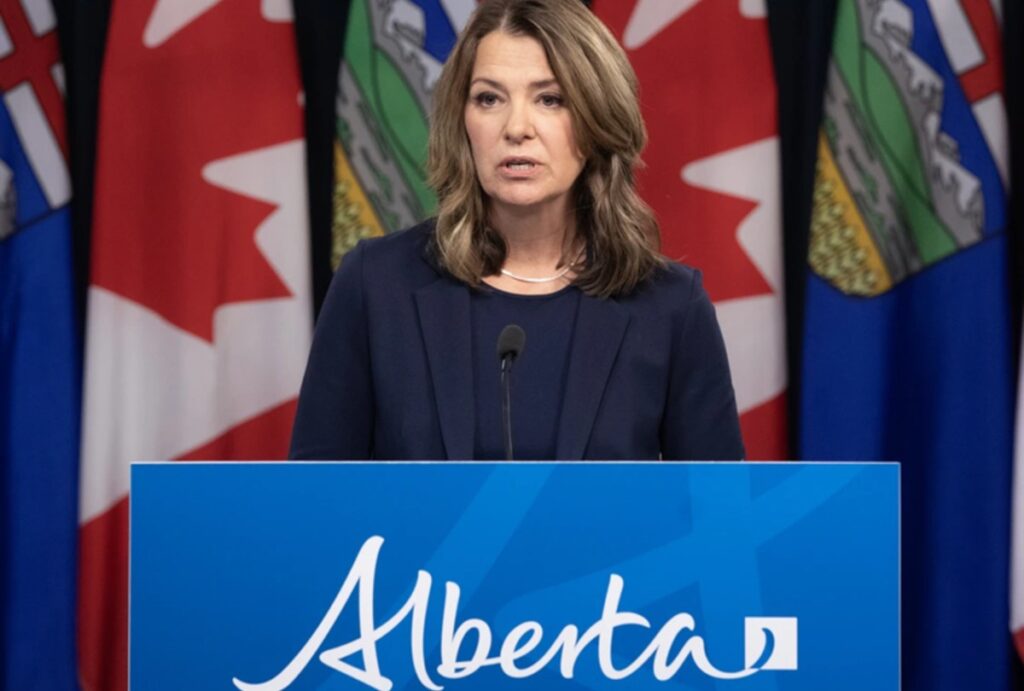
Alberta Premier Danielle Smith is expected to lay out the next stage of her government’s push for a new West Coast oil pipeline on Thursday, July 2, 2026, as the province moves to meet a key deadline under its energy agreement with Ottawa.
CTV News reported on June 29 that Alberta is preparing a “major announcement” on July 2 outlining new details about the province’s submission to the federal Major Projects Office for a proposed one-million-barrel-per-day pipeline to Canada’s West Coast. The announcement follows a July 1 deadline for Alberta to submit its pipeline proposal under the Canada-Alberta energy memorandum of understanding.
The proposed pipeline has quickly become one of the most consequential energy and nation-building files in the country. For Alberta, it represents a chance to unlock long-term oil sands growth, reduce dependence on the U.S. market, and create a direct route to Asian customers. For Ottawa, it has become a test of whether the federal government’s new Major Projects Office and Building Canada Act can actually move large, controversial infrastructure projects through review faster while still meeting Indigenous consultation and environmental obligations.
A Pipeline Tied to a Bigger Canada-Alberta Deal
The pipeline commitment was first set out in the Canada-Alberta MOU signed in late 2025. That agreement called for one or more privately financed and constructed pipelines, with Indigenous co-ownership and economic benefits, capable of moving at least one million barrels per day of Alberta bitumen to export markets, with Asian access identified as a priority. It also stated that Alberta’s application would be ready for submission to the Major Projects Office by July 1, 2026.
The same MOU positioned the pipeline as part of a broader energy and emissions bargain. Alberta agreed to advance carbon capture, Indigenous economic participation, data centre development and other energy priorities, while Ottawa agreed to treat an Alberta bitumen pipeline to Asian markets as a potential project of national interest that could be referred to the Major Projects Office under the Building Canada Act.
In May 2026, Prime Minister Mark Carney and Premier Smith signed an implementation agreement that sharpened the timeline. Alberta committed to submitting the pipeline application by July 1, 2026, while Canada agreed to pursue designation of the pipeline as a project of national interest by October 1, 2026, subject to required conditions and Indigenous consultation obligations.
The Alberta government says the submission will include engagement with Indigenous communities, a general path and size of the pipeline, costs and benefits to Canada, market demand, economic viability, and the social, environmental and economic case for recommending the project. Alberta’s own project page states that the goal is to obtain the permissions necessary so design and construction could begin as early as September 1, 2027.
Alberta Acting as Early Proponent
One of the most unusual features of the proposal is that Alberta itself is acting as the early-stage proponent. The province says no construction has started and that its current role is to assess the project and prepare a submission for federal consideration. Alberta has also said it is contributing $14 million for early planning work, including preliminary engineering, cost estimates, economic modelling and early engagement.
That government-led approach is meant to reduce early uncertainty and create conditions for a private-sector proponent to step in later. However, the absence of a clearly identified private company remains one of the project’s biggest unanswered questions.
Major pipeline projects require long-term shipper commitments, regulatory certainty, Indigenous agreements, route certainty, port access and billions in capital. Alberta has said it expects private industry to ultimately build and finance the line, but as of the June 29 reporting, no private-sector proponent had been publicly named.
That uncertainty matters. Reuters reported in May that the proposed pipeline still lacked a private-sector proponent and that Carney was counting on carbon-market incentives and improved investment conditions to attract commercial interest. Reuters also reported that any West Coast pipeline would face hurdles from British Columbia and affected First Nations.
Carbon Pricing, Carbon Capture and the Politics of Trade-Offs
The pipeline proposal is closely linked to the broader carbon-pricing deal reached between Alberta and Ottawa. Under the May 2026 agreement, Canada and Alberta agreed to an effective carbon price of $130 per tonne by 2040, with a headline carbon price of $115 by 2030, $130 by 2035 and $140 by 2040. The agreement also includes a minimum floor price for TIER credits beginning in 2030 and 75 million tonnes of jointly issued Carbon Contracts for Difference to support emissions-reduction projects.
For Ottawa, that structure is intended to preserve the federal government’s net-zero and emissions-reduction objectives while allowing a major oil export project to move forward. For Alberta, it provides a longer timeline and more flexibility than previous federal expectations, while tying energy growth to emissions-reduction investments.
The deal also links pipeline development to the Pathways Plus carbon capture proposal, a major oilsands decarbonization initiative also listed by the Major Projects Office among its supported projects. The political bargain is clear: Alberta gets a path toward new export infrastructure, while Ottawa gets stronger long-term carbon-market commitments and a major carbon capture project tied to oil sands growth.
Why the West Coast Matters
The strategic argument for a new pipeline is straightforward. Canada remains heavily dependent on the United States as its dominant crude export customer. A West Coast pipeline would give Alberta producers greater access to Asian markets, improve customer diversification and potentially strengthen Canadian price realization.
The Trans Mountain expansion, completed in 2024, already opened new export capacity from Alberta to the B.C. coast. Reuters reported in March 2026 that Trans Mountain was running a bidding process to secure more firm transportation contracts and that future optimization projects could lift total system capacity from about 890,000 barrels per day to roughly 1.19 million barrels per day.
The Canada-Alberta MOU specifically says the proposed new pipeline would be in addition to a further Trans Mountain expansion of 300,000 to 400,000 barrels per day destined for Asian markets.



Meanwhile, pipeline capacity is again becoming a live issue across North America. South Bow has been advancing the Prairie Connector project, a partial revival of the Keystone XL concept that would move 550,000 barrels per day from Alberta to Wyoming. Reuters reported in May that South Bow had secured 20-year binding shipper commitments and was targeting a final decision by mid-2027, though the company still wants assurance that U.S. permits will remain durable under future administrations.
Together, the Trans Mountain optimization work, Prairie Connector proposal and Alberta’s West Coast pipeline push reflect a larger industry reality: producers are again looking for long-term egress as Canadian oil output grows and global customers seek secure energy supply.
B.C. Opposition Remains a Major Barrier
The largest political obstacle remains British Columbia.
B.C. Premier David Eby has repeatedly opposed any move to repeal or weaken the North Coast tanker ban. In a May 15 statement responding to the Canada-Alberta MOU, Eby said B.C.’s opposition to any repeal of the tanker ban “has not changed,” and argued that Ottawa should focus on B.C. projects with existing proponents and identified routes.
That opposition is particularly important if Alberta’s preferred route leads to the northwest coast, where tanker access would be essential. The Oil Tanker Moratorium Act restricts large crude oil tankers from stopping, loading or unloading along B.C.’s north coast, which is why any northern route would almost certainly require federal legislative or regulatory changes.
Smith has also left open the possibility of a southern route, including one that could follow the existing Trans Mountain corridor. That option could avoid some north coast tanker-ban issues, but it would bring its own technical, port-capacity, land-use and public-opposition challenges.
Indigenous Consultation Will Be Decisive
Indigenous consultation and participation could determine whether the project advances or stalls.
Alberta’s West Coast pipeline materials emphasize Indigenous co-ownership, leadership and economic benefits, and the MOU specifically refers to Indigenous co-ownership and opportunities through the Alberta Indigenous Opportunities Corporation.
At the same time, opposition from some B.C. coastal First Nations and environmental groups is already mobilizing. A June 29 report republished by Te Ao Māori News from APTN said Alberta had not publicly identified which First Nations had been consulted, while Alberta’s Ministry of Indigenous Relations said more than 40 Indigenous community leaders had been engaged and that specific names were not being released to preserve open participation.
The same report said possible route options include northern paths toward Observatory Inlet, Nasoga Gulf, Kitimat and Prince Rupert, as well as a southern option terminating in Vancouver. It also noted continued opposition from the Haisla Nation to an oil pipeline and export facility in its territory.
There is also Indigenous support for oil and gas development in Alberta and among pro-resource First Nations leaders who argue that pipeline ownership, jobs, contracting and environmental stewardship can bring long-term benefits. The challenge for Alberta and Ottawa will be to prove that consultation is meaningful, route-specific and capable of addressing concerns before federal fast-tracking decisions are made.
A Test of Canada’s Ability to Build
The Major Projects Office is now central to the federal government’s economic strategy. Ottawa says the office is designed to move nation-building projects faster and more responsibly, working with provincial, territorial and Indigenous partners while respecting environmental responsibilities and Indigenous rights. As of June 24, the MPO listed 15 supported projects and seven transformative strategies, with projects across energy, mining, transportation, ports, nuclear, LNG, critical minerals and trade corridors.
On June 24, the federal government also initiated the process to potentially list three major projects under the Building Canada Act: the Mackenzie Valley Highway, the Grays Bay Road and Port Project, and the Nuclear Waste Management Organization’s deep geological repository. Ottawa said the Building Canada Act is intended to improve predictability, efficiency and coordination, while maintaining Indigenous consultation and environmental safeguards.
Alberta’s pipeline proposal now enters that same national debate. Supporters will argue the project is precisely the kind of infrastructure Canada must build if it wants to diversify trade, grow exports, strengthen energy security and unlock private investment. Opponents will argue that fast-tracking a new oil pipeline risks weakening climate policy, threatening coastal ecosystems, undermining the tanker ban and short-circuiting Indigenous consent.
Smith’s July 2 announcement will not settle those questions. But it will mark the next formal step in a project that could define Canada’s energy politics for years.
The key questions now are whether Alberta can identify a credible route, whether a private proponent will emerge, whether Ottawa will move to designate the pipeline as a project of national interest by October 1, 2026, and whether Indigenous and B.C. concerns can be addressed in a way that allows the project to move from political ambition to actual construction.
For Alberta, the July 2 announcement is about more than filing paperwork. It is the province’s attempt to put a new West Coast pipeline back at the centre of Canada’s economic future.
Share This: