


 CDN NEWS |
  US NEWS







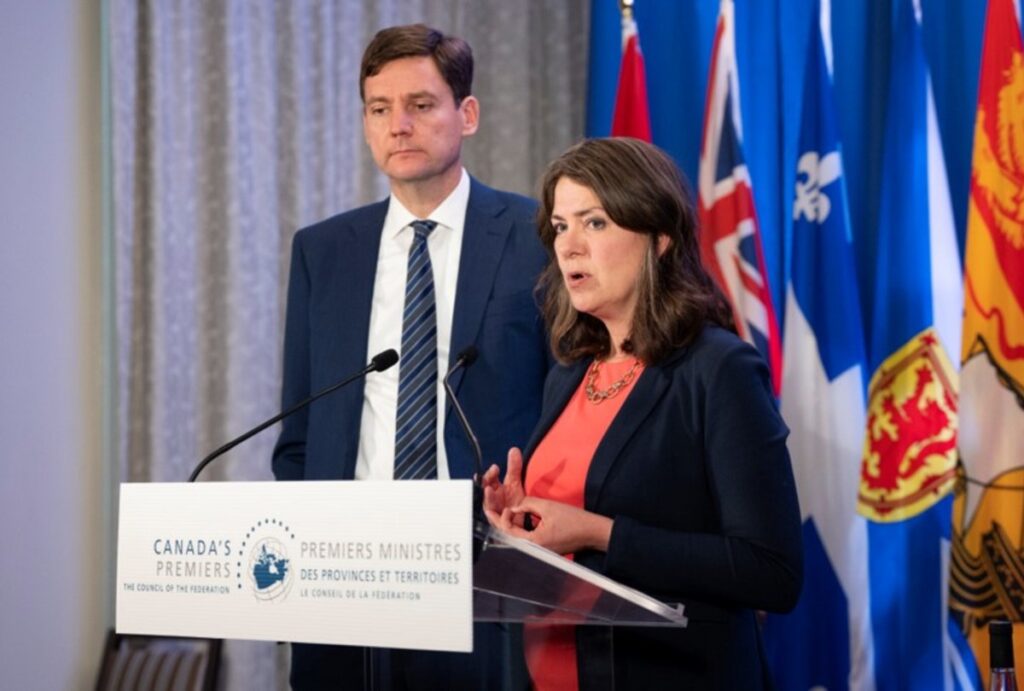
The Smith-Carney pipeline MOU, the carbon price fight, the BRIK gambit, and what it all means for British Columbia’s resource economy.
Danielle Smith walked out of her meeting with Mark Carney last week and changed one word. “If” became “when.”
The pipeline memorandum of understanding, signed in November, is moving toward finalization. A million barrels a day to tidewater. A federal government that has, for the first time in a decade, put its name on a document committing to expanded oil export capacity. I wrote last week about Fatih Birol’s remarkable reversal and Jon McKenzie’s public rebuke of Canadian energy policy. The signals from the IEA and from Calgary’s boardrooms are converging. What deserves closer examination now is the deal itself, its mechanics, and what it means for British Columbia.
* * *
The deal on the table
The MOU contemplates a new pipeline carrying up to a million barrels a day of oil sands crude to the Pacific for export to Asia. The federal government has designated it a project of national interest. Where it ends up is less settled than either side lets on. Alberta prefers Prince Rupert, with its deep water and three-day sailing advantage to Asia. Ottawa has been leaning south, toward a route alongside or paralleling Trans Mountain to the Lower Mainland, on the theory that it faces fewer obstacles. In Vancouver’s federal Liberal circles, it has become quietly acknowledged that the northern route won’t fly but the southern option should be workable, though nobody is eager to talk about the details of how that would actually get done. Smith has said she is “skeptical” of the southern route. Alberta is expected to submit a northern proposal to the Major Projects Office this summer.
The route matters, but it is not the main event. The main event is the carbon price.
Alberta has agreed to ramp its industrial levy from the current freeze at $95 per tonne to $130 by 2040, using an output-based system in which efficient producers earn credits and laggards pay. The Canadian Climate Institute puts the incremental cost at about 50 cents a barrel. The Oil Sands Alliance, representing the five largest producers, calls it “an uncompetitive industrial carbon tax that no other major heavy oil producing jurisdiction faces.”
Fifty cents a barrel sounds small until you multiply it across five million barrels a day and 365 days a year. That is roughly $900 million annually in costs that no competitor in Saudi Arabia, Iraq, or the Permian Basin faces. And there is no prospect of recovering it from buyers. Not a single crude oil purchaser in the world has ever paid a premium for a barrel with a lower carbon profile, and no one who actually sells into Asian markets expects them to start. The fifty cents is a pure cost, absorbed entirely by the producer, in exchange for a climate benefit that is unmeasurable at the global scale. Heather Exner-Pirot has made the point with characteristic precision: Cenovus has operated in Asia for over a decade, and the premium its customers are willing to pay for carbon capture is, in her estimation, zero.
McKenzie made the point with the directness you would expect from someone who runs a $50-billion company: the MOU sets out a path for a pipeline but fails to create the conditions for the production growth needed to fill it. You can lay the pipe. If the fiscal regime sends capital to the Permian, the pipe carries air.
* * *
The BRIK gambit
Alberta’s answer to the “who fills the pipe?” problem is one of the more unusual instruments a Canadian province has deployed in the resource space, and it deserves more scrutiny than it has received.
Under the Bitumen Royalty-In-Kind program, which dates to 2007, the province got rights to a portion of its royalty payments from oil sands producers not as cash but as physical barrels of bitumen. The Alberta Petroleum Marketing Commission then markets those barrels directly. A new oil refinery was one result. In January 2026, the energy minister authorized APMC to borrow up to $900 million for hydrocarbon marketing activities, from equity positions to joint ventures to subsidiary corporations. Smith has already met with a multinational petrochemical firm about selling roughly two million government-owned barrels per month overseas, leading to speculation about a pipeline tie-in.
The political logic is elegant. If industry says it cannot commit enough volume to justify a new pipeline, the province points to its own supply. The government already owns the barrels. It can guarantee throughput.
The economic logic is less tidy. These are not new barrels. They are royalty barrels, production that already exists and already moves through existing infrastructure. The producers still pump the oil. The province simply takes its share in kind rather than cash, then redirects it. BRIK does not create supply. It reassigns who controls where that supply goes.
If the government is committing those barrels to a pipeline that producers themselves declined to underwrite with firm volume commitments, something interesting is happening: the state is deciding where Canadian oil flows because the market chose not to. The $900-million borrowing authority lets APMC behave like a commercial shipper. But the motive force is political. Smith needs the pipeline to be viable whether the majors co-operate or not.
There is a certain irony in all of this. BRIK is a lever that would be a natural fit for Hugo Ch’avez’s Venezuela. The state collects the resource, the state markets the resource, the state decides where it goes. That this instrument is being deployed by the most free-enterprise provincial government in Canada requires some logical massaging. Alberta’s deep-blue instincts run to deregulation, private sector primacy, and government getting out of the way. BRIK is government stepping very much into the way, with $900 million in borrowing authority and a direct marketing arm that competes with the producers whose royalties fund the province. The contradiction is managed, for now, by the argument that Ottawa and the regulatory class left Alberta no choice. Whether that reasoning holds once the program has its own bureaucracy, its own contracts, and its own institutional momentum is another question.
* * *
The dissenting view
Eric Nuttall, one of the most closely followed energy fund managers in Canada, has taken to calling the MOU “The Grand Ransom.” His objections are structural, not technical.
A million-barrel pipeline is a pipe dream without taxpayer funding, he argues, because firm volume commitments at that scale will never materialize. The roughly $30-billion Pathways carbon capture project was conceived in a different world and should be scrapped. The carbon tax makes the industry marginally less competitive in exchange for solving a problem that represents 0.1 per cent of global emissions. And the entire premise of “future-proofing” the industry through social licence is, in his view, a fiction.
“Not a single purchaser of oil in the world asks nor cares about a barrel’s carbon profile.”
— Eric Nuttall
Nuttall’s alternative: expansion on existing pipelines plus the Prairie Connector/Bridger project would add 1.6 million barrels per day of incremental capacity, enough to get Canada through to the mid-2030s. No new greenfield pipeline required.
If he is right, BRIK becomes something its architects did not intend: the province as shipper of last resort for a pipeline the market did not ask for. If he is right about Pathways, the emissions architecture holding the MOU together collapses, and what remains is a political accommodation between a Conservative premier and a Liberal prime minister, each handing the other something to show their base. A pipeline for Smith. A carbon price for Carney. The oil, as always, goes where the economics take it.
* * *
Three positions, one fracture



McKenzie wants the pipeline but not the carbon tax. Reform the economics, keep the architecture. Nuttall rejects the architecture. No mega-pipeline, no megaproject on carbon capture, no carbon price at any level. Let the market work. Smith and Carney need the whole package to hold together because the politics of each piece depend on the others. Carney cannot defend a new oil pipeline to his base without carbon capture. Smith cannot defend the carbon price to hers without the pipeline.
Pull one thread and the deal unravels. That is why BRIK matters beyond the pipeline file. It is Smith’s hedge against the entire framework coming apart.
Whether the hedge pays off depends on a single question: does the world still want a million barrels a day of Canadian heavy oil in 2035? Birol, from that hotel in Toronto, offered an answer. But then Birol has answered the same question differently before, and may answer it differently again. The IEA’s track record on forecasting the energy transition is, to put it generously, uneven.
* * *
What this means for British Columbia
However the argument between Calgary, Edmonton, and Ottawa resolves, and whichever route prevails, the barrels end up on the coast. Our coast. Whether it is Prince Rupert or the Lower Mainland, the tanker access, the port capacity, the Indigenous engagement, the regulatory approvals: those are BC decisions, and no amount of MOU-signing in other people’s capitals changes that.
I have written before that British Columbia has Norway’s assets and California’s politics. The Montney formation is among the cleanest and most competitively priced natural gas plays on Earth. The Golden Triangle holds a critical minerals endowment the world is queueing for. LNG Canada Phase 2 sits on the doorstep of a final investment decision. And CleanBC has cost $3.5 billion over seven years with no measurable emissions reduction. We have the resource base of a petrostate and the regulatory posture of a graduate seminar.
The carbon price trap, and Eby’s escape route
The Alberta deal has created a competitiveness problem for BC that David Eby, to his credit, has identified publicly. If Alberta freezes its industrial carbon price at $100 per tonne through 2030 while BC’s Output-Based Pricing System tracks the federal benchmark at $110 and climbing, every LNG facility, gas processor, and mine in this province faces a carbon cost that its counterpart across the Rockies does not.
“We are in direct competition with Alberta on certain projects. We will not be in a competitive position if Alberta has a special federal carbon price that the rest of us don’t have access to.”
— Premier David Eby
That sentence has received almost no attention. It should. Eby is not objecting to the pipeline. He is not objecting to oil exports. He is objecting to being undercut on industrial carbon costs by the province next door. This is a competitiveness argument, not an environmental one, and it opens a door that the premier may not have intended to open.
BC’s OBPS, launched in April 2024, applies to facilities emitting more than 10,000 tonnes of CO2 equivalent per year. The compliance obligation was 50 per cent in 2024, 60 per cent in 2025, and rises to 70 per cent through 2030 at $110 per tonne. For LNG Canada Phase 2, whose economics span a 40-year project life, the gap between $100 in Alberta and $110-and-rising in BC is not a rounding error. It changes where capital goes.
Eby’s options are more numerous than the public conversation suggests. He could negotiate a parallel deal with Ottawa that aligns BC’s industrial carbon price with Alberta’s. He could freeze the OBPS ramp. He could carve out project-specific fiscal terms for LNG and mining. He could accelerate the offset mechanisms that reduce effective costs for high-value projects. Every one of these moves is available today, and every one can be framed as competitive alignment rather than climate retreat, which is the only framing that survives inside his caucus.
The question, and it is a genuine one, is whether the premier who removed the consumer carbon tax, backed LNG Canada Phase 2, and launched the Critical Minerals Office has the political room to take the next step on industrial pricing. The environmental left holds outsized influence in his cabinet and his caucus. It shaped CleanBC, it shaped DRIPA, and it shaped the instincts of a premier who came to office through the party’s progressive wing. Alberta’s MOU has handed Eby something useful: the cover to move on competitiveness grounds rather than ideological ones. Whether he takes it or watches his industrial base migrate next door is the most consequential economic decision facing this province in 2026.
* * *
A northern route, if it prevails, transforms the economic geography of northwest BC. It creates Indigenous equity partnerships along a corridor where the Haisla, the Nisga’a, and the Tahltan have already demonstrated, through LNG Canada, Ksi Lisims, and the Golden Triangle mining agreements, that they are further ahead on economic reconciliation than the provincial framework acknowledges. They would rather Victoria stopped being an obstacle. A southern route raises different questions, not least how much additional tanker traffic the Burrard Inlet and the Salish Sea can absorb, and how a second pipeline corridor through the Fraser Valley would be received by communities that have already absorbed Trans Mountain’s expansion. Neither route is simple. Both end in BC.
The northwest coast
I have covered resource debates in this province for more than 30 years, and the pattern is always the same. Whenever a pipeline proposal reaches the coast, someone discovers that the local waterway is uniquely dangerous, singularly unsuited to marine traffic, and imperilled in ways that no other body of water on the planet could possibly be.
Hecate Strait is the latest candidate for this honour. Before that, it was Burrard Inlet. Before that, it was Douglas Channel. The argument changes its geography but never its structure: this particular stretch of water is somehow different from every other strait, channel, and harbour in the world where tankers operate without incident, year after year.
The North Sea is not gentle. The Strait of Malacca serves 84,000 vessel transits a year in equatorial heat and monsoon squalls. The approaches to Valdez, Alaska, handle crude tankers in conditions that make Hecate Strait look like a bathtub. Every ocean has weather. It is not a distinguishing characteristic.
What is distinguishing about Prince Rupert is how good it actually is. Transport Canada’s own comparative risk analysis of potential Pacific coast oil ports ranked Port Simpson and Ridley Island, both in the Prince Rupert area, as the lowest marine risk among the locations assessed. The deepest natural harbour in North America. Deep-sea vessels enter through Dixon Entrance, not Hecate Strait, picking up BC Coast marine pilots at Triple Island. The port’s CEO has put the matter simply: there is arguably no safer place in Canada to do this.
The BC coast already handles fuel barges, LNG tankers out of Kitimat, bunker-fired cruise ships, and bulk freighters carrying everything from grain to potash. American crude oil tankers transit the same waters the tanker moratorium is supposed to protect. Seventy years of crude tanker operations on this coast, no spills. The 2016 incident at Bella Bella, cited reflexively by moratorium supporters, involved a tugboat that sank while pushing an empty fuel barge. It was not a tanker, it was not crude oil, and it was not on the north coast shipping lanes.
The route debate between north and south will play out over the coming months. If the decision is made on safety data rather than political convenience, Prince Rupert’s case is strong. If it is made on the path of least political resistance, the south may win by default. Either way, the mythology of the uniquely dangerous BC waterway does not survive contact with the government’s own data, which may be why the data is so rarely cited by those who prefer the mythology.
* * *
Alberta has clarity. Whether that clarity is well-founded or not, it has produced a premier who negotiates pipelines, a BRIK program that secures barrels, and a borrowing authority that underwrites the commercial risk. BC has the assets, the coastline, and a harbour that is by the government’s own assessment the safest in the country. It also has a government that has not decided what it wants to be.
The pipeline needs a terminus, north or south. The LNG needs a loading berth. The critical minerals need a port. The route will be argued over for months. What cannot be argued is that BC is where the resource meets the ocean. The only thing standing between the two is a decision.
The barrels are coming. They always were.
Stewart Muir is the president and CEO of Resource Works Society.
Share This:






















On The Verge: Energy Sector Primed for New Wave of Growth – ATB Economics