


 CDN NEWS |
  US NEWS







From the oilsands to Bay Street, from B.C. shipping terminals to a New Brunswick refinery, the war in the Middle East has flipped the energy script in this country. And the drama is far from over
By Reid Southwick, Chris Varcoe, Barbara Shecter, Meghan Potkins, Derrick Penner
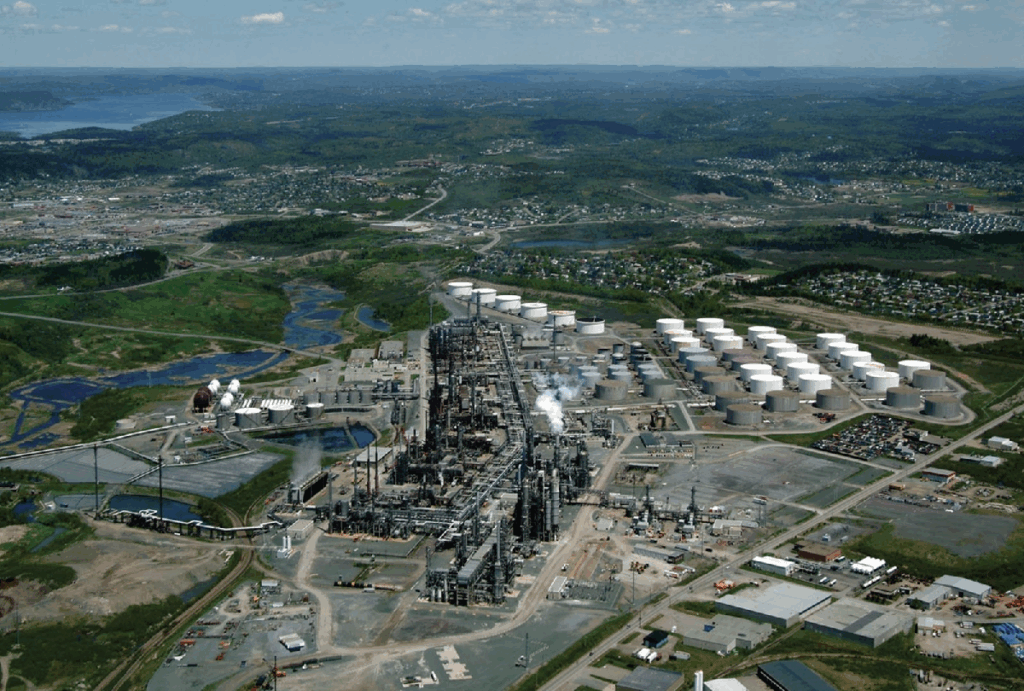
Inside Irving Oil Ltd.’s corporate headquarters in New Brunswick, staff at the notoriously discreet energy giant wrote a request to a federal agency — and their message was anything but reserved.
The century-old company that runs Canada’s largest refinery tried to impress upon Ottawa the enormous stakes of the energy crisis caused by war in the Middle East.
Irving Oil wanted special permission to use a foreign tanker to ship oil from the coast of Newfoundland and Labrador to its refinery in Saint John, N.B. It said Canadian ships were not available — and it needed the oil.
In the filing with the Canadian Transportation Association, the company said the Iran war was having “far-reaching implications for global production, shipping, refining and energy security.”
“In this context, it is essential for our customers, for our business and for the broader energy security of Atlantic Canada that we have the ability to use foreign crude oil tankers to access Canadian crude oil,” the company wrote.
Irving Oil’s concerns for energy security are but one side effect of the weeks-long, near-closure of the Strait of Hormuz, a shipping lane for one fifth of the world’s oil. Though there were tentative signs Wednesday that commercial traffic along the strait would resume following the announcement that the United States and Iran had agreed to a temporary ceasefire, the route ahead is anything but certain.
Every day this doesn’t come to a resolution, the worse it’s going to be
Bart Melek, global head of commodity strategy at Toronto Dominion Bank
Iran’s blockade of foreign tankers along the waterway inflicted the biggest energy supply disruption the world has ever seen.
Like a clogged artery in a human body, the war starved the global economy of a critical source of oxygen.
And the widely accepted prognosis is that it will take weeks or months — if not years — to fully recover, even if the shaky ceasefire leads to an end of the war.
For an energy-producing country such as Canada, the consequences are profound. Already, some Western Canadian oil and gas producers are considering stepping up their spending and drilling plans to take advantage of crude prices that have risen well above US$90 a barrel.
Other producers, however, will be more conservative and instead return cash to investors: The era of lavish spending sprees in the oilpatch is over and not even a record-breaking supply disruption is likely to resurrect it.
For some provinces, like Newfoundland and Labrador, Saskatchewan and Alberta, government deficits could shrink or turn to surpluses as oil money washes away the red ink.
But for countless other budgets across the country, the effects of this crisis will be severe, forcing many Canadians to rethink what they can afford. They will feel it in their daily commutes, when they’re booking vacations and at the cash register as companies pass on rising fuel costs.
“What’s happening in the Middle East, it’s a bit humbling for most of us, because we are looking at our expenses,” said Estella Petersen, who works in the oilsands, the main source of Canadian oil production.
“We’re looking at how much we’re paying more for fuel and for food and everything.”
From Toronto’s Bay Street to northern Alberta’s oilsands, from British Columbia’s energy shipping terminals to Irving Oil’s refinery, this shock has flipped the energy script in Canada.
And the drama is far from over.
“This application is being made in the context of ongoing global events and the uncertainty it has caused and will cause in energy markets and in marine planning,” Irving Oil wrote in its request to regulators, who approved the application last month.
Irving Oil expects to ship up to 680,000 barrels of offshore Newfoundland oil to its refinery in late April. The company, which did not respond to requests for comment, said in its application that it was in discussions to buy crude from the Hebron oilfield, a joint venture involving several partners, including Exxon Mobil Corp. and Calgary-based Suncor Energy Inc.
The operators of Hebron and other offshore drilling projects generally sell most of their oil to refineries along the U.S. Gulf Coast, said Paul Barnes, the director of Atlantic and Northern Canada for the Canadian Association of Petroleum Producers. The remaining roughly 40 per cent typically heads to Western Europe.
“The platforms that are off Newfoundland are basically producing at their capable levels of oil production at the moment,” Barnes said, noting that Ottawa has asked operators to ramp up output because of the war.
Despite Irving Oil’s relative proximity to Newfoundland, the company rarely buys oil from its neighbouring province, likely because its refinery is set up to process different blends of crude, Barnes said.
Instead, the Saint John refinery typically sources significant volumes from Saudi Arabia, which has cut production throughout the conflict due to supply constraints.
Sources: Kalibrate, weekly fuel prices | Graphic: Steven Wilhelm, Calgary Herald
At a nearby gas station, Carter Nesbitt is feeling the effects of those constraints.
With the refinery in view behind him, Nesbitt is doing everything he can to avoid the spiralling expense of refuelling his SUV, ever since the Iran war broke out.
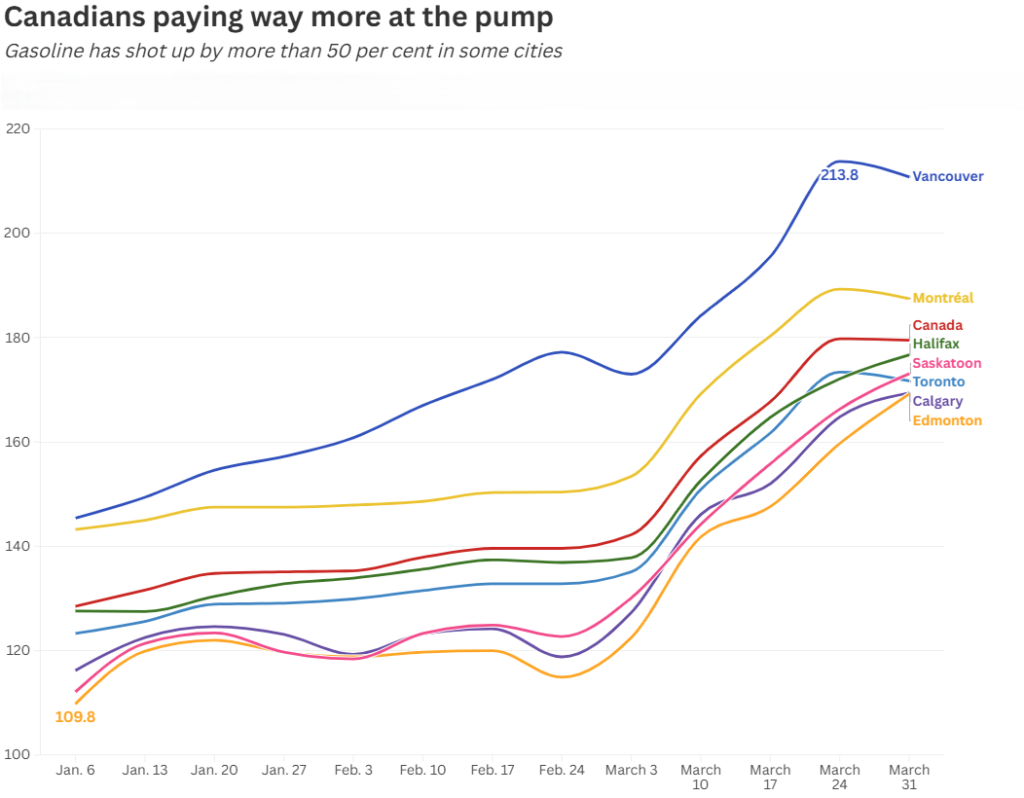
The 24-year-old is careful about driving too much after work, and he’s scaling back road trip plans. On this recent afternoon, it costs him about $75 to fill the tank with gas at $1.72 per litre, a bargain compared to current average prices in New Brunswick, which have risen to nearly $1.90.
“I didn’t even really want to come here,” Nesbitt said with wafts of Saint John wind blowing through his mop of hair.
“I’ve been putting off getting gas, trying to just drive less because it’s a little scary trying to work it into my budget when it’s already kind of tight.”
If pump prices keep rising like this, Nesbitt said he may have to sell his vehicle.
From Bay Street to Main Street
Phones started buzzing on Feb. 28, interrupting weekend plans for a couple dozen senior strategists across Toronto-Dominion Bank’s operations in London, New York, Toronto and Singapore. A flurry of messages ricocheted between them over the course of the day as they hammered out how to interpret military attacks on Iran by the U.S. and Israel that were sure to affect global oil markets and broader economies.
“We try to respond in real time to global events that are market-moving,” said Bart Melek, global head of commodity strategy at TD.
Melek’s commodities team began briefing a range of clients, including central banks, large companies, traders and fund managers. They were guided by earlier disruptions caused by military conflict in the region, such as the Iran-Iraq war in the 1980s, and had concluded that oil prices were likely to soar, possibly by as much as 50 per cent.
“Almost immediately our view was that probably WTI (West Texas Intermediate) and Brent (crude) will be north of US$90 a barrel,” Melek said.
Importantly, the team zeroed in on the closure of the Strait of Hormuz, advising clients that oil production was less important for markets at that point than the ability to ship it.
“We ultimately are where we are now (with oil over US$90 a barrel), and our view at this point is that every day this doesn’t come to a resolution, the worse it’s going to be,” Melek said.
“We think at about US$150 WTI and Brent, there is an element of demand destruction,” he said before news of the ceasefire.
After markets started considering the possible implications of the Iran-U.S. deal, oil fell from highs of around US$116 per barrel, but it remained an expensive commodity.
“Normalization in energy supply will be measured in months, not weeks. We continue to view US$90 for Brent as the new normal for this year,” TD Securities wrote in a note on Wednesday.
Many Canadians are already changing their behaviour to manage these higher costs.
They are dealing with the sharpest jump in gasoline prices on record — a 29 per cent leap, on average, in March. They’ve also been slapped with higher costs to book air travel and even order toothbrushes online.
Airlines are now imposing fuel surcharges on many flights. Delivery companies are charging special fees to cover their rising fuel costs.
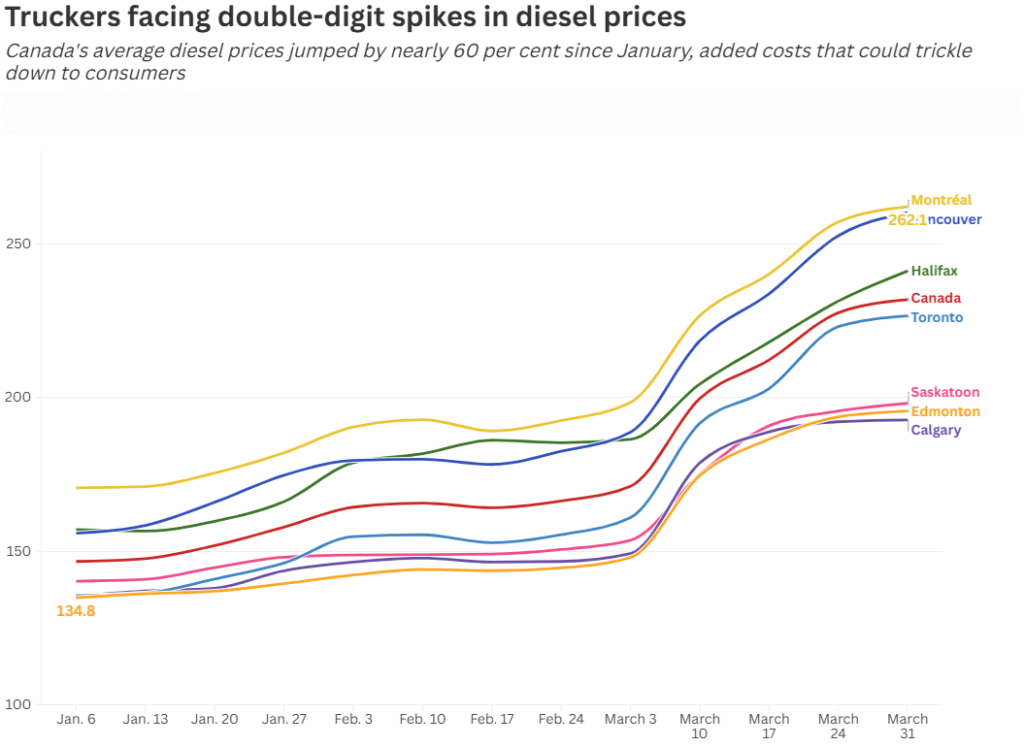
Retail diesel prices have shot well above $2 per litre in most cities across the country, with truckers in Vancouver paying the country’s highest prices, at $2.79 per litre.
“We have to pass on those price increases to our customers,” said Murray Mullen, the senior executive officer and president of Okotoks, Alta.-based Mullen Group, one of Canada’s largest trucking companies.
“Fuel is like 25, 30 per cent of our total costs. So we can’t eat that. We’re going to have to pass it on in the form of a fuel surcharge. And that’s precisely what’s going to happen.”
Source: Kalibrate, weekly fuel prices | Graphic: Steven Wilhelm, Calgary Herald
Aside from oil, other commodities that typically move through the Strait of Hormuz in big volumes, such as aluminum and fertilizer, are also getting a lot more expensive, potentially driving up the cost of manufactured goods and food.
Mullen said the higher cost of moving those goods will filter down into the economy over the next three to nine months.
“Everybody takes one on the chin in the short term, but in the longer term, it’s not healthy,” he said.
“The longer this goes on, I think the more that the overall economy gets hurt. And that’s not good for freight demand, and that’s not good at all.”
‘A raging bull’
Oilman Del Mondor can drive to about 500 of his company’s oil wells within 90 minutes of the company’s head office in the southeast Saskatchewan city of Weyburn, and he knows the terrain that surrounds it.
The head of Aldon Oils Ltd., a junior petroleum producer that his father started running in 1974 — and has remained in the family since — also knows a thing or two about the global energy landscape.
Right now, it’s shifting in a seismic way.
Entering the year, Mondor was bracing for a tough stretch, with weak prices widely expected throughout 2026 due to excess global supplies.
Now, the owner of Aldon Oils, which employs about 40 people and pumps out more than 4,000 barrels of oil per day, anticipates a starkly different outlook.
“Going into 2026 it was fairly bleak,’” Mondor said.
“Then all of a sudden, Iran happened … What this is all showing is an increased weakness in the world (that’s unable) to provide the supply that is necessary with the demand.
“Overall, I think we’re in for a multi-year situation here and that, I know, makes me a raging bull.”
His company is considering doubling, at a minimum, its well-drilling plans for the year as conditions change. It would be an aggressive stance, but one that a nimble, privately-owned company is able to pursue. Aldon has assets in other parts of Western Canada, but its main focus is on Saskatchewan’s oilpatch.
And there’s oil to be produced.
Saskatchewan is the second-largest oil producing province in the country, with the Western Canadian Sedimentary Basin extending across a swath of the Prairie province.
Last year, production averaged about 435,000 barrels per day, declining about three per cent from 2024 levels. But the provincial government has set a goal of boosting output to 600,000 barrels per day by decade’s end.
Premier Scott Moe said the importance of the resource in Saskatchewan — and Canada — is underscored by the Middle East conflict and concerns surrounding global energy security.
Higher oil prices and more spending will make the province’s growth ambitions more achievable. But the industry will need more pipeline capacity to enable bringing that oil to markets that need it, Moe said.
“If we’re able to get to some agreements with the federal government, we would see significant expansion of the energy industry in Saskatchewan,” he said.
“That would be very much a positive for our economy and for the job creation.”
The boost would require more capital spending, and more drilling, from companies such as Aldon Oils.
“The sector is always important, not just from a production standpoint, but from all the service jobs and the adjacent activity and businesses that grow up around the oil business,” said Brad Wall, who was born and raised in Swift Current and served as Saskatchewan’s premier from 2007 until 2018.
“Whenever there’s an external event that really impacts the oil and gas sector, (in Canada) we are therefore sort of at the top of the list of geographies that are affected.
“The most important impact is always economic development — to the jobs — and it’s investment. But it wasn’t very long ago in my old job where the budget was also greatly affected by what was going on in the oil business.”
According to the Canadian Association of Petroleum Producers, the oil and gas industry contributed about $11 billion to Saskatchewan’s economy, or almost 13 per cent, in 2024.
In last month’s budget, Moe’s government forecast benchmark oil prices would average just US$59.75 a barrel in the 2026-27 budget year, but would still generate revenues of $721 million.
Prices averaging US$90 a barrel for the year could cut the expected $819-million deficit by more than half.
Mondor, who bought Aldon in 2011, is bullish that more wells will be drilled in the province as prices rise and the global market calls for more supply.
“We’re regular drillers and certainly very active. We love Saskatchewan, and we love putting a bit to the ground in Saskatchewan,” Mondor said.
“Our team in Weyburn is adding wells to the drilling program. We’re digging up more. We’re trying to do better things with an eye to drilling more in the next year, two, three.
“Now, how is that for positivity?”
Like other parts of Canada, however, soaring energy prices have other ramifications in Saskatchewan, from consumers at the gasoline pumps to farmers facing higher input costs.
It’s not a comfortable spot going into this growing season
Saskatchewan farmer Dean Roberts
Fertilizer prices are rising as shipments from the Middle East region are disrupted, with prices for urea shooting up about 50 per cent during the first three weeks of March, according to an Alpine Macro report.
“If ag producers in Saskatchewan or Canada for that matter, or around the world, if they don’t have their fertilizer pre-bought, they’re going to be facing higher costs this spring,” Moe said.
“We’re very much concerned about the ag industry, which is a $20 billion industry for us just in exports, (as well as) the price of fertilizer and how that is going to impact the profit margins of the farmgate.”
Dean Roberts, who farms near the community of Coleville, about a two-and-a-half hour drive southwest of Saskatoon, said the combination of rising costs for fertilizer, along with higher fuel bills, are creating more uncertainty for producers in 2026.
He grows wheat, canola, lentils and flax, and is planning to put less nitrogen fertilizer on his fields this year due to higher costs, although he acknowledges it could limit the upside potential of his crops, depending on the weather.
“We’re going to go to the field with a little less nitrogen than we would maybe like. But at these prices, if it doesn’t rain, I can’t gamble,” Roberts said.
The family farm is located in an oil-producing area of west-central Saskatchewan, where higher prices generally help the region’s economy, he noted.
Yet, it also means higher energy expenses.
“Nobody loves their fuel bill at any time. Big tractors burn lots of diesel fuel, so this is going to be impactful,” said Roberts, who is also on the board of the Canadian Canola Growers Association.
“It’s not a comfortable spot going into this growing season.”
Risks versus reward in Alberta
Teams in charge of both investing and risk management at Alberta Investment Management Corp. gathered for a series of top-level meetings as soon as it became clear that attacks on Iran would have a dramatic effect on oil supplies.
The first thing these teams began to do as oil prices soared was run stress tests on AIMCo’s nearly $200-billion portfolio, which it manages for dozens of clients including pensions, government funds and endowments.
They measured what would happen to those savings of teachers, judges and public service workers under various scenarios, including the worst one in which oil prices stay high for a prolonged period of time.
In that case, all expectations for economic growth are off the table, replaced by the very real possibility of a global recession. The crisis, their modelling showed, could also lead to stagnant or declining stock markets, disruption in credit markets and inflation that would run well past the initial shock on oil prices and hits to consumers at the gas pump.
Justin Lord, AIMCo’s chief investment officer, said staff in the meetings concluded that the risks to the portfolio in that worst-case scenario would far outweigh any gains from the fund’s energy holdings.
“This is where we would be making decisions with respect to any positioning changes or tilts within the portfolio to perhaps protect against any of that … risk or a drawdown in equity markets … as well as any potential credit market duress,” he said.
AIMCo is a member of Canada’s Maple 8, a group of large pension management organizations known for investing around the world in assets as varied as stocks, bonds, airports, water utilities, shopping malls and pipelines. They don’t tend to make sudden adjustments to what they invest in and where based on short-term market moves or commodity prices because they are diversified, long-term investors.
But Lord said stress-testing and modelling different scenarios allows them to rethink risk and rebalance portfolios to protect against the fallout from the worst possible outcomes and take advantage of potential opportunities.
The conflict in the Middle East presents a challenge, he said, because the teams must also consider what would happen if there is a rapid de-escalation in the war, making assets that previously looked risky suddenly rise in value.
“We also don’t want to miss that on behalf of our clients,” he said. “This is a topic that we’ve been spending a lot of time on.”
Part of risk management is acknowledging that markets don’t always act in predictable ways, Lord said, but AIMCo is looking at past oil shocks for guidance.
“Certainly a period of time with elevated energy prices does impact the global economy and potentially public market and risk asset pricing — or volatility in general,” he said.
“History doesn’t necessarily repeat, but it often rhymes, as they say.”
Even oilsands workers are struggling
When she’s on day shift, Estella Petersen is up at 4:45 a.m. Less than an hour later, she’s on a bus, heading from her home in Fort McMurray, Alta., to the oilsands, where she runs heavy equipment. She won’t be home for 14 hours.
“I don’t know if you’ve ever sat in a closet, but that’s about the space of my dozer,” Petersen said.
From that tiny cab in a hulking oilsands bulldozer, Petersen said she makes good money. “I’ve never earned this much in my life,” she said, but she’s still finding her budget is tight with gas prices spiking.
Other workers in town are in a similar bind.
“It’s humbled a lot of people,” said Petersen, a member of the Cowessess First Nation in southern Saskatchewan. “There’s less travel, and people are talking about their summer holidays. They’re going to have it in Alberta. They’re not leaving to go out of country.”
Petersen works in the growth engine of Canada’s oilpatch. If any pocket of the country is bracing for an economic lift-off from spiralling energy prices, it’s the Alberta oilsands.
But Petersen suspects the “real money” from any short-term gains will likely flow to investors.
“We don’t get bonuses when there’s a war or something,” she said. “The cost of living is still high for us.”
Like countless other workers, Petersen landed a job in the oilsands in the early 2010s. At the time, the remote patch of northern Alberta was the site of a modern gold rush, with investors, global companies and Canadians piling in to make loads of money.
But the industry has since matured and its investors are far less willing to back expensive, long-term mega-projects.
Producers are also more disciplined when it comes to growth.
“Companies are more measured than they were in past cycles. We’re financially in better shape. We’re able to withstand volatility,” said Rob Broen, chief executive of Calgary-based Athabasca Oil Corp.
“We’re cautious in terms of not knee-jerking too quickly. We have very measured plans. It’s setting up to be very constructive, but I’m not ready to call it a boom.”
Athabasca’s stock price, which hit just 11 cents during the depths of the pandemic in April, 2020, has since rebounded. The shares hit a decade-long high of $11.25 a pop on the Toronto Stock Exchange on March 31.
The company is far from alone. Canadian producers have generally been getting more investor love over the past year. The S&P/TSX Capped Energy Index, which tracks the stock performance of oil and gas stocks, recently hit its highest levels in more than a decade.
For the oilsands, the latest energy crisis may have a much longer impact. Given the long-life nature of the resource, this could be a moment for producers to attract increased international attention as a safe, secure, growing supplier — if Canada has enough pipeline capacity to get more oil to export markets.
“We believe that there are structural changes. We’re going to have a supply crunch out of all of this with the Strait of Hormuz shut and so, longer term, that’s bullish for commodity prices,” Broen said.
“If you look at Canada, we’re a reasonably safe jurisdiction to invest in. We have some of the biggest reserves in the world, and the nature of particularly the oilsands is stable, long-term production, and that’s exactly what the world needs.”
This is a massive supply disruption that’s affecting the entire world
Grant Fagerheim, CEO of Whitecap Resources Inc.
Less than five blocks from Athabasca’s headquarters in downtown Calgary is the office of Whitecap Resources Inc., an oil and gas player which completed a $10-billion takeover of Veren Inc. last year to become the country’s seventh-largest producer.
Grant Fagerheim, Whitecap’s chief executive, said the company has not changed its $2.05-billion spending plans for the year, despite the massive rally in prices.
Instead, it will use additional cash flow generated by higher prices to strengthen its balance sheet.
“This is a massive supply disruption that’s affecting the entire world,” Fagerheim said. “What this looks like on the other side, we’ll have to see.”
A big question mark overshadowing oil markets is the unknown length of time that the conflict will last, keeping prices high.
“We’ll monitor as we advance through this year. What could change is our behavior for 2027,” if prices remain high, Fagerheim said.
“If there was more capital to be spent, it would be sometime late in the third quarter, or early fourth quarter, as you’re leading to 2027.”
Yet, as the war has extended into its second month, more analysts are boosting their price forecast for the rest of 2026 and 2027. Middle Eastern oil and gas facilities, shut down by the war, can’t be turned back on with the flick of a switch. The process can take months.
And it could take years to repair damaged infrastructure in the region.
Even after news of the U.S.-Iran ceasefire, energy analytics firm Enverus said it stood by its earlier call that Brent crude prices would average US$100 a barrel next year.
“We should come down to more stabilized pricing, in time,” Fagerheim said.
“It’s not a boom — an energy boom — but what it does is strengthens the legs underneath us.”
Like many oilpatch executives, Fagerheim is also watching to see what higher energy prices will do to the economy, potentially slowing global demand if prices get too hot and drive inflation sky-high.
“At $70 to $75, the world works OK,” the oilpatch CEO said. “But you start getting into these elevated prices … this is not helpful.”
Dan Halyk, CEO of Calgary-based Total Energy Services Inc., one of the country’s largest oilfield service firms, said he hasn’t seen a sudden response by producers looking to drill more oil and gas wells, given the industry’s seasonal slowdown in the spring.
However, if prices remain high into late May, it could change demand for drilling activity in Western Canada later in the year.
“I’m not going to start making big bets,” Halyk said. “When oil prices go up because things are blowing up, that’s generally not a good environment. I prefer a strong economy driving demand. That’s always a better outcome.”
The view from B.C.
While some parts of the industry are biding their time, other companies are backing new projects to ship Canada’s natural gas to Asia.
The war in Iran not only choked off supplies at the Strait of Hormuz, where a fifth of the world’s liquefied natural gas once flowed, but it has also made energy importers in Europe and Asia worried about more lasting damage to energy infrastructure.
Among the biggest concerns is the reported extensive damage to the world’s largest LNG production facility, Qatar’s Ras Laffan LNG complex.
All of this is driving increased interest in Canadian export projects.
“The market is calling for more of those products off the West Coast,” Chris Scherman, Pembina Pipeline Corp.’s chief marketing and strategy officer, said this week as the company released its plans for growth.
“Our federal government, provincial governments, everyone’s aligning behind trying to make that happen.”
Pembina is exploring ways to boost cargos from its partnership with the Haisla Nation on the Cedar LNG project in Kitimat, B.C., — which is set to begin operations in 2028 — as well as a potential expansion. The company said that if Cedar were operating today, it would be earning about US$300 million or more annually at current prices.
“We’re interested in expanding Cedar to the extent that’s possible,” Scherman said. “We’re working out the details of how that might be able to happen, and (we’re) very interested in other opportunities off the West Coast.”
Pembina’s bullish ambitions come on the heels of recent statements by federal Natural Resources Minister Tim Hodgson revealing that Woodfibre LNG — a separate project under construction in southwestern B.C. — could potentially double or even triple in size.
The minister’s remark made headlines in B.C. earlier this month, prompting a statement from Woodfibre that the project is only approved for a 2.1 million tonne per year export facility. It said any future changes in project scope would follow an “appropriate” regulatory process.
Woodfibre is set to become Canada’s second LNG export facility when it begins operating next year. The project’s massive gas liquefaction unit arrived recently to the northwestern shore of Howe Sound near Squamish B.C. — the site of a former pulp mill — where the project is taking shape.
“The current geopolitical situation is a reminder of the importance of diverse and stable supply,” Woodfibre CEO Luke Schauerte said.
“With the current conflict stranding a significant portion of the world’s production of oil and gas, it reinforces the value of Canadian energy that can reach across the Pacific Ocean to help supply foreign markets.”
The upshot, according to analysts, is that Canadian energy export projects are looking increasingly viable. The consortium behind the LNG Canada mega-project is examining an expansion at Kitimat, B.C.
Raymond James analyst Michael Barth said he expects to see multiple final investment decisions for Canadian LNG projects this year, setting up long-term growth prospects for gas producers in Western Canada.
“With the conflict in Iran, we suspect many Asian/European buyers are rethinking reliability of energy supply chains, and we think Canadian LNG is set to benefit from that theme,” Barth wrote in a note.
Inland from all the LNG construction, Bob Smith is behind the wheel, chauffeuring cancer patients to their appointments across much of B.C.’s Lower Mainland.
The retiree from South Surrey said the group he’s driving for, the Volunteer Cancer Drivers Society, is suddenly trying to manage expenses on a shoestring budget in the middle of an energy crisis. In Metro Vancouver, gas prices have risen by about 40 per cent since the war began to $2.14 a litre, by far the highest cost for any big city in Canada.
The charitable group, which is seeing demand go up, doesn’t leave its drivers out of pocket; it does cover mileage. It just increased its rate by a few cents to 55 cents per kilometre, but Smith said the new structure is still on the edge of covering costs with gas at north of $2 per litre.
For every additional cent the society reimburses its drivers, the group’s expenses rise by about $12,000, a challenge given that “we beg, steal and borrow to meet our costs,” said Smith, past president of the group.
With no end in sight to elevated energy costs, the society promised volunteers to review their mileage rates on a monthly basis.
“This is all relatively sudden, and we do get queries from drivers (asking) ‘what are you guys doing about it,’” Smith said.
“There’s no question it is concerning.”
Additional reporting by Payge Woodard and Daniel Trainer
Share This:






















On The Verge: Energy Sector Primed for New Wave of Growth – ATB Economics