


 CDN NEWS |
  US NEWS







by Terry Winnitoy
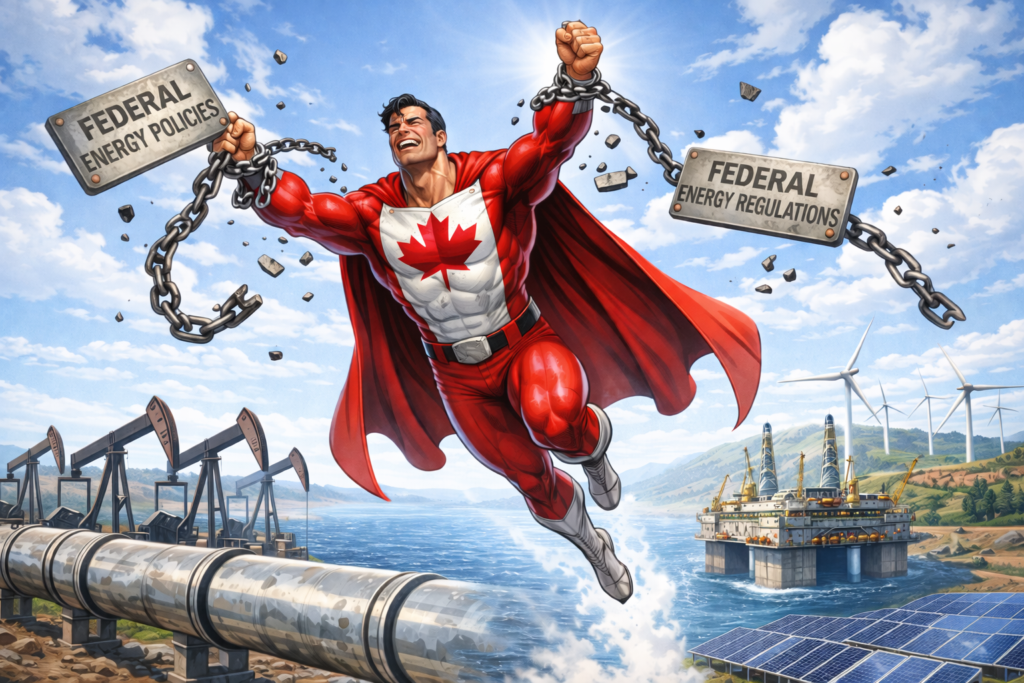
Canada, with its sprawling landscapes and abundant natural resources, stands poised to be not only an energy superpower, but as an energy superhero supplier on the global stage. The country’s reserves of oil and gas are among the most substantial in the world, with proven reserves in Alberta’s oil sands and conventional oil and gas fields stretching across British Columbia, Saskatchewan, and Newfoundland and Labrador.
Canada’s stable political environment, advanced technical expertise, and commitment to responsible resource development provide a foundation for leadership. Yet, despite these advantages, Canada’s energy infrastructure has not kept pace with its potential, constrained largely by policial regulatory barriers and policy decisions, influenced by anti-oil and gas groups both domestically and foreign, that have held back progress.
As the global energy landscape shifts in response to geopolitical conflict and climate imperatives, Canada’s opportunity to rise as a superhero – rescuing both its economy and providing the world with more energy security—has never been more urgent.
Policy and Regulatory Barriers: Anti-Oil and Gas Regulations
At the heart of Canada’s challenge lies a complex network of policies and regulations that govern the development of oil and gas infrastructure. Environmental assessments and permitting processes are exceedingly complicated, often taking years to complete and resulting in inconsistent outcomes. The federal Impact Assessment Act, for example, has been criticized for its lack of clarity, lengthy timelines, and potential to create uncertainty for investors. Meanwhile, provincial governments have implemented their own additional requirements, sometimes leading to overlapping or conflicting mandates.
Moratoriums on pipeline construction, carbon pricing, and emission reduction targets, as compared to other oil and gas producing nations, have discouraged investment in both upstream and downstream projects. Pipeline proposals such as Northern Gateway and Energy East have been cancelled or abandoned due to polical agendas, regulatory hurdles and public opposition. The cancellation of these projects has left futher development of Canadian oil mostly landlocked, unable to access global markets efficiently. While safeguarding ecological interests is vital, the absence of clear, streamlined processes leaves project proponents uncertain, slowing progress and diminishing Canada’s ability to react swiftly to global energy needs.
Public opposition has also played a significant role, driven by concerns over environmental impacts, Indigenous rights, and climate change. While engagement with stakeholders is crucial, prolonged consultations and legal challenges often delay or derail projects that could benefit the national economy and global energy security. The result is a policy environment that, while protective, is opten paralyzing – limiting Canada’s ability to act decisively as an energy leader.
Missed Opportunities: The US-Iran Conflict and Canada’s Role
The recent conflict between the United States and Iran underscores the fragility of global energy supplies. As tensions have escalated and disruptions continue, soaring oil prices and uncertainty have gripped markets worldwide. In such moments, reliable energy suppliers become invaluable. Canada, with its immense reserves, could have filled many gaps – offering stable, ethically produced oil and gas to allies and partners. Instead, the cancellation of the Keystone XL pipeline under President Joe Biden meant Canadian oil could not reach American refineries as efficiently as planned, hampering Canada’s ability to stabilize prices and ensure supply. It also meant a Trans Mountain expansion, that was often bogged down in political and court challenges, delayed Canada’s ablity to establish other markets for it’s oil and gas resources.
The Keystone XL pipeline, designed to carry moore crude oil from Alberta to the Gulf Coast, would have provided a crucial outlet for Canadian oil. Its cancellation was a blow, not just to Canadian producers, but to North American energy security as a whole. While a completed Trans Mountain pipeline helped enable exports to Asian markets, diversifying Canada’s options and reducing reliance on the United States, there is still a need for greater diversification away from US markets, Looking beyond the politics, had projects like Northern Gateway, Energy East and Keystone XL been completed in the last 10-15 years, Canada would not only have been in a much better financial position today, but would have been ready to step in during the US-Iran conflict, helping to fill supply gaps, stabilize prices, and support allies seeking alternatives to Middle Eastern oil.



Canada’s untapped potential has been evident to energy analysts and non-partisan policymakers for decades. The inability to export efficiently has left hundreds of billions of dollars in economic value unrealized for Canada, and crucial international relationships underutilized. Canada’s inability to responsibly unlock energy development has been noticiable workwide where other energy producing nations have thrived by developing energy infrastructure with timely and decisive action to meet global energy needs.
Path Forward: Advancing Oil and Gas Development
To transform from an energy superpower into an energy superhero, Canada must chart a path forward that balances environmental protection, Indigenous partnership, and economic opportunity. Policymakers should revisit the regulatory framework, seeking to streamline approval processes while maintaining rigorous environmental standards. Enhanced transparency, clear timelines, and consistent criteria can reduce uncertainty and encourage investment.
Meaningful engagement with Indigenous communities is essential. Many major infrastructure projects cross traditional territories, and respectful partnership—including revenue sharing, employment opportunities, and environmental stewardship—can build trust and ensure projects proceed ethically and sustainably. Regulatory bodies must prioritize open dialogue and collaborative decision-making, creating pathways that respect both economic and cultural priorities.
High-priority projects include the construction of a pipeline from Alberta to the West Coast, which would unlock access to the Pacific and facilitate exports to growing Asian markets. Expanding LNG export terminals such as LNG Canada in Kitimat, and fast tracking approvals for other LNG developments, can further enhance Canada’s role as a global supplier, meeting the rising demand for cleaner-burning natural gas. Modernizing existing infrastructure, investing in carbon capture and storage, and integrating renewable energy into traditional oil and gas operations will position Canada as a leader in both energy supply and environmental stewardship.
The completion of the Trans Mountain Expansion was a crucial step, offering increased capacity and reliability for exports. New pipeline initiatives and additional LNG projects should be prioritized to diversify Canada’s export routes, reduce bottlenecks, and strengthen resilience against geopolitical shocks. Policymakers must also incentivize innovation—supporting research and development in cleaner extraction technologies, emissions reduction, and energy efficiency.
The path forward demands vision and collaboration across industry, government, and communities. By fostering an environment where investment is encouraged, and environmental outcomes are rigorously protected, Canada can unlock its potential and rise as a global energy superhero.
Canada’s Future as an Energy Super Hero
Canada possesses the resources, expertise, and stability necessary not only to sustain its own economy but to provide energy security to allies around the globe. The challenges presented by policy and regulatory barriers are not insurmountable with the right reforms, meaningful partnerships, and investment in high-impact projects. Canada can seize the opportunity to lead but action is required. As the world faces increasing uncertainty—whether from geopolitical conflicts, climate change, or shifting markets—the need for reliable, responsible energy suppliers is paramount.
Becoming an energy superhero means more than exporting oil and gas; it means setting a standard for ethical development, environmental stewardship, and international partnership, but in a timely fashion. By advancing infrastructure, embracing innovation, and ensuring that all voices—especially Indigenous and environmental stakeholders—are heard and respected, Canada can rise to the challenge.
Canada has been bogged down for far too long with governments that have ignored the energy realities of the world for domestic partisan agendas that have not always been in the best interest of Canada. The moment is ripe for leadership; with bold action and most importantly, political will: not focusing on what is best for the party, but what is best for Canada.
If the necessary political will can be summoned, Canada can secure its legacy as a global energy superpower and superhero for decades to come, providing not only energy security for Canada and it’s world energy partners, but increased prosperity for Canadians in an uncertain world. But before Canada can become an energy superhero, it has to become an energy superpower. It has the resources to be one, but action, not political rhetoric is needed to become one.
Share This:






















On The Verge: Energy Sector Primed for New Wave of Growth – ATB Economics