


 CDN NEWS |
  US NEWS







The mandates for SAF are racing ahead of supply, and amid a supply crunch due to conflict in Iran, prices are only going to get worse.
By Geoff Russ
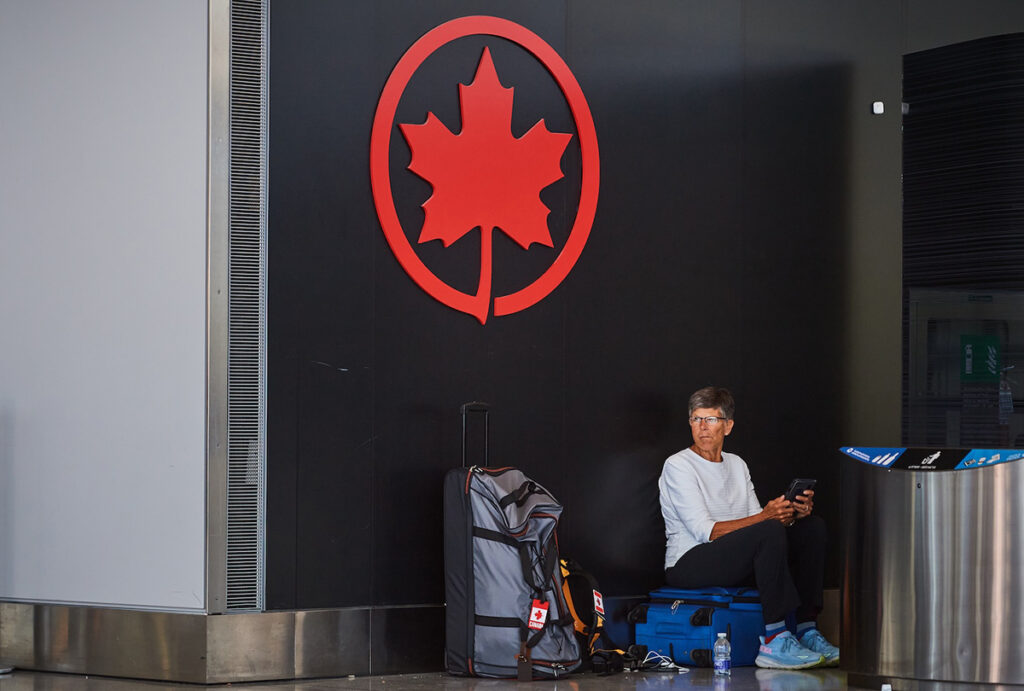
A traveller waits by the Air Canada departure gates as flight attendants picket at Pearson International Airport in Toronto, on Monday, Aug. 18, 2025. THE CANADIAN PRESS/Sammy Kogan.
By Resource Works
More News and Views From Resource Works Here
Summer holidays were already going to cost plenty. Now they are running headlong into a jet-fuel shock, and for travellers flying out of British Columbia, a made-in-policy cost squeeze is waiting in the wings as well.
The immediate problem is the war centred on Iran. Average U.S. jet fuel prices jumped roughly 60 per cent in the days after the first attacks, peaking at US$167.75 a barrel on March 13, while delivered prices into northwest Europe climbed to an all-time high above US$1,600 a tonne.
European airlines are openly warning of higher fares and possible fuel shortages, and the same pressure is already reshaping how Canadians book summer travel.
The jet fuel supply shock
Why jet fuel first? Because it is the thinner end of the barrel. A typical barrel yields just three to four gallons of jet fuel, making it far more exposed to supply shocks than gasoline or diesel.
About 24 per cent of global jet fuel exports normally move through the Strait of Hormuz, and since the beginning of March those exports have fallen by more than 60 per cent to less than 700,000 barrels a day. California SAF prices hit a record US$8.85 a gallon in the week of March 4.



The British Columbia mandate
That would be bad enough on its own. In B.C., however, travellers also face a province that is pressing ahead with low-carbon jet fuel rules before anything close to adequate domestic supply exists. Under the B.C. regulation, jet fuel suppliers must hit a two per cent carbon-intensity reduction this year, rising to 10 per cent by 2030.
The renewable fuel requirement for jet fuel remains at zero through 2027, then rises to one per cent in 2028, two per cent in 2029 and three per cent in 2030, with a penalty rate of 50 cents a litre for non-compliance. Ottawa has its own broader push underway, with Transport Canada saying it will finalize a sustainable aviation fuels blueprint, and industry groups announcing in 2024 that the federal government has set a goal of 10 per cent SAF use by 2030.
Policy racing ahead of supply
The difficulty is that policy ambition is racing ahead of supply. Global SAF production was expected to reach only two million tonnes in 2025, or 0.7 per cent of aviation’s fuel needs, and that Europe’s mandates have made SAF five times more costly than conventional jet fuel once compliance fees are added.
In Canada, Parkland did produce the country’s first batch of low-carbon aviation fuel in Burnaby in December of 2024, but it amounted to about 101,000 litres. YVR alone uses roughly 1.5 billion to two billion litres of jet fuel a year. Parkland had already shelved plans for a $600-million commercial biorefinery after U.S. subsidies changed the economics.
That is the contradiction at the heart of this summer’s airfare squeeze. Canada plainly has the ingredients for a domestic SAF industry. In 2023, Airbus Canada’s chief executive said it was “bizarre” that the country lagged the United States and Europe despite its resources, agriculture, aerospace base and clean electricity. Yet travellers are being asked to absorb the cost of scarcity before governments and industry have built the volume to fix it.
When scarce green fuel is mandated before it is abundant, the bill lands on passengers. This summer, that bill is arriving just as a Middle East war has made flying dearer anyway.
Geoff Russ is a writer for Resource Works, a non-partisan organization that champions responsible resource development in British Columbia and Canada. Reach Geoff at [email protected].
Share This:






















On The Verge: Energy Sector Primed for New Wave of Growth – ATB Economics