


 CDN NEWS |
  US NEWS







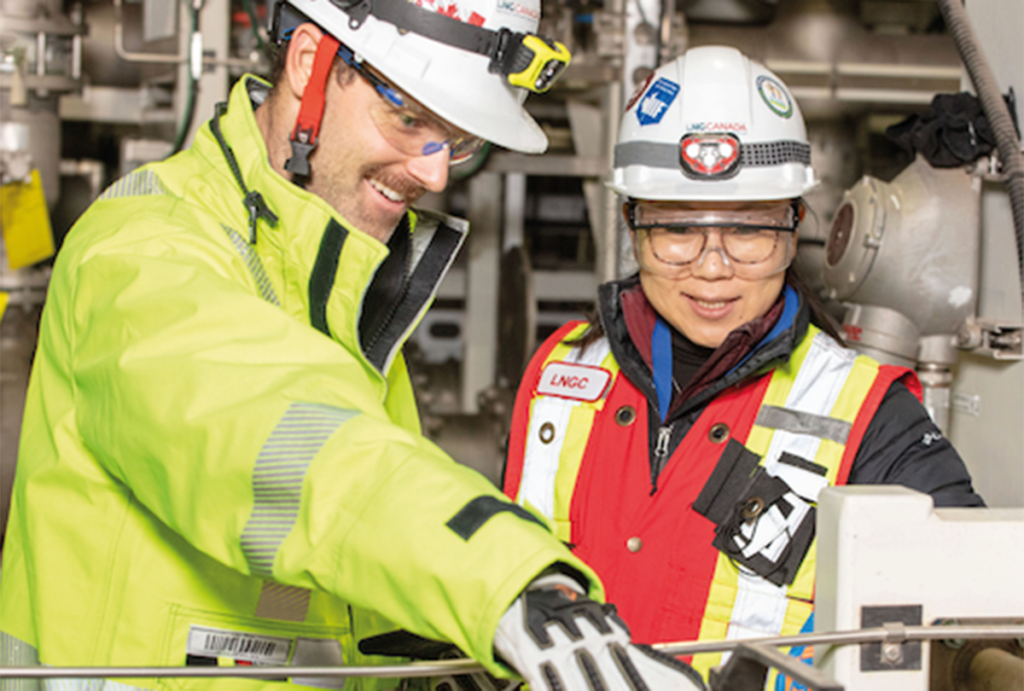
LNG Canada workers; photo from Shell
By Resource Works
More News and Views From Resource Works Here
LNG watchers looked in mid-March for the annual outlook by energy giant Shell on the state and fate of the world liquefied natural gas market. But it never came, thanks to the war on Iran and Middle East chaos.
Instead, Shell published a 28-page document entitled LNG Portfolio. Strategic Spotlight. “We are publishing this Strategic Spotlight during a period of evolving conflict in the Middle East. . . . While the conflict has created high levels of volatility in prices, Shell continues to have a positive outlook for LNG over the long term.”
Some key points:
- “LNG is the fastest-growing energy source after non-hydro renewables, making up more than half of overall natural gas demand growth to 2040, driven by Asia which represents 70% of the growth.”
- “In 2025, around 65% of LNG imports were in Asia, despite a record year for European imports in response to the Russia-Ukraine war. Asia is expected to remain the centre of global economic growth at least until the middle of the century, which will drive growth in underlying energy and natural gas demand.”
- “While global gas consumption may peak in the 2030s and has peaked in some regions such as Europe and Japan, global LNG demand is expected under most independent outlooks to continue to grow to 2040, if not beyond.”
- “Importantly, due to natural field decline in older LNG supply projects, a gap between demand and supply continues to exist beyond the mid-2030s. As a result, further investment will be required in the 2030s and 2040s to meet even the lower range of LNG demand forecasts in 2050.”
A stabilizing force for global energy
Shell goes on to say it expects global demand for LNG to increase from 422 million tonnes a year in 2025 to between 650 million and 710 million tonnes by 2040, or by around 54-68%.
It then extended its forecast range to 2050, with LNG demand expected to increase to between 610 and 780 million tonnes by 2050, or by some 45-85%.
“Many forecasts show that the world needs more natural gas. Gas, and in particular LNG, is a stabilising force in the energy system as it continues to transform because it is versatile, flexible and reliable.
“LNG is versatile because it can be used in power generation, industry, heating and transport. It is also flexible and reliable because it is simple to deploy and can be shipped to different markets at different times.
“LNG helps to provide the flexibility and stability the power system needs, supporting the rapid growth of renewable energy. It contributes to decarbonisation in industry and power generation, by replacing coal, and in heavy-duty road transport and shipping, by replacing oil.”
The Canadian low carbon advantage
LNG Canada at Kitimat BC gets a cleaner-energy mention from Shell: “Our LNG Canada joint venture, for example, uses efficient gas turbines and hydroelectricity for auxiliary power, while the electrification of the Montney gas processing facility, which feeds, in part, LNG Canada, will further reduce greenhouse gas emissions.”



And: “LNG Canada was designed to be among the lowest-carbon-intensity, large-scale LNG facilities in the world. Four powerful gas turbines (model LMS100), derived from aircraft engines and used in an LNG plant for the first time, power the liquefaction process. Together, they could power a city the size of Vancouver.”
The LNG Canada project was designed to have an emissions intensity of 0.15 per cent carbon dioxide per tonne of LNG. That compares with the global average emissions intensity of 0.35 per cent CO₂ per tonne, as reported by the Oxford Energy Institute
To which, in that vein, we add the following:
- Woodfibre LNG, under construction on Howe Sound, seven km southwest of Squamish, aims to be “the world’s first net-zero LNG facility” by 2027. It expects to have an emissions intensity of only 0.04% CO₂ per tonne of LNG.
- Haisla Nation’s Cedar LNG project near Kitimat “will have one of the cleanest environmental profiles in the world.” Powered by clean, renewable energy from BC Hydro, Cedar LNG cites an emissions intensity of 0.08 per cent CO₂ per tonne of LNG.
- Ksi Lisims LNG, led by the Nisga’a Nation in northern BC, “will have one of the lowest carbon intensities of any LNG export project in the world” and will be “net-zero ready by 2030.”
Back to Shell’s strategic spotlight: “Shell has also electrified the Montney gas processing facility in our Groundbirch asset in Canada which feeds, in part, LNG Canada. We installed 14 high-efficiency electric motors, powering the facility from the local power grid, which is 98% renewable energy.
“The electrification of Montney is expected to reduce greenhouse gas emissions (GHG) by over 149,000 tonnes of CO2 a year. Electrification also helped to improve the performance of the plant, increasing gas flow and operational efficiency.
“In 2015, Shell first electrified its Saturn 1 gas processing plant in the Groundbirch field. According to the British Columbia GHG reporting process, this change has cut the plant’s combined GHG emissions by about 90% during normal operations.”
Catching the second wave
To Shell’s outlook for LNG demand, add an outlook given to Resource Works by Enverus Intelligence Research director Dane Gregoris.
“Globally, the industry consumes around 400 billion cubic feet of natural gas every single day,” Gregoris says. He expects that number to climb by another 100 billion over the next few decades.”
For one thing, he notes that shipping LNG from Kitimat to Japan takes about 10 days, compared to 25 days from the US Gulf Coast. This proximity cuts shipping costs nearly in half, and provides a significant price benefit for Canadian exports.
Gregoris thus sees a “second wave” of LNG projects, in which Canada could jump from exporting two billion cubic feet a day to 20 billion by 2040. It would mean thousands of jobs, and more revenue for governments for essential services.
“It would be a huge boon,” Gregoris says.
All in all, then, the outlook is that LNG is here to stay — and to grow.
Don MacLachlan is a writer for Resource Works, a non-partisan organization that champions responsible resource development in British Columbia and Canada. Reach Don at [email protected].
Share This:






















On The Verge: Energy Sector Primed for New Wave of Growth – ATB Economics