CDN NEWS |
  US NEWS







As conflict in the Middle East chokes global supply, experts say B.C.’s massive Montney formation could sustain a sixfold increase in LNG production to stabilize markets.
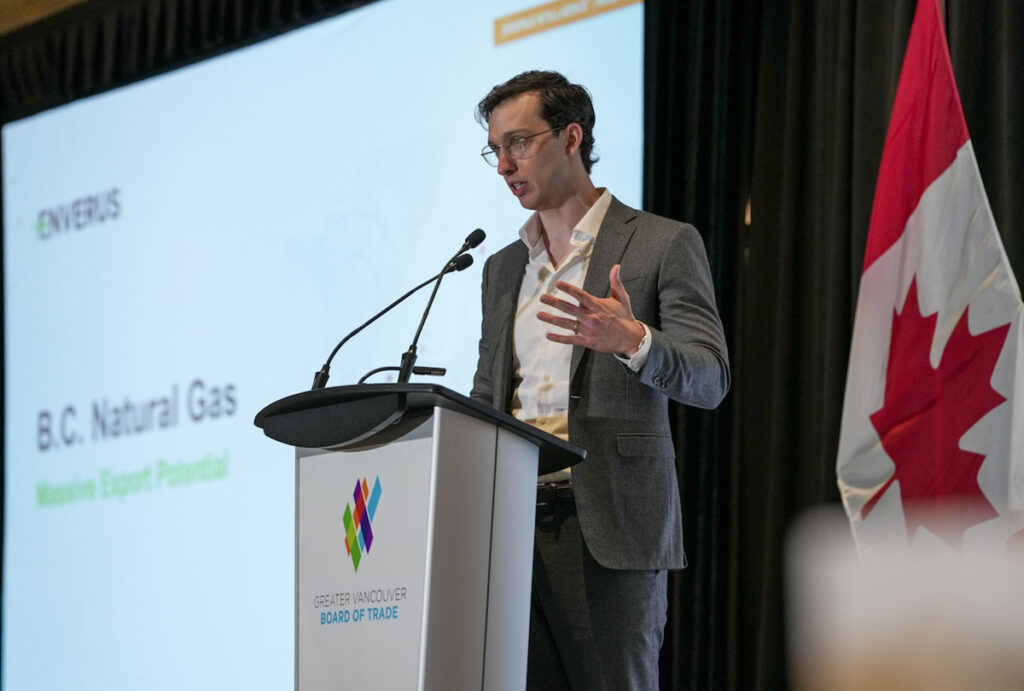
Dane Gregoris, managing director, Enervus. | GVBOT photo
By Resource Works
More News and Views From Resource Works Here
With the Strait of Hormuz now closed and LNG production shut down in Qatar, due to the war in Iran, oil and LNG markets are roiling – again.
Crude oil spiked by about US$10 per barrel between Sunday and Tuesday, while European natural gas spiked 30%.
Roughly 20% of the world’s oil and LNG move through the Strait of Hormuz, with Asia being especially reliant on seaborne energy trade.
We’ve seen this movie before, just four years ago, when a global energy crisis was triggered by Russia’s invasion of Ukraine, sending oil, natural gas and LNG prices through the roof.
Canada’s untapped potential
Depending on how long the war in Iran lasts, the world may be facing another energy crisis and another cycle of inflation.
Wouldn’t it be nice if there were some major oil and natural gas supplier in the world that is less vulnerable to these kinds of geopolitical shocks?
Oh right, there is. It’s us — Canada.
Canada is already the world’s fourth largest oil producer and fifth largest natural gas producer.
Unfortunately, we are hostage to the U.S. and price discounting, thanks to our inability to build pipelines to tidewater and access global markets.
If Canada could only get its act together and build sufficient pipeline capacity, both west and east, we have the resources to ease global energy insecurity.
Demand for oil and gas isn’t declining
Forget what you may have heard about declining demand for LNG and oil in Asia from anti fossil fuel NGOs like the IEEFA. The demand for Canadian natural gas and oil is growing, particularly in Asia. And we have the raw resources to meet that demand.
“Asian demand growth is actually really, really strong,” Dane Gregoris, Calgary-based analyst for the American energy intelligence firm Enervus, said at a recent energy forum hosted by the Greater Vancouver Board of Trade.
“In Asia, a lot of these countries are hydro-carbon starved. They need more gas, and we have it here in this country.”
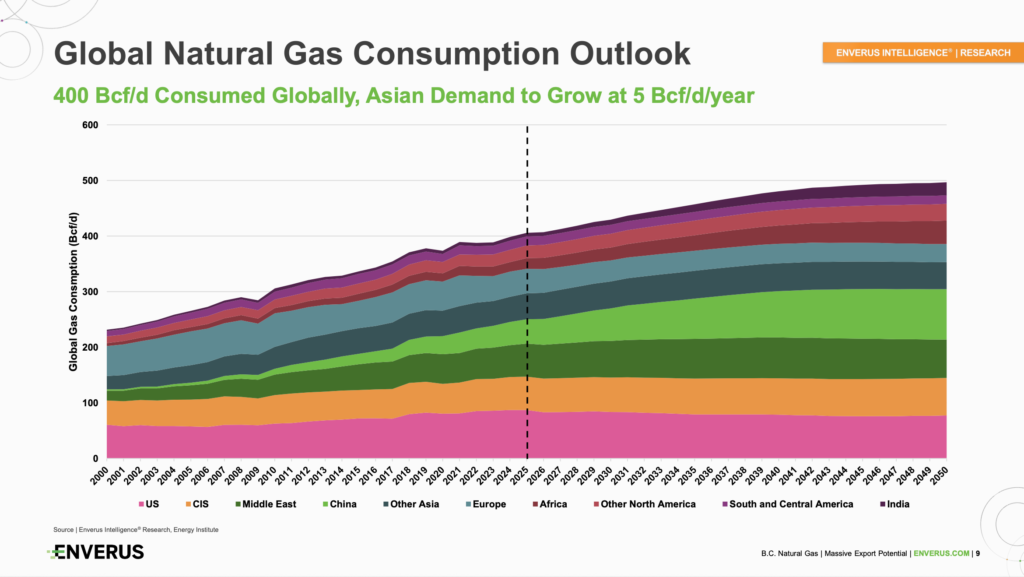
Total global natural gas consumption is 400 billion cubic feet per day (bcf/d).
“We anticipate Asian demand is going to grow roughly 5 bcf a day every year for the next 10, 20 years,” Gregoris said.
A new strategic partnership
According to last year’s outlook, Shell forecasted LNG demand will grow 60% by 2040. The demand for natural gas in India is expected to grow by 60% by 2030, according to the International Energy Agency (IEA).
Good thing Prime Minister Mark Carney has just returned from India with a new energy trade deal that promises to open a big new market for Canadian LNG.
The Canada-India Strategic Energy Partnership, which represents $70 billion in two-way trade, specifically identifies LNG, LPG (i.e liquids like propane), uranium, and hydrogen as the key Canadian commodities that are subject to this new trade pact.
Montney ‘the largest gas play in North America’
So, the demand is there, in Asia. As for supply, Western Canada’s raw reserves are large and have plenty of life left in them.
Gregoris presented new Enervus data that underscores just how large the B.C.-Alberta Montney formation is, compared to other major North American oil and gas fields.



Because it has been less developed than the major shale plays like the Permian basin, Gregoris said the Montney is now “the largest gas play in North America.”
“That’s both from a total scale of fundamental resources, as well as the economic quality of those resources,” he said.
As they get exploited, all oil and gas deposits eventually start to play out.
The Montney has a longer life than other North American gas plays simply because it has not been developed to the extent the American plays have. Gregoris noted that 70% of the Montney resource is in B.C.
Room for six more LNG megaprojects
“It’s not really that we have more rock — we just haven’t capitalized it,” Gregoris said.
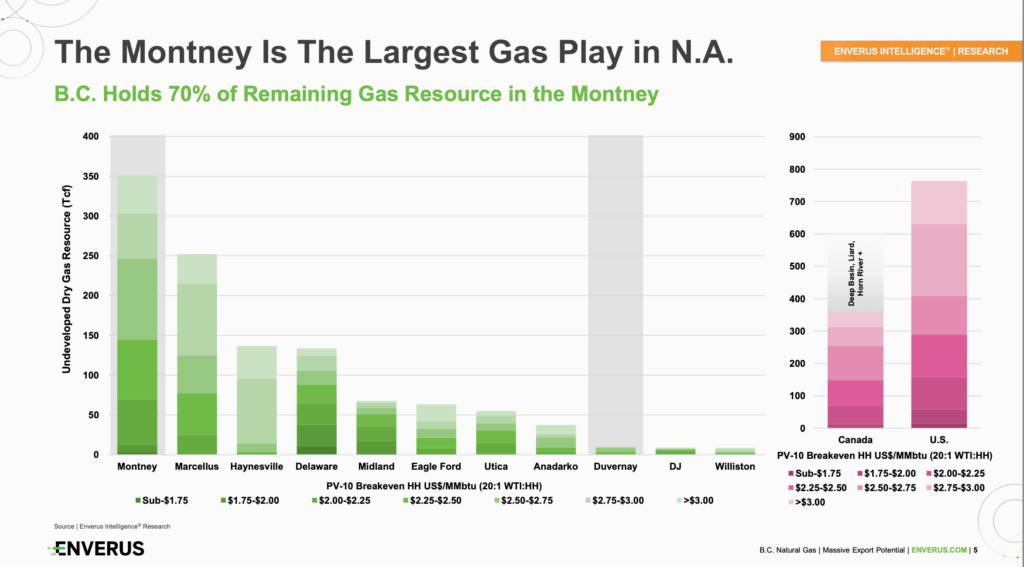
“In the U.S., frankly, over the next 10, 15 years, you start to run out of high quality resources,” Gregoris said. “In Canada, we have well over 30 years.”
The total North American gas market is 130 bcf/d, Gregoris noted, with the U.S. producing 100 bcf/d, and Canada 20 bcf/d. B.C. accounts for 8 bcf/d.
LNG Canada is currently exporting about 1 bcf/d, which should ramp up to 2 bcf/d in the coming months.
Other LNG projects in the works — LNG Canada Phase 2, Ksi Lisims, Cedar, Woodfibre and Tilbury — would bring B.C.’s total production capacity to between 6 and 7 bcf/d.
“That’s a pretty low bar, I would say, that Canada’s setting for itself in terms of getting more gas exported,” Gregoris said.
He raised some eyebrows when he pronounced that there could be a demand for six more LNG terminals the size of LNG Canada.
“The market opportunity’s there,” he said. “We think there roughly could be at least six more LNG Canada sized projects that easily could get done in that decade (2030s).”
The cost of political dithering
Based on the reserves in the Montney, and given global demand, Canada could be exporting 20 bcf/d of natural gas, he said.
“In order to build the next decade of projects — 2030 to 2040 — we need to get them greenlit now,” he said.
Unfortunately, there are no other major LNG projects proposed for B.C., apart from those already approved. That’s because we chased major players like Chevron and ExxonMobil out of the country.
Fifteen years ago, major players in oil and gas started lining up to invest tens of billions of dollars in B.C., and we basically told them to get lost.
We might already be at 20 bcf/d in LNG export capacity, had we not sent investors packing. The $36 billion Petronas Pacific NorthWest LNG would be in operation by now, were it not for political dithering.
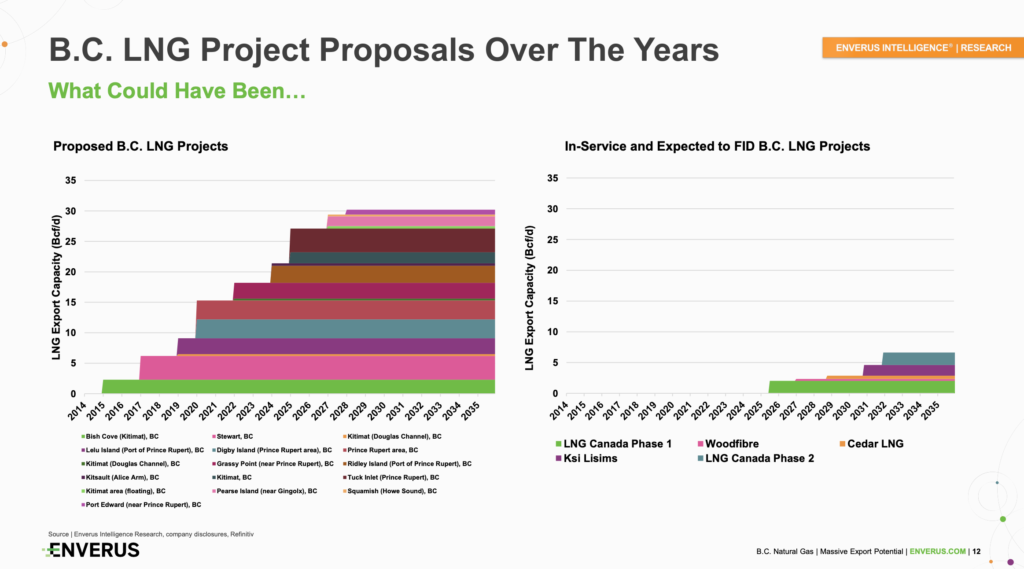
“The last 14 years have been, I think, very challenging for both the upstream and for LNG development,” Shannon Young, vice president of external affairs for Petronas, said at the GVBOT energy forum.
“We look at the last decade, and what should have been, and we now have a window of opportunity to meet this global demand for Canadian LNG.”
The same could be said for the viability of a second west coast oil pipeline.
“We are blessed with an incredible wealth of resources that other countries don’t have,” said Michael Davies, chief operating officer for Trans Mountain Corporation.
“But they’re not worth much without linear infrastructure to get them to market.”
Nelson Bennett’s column appears weekly at Resource Works News. Contact him at [email protected].
Share This: