CDN NEWS |
  US NEWS







By Yogi Schulz
In the raging debate over how to address climate change and the role of fossil fuels in raising atmospheric CO2 levels, the critical importance of certain unavoidable energy realities is often ignored, suppressed, or even deliberately swept under the carpet. These realities include:
- Energy in its many forms is a prerequisite to life.
- Readily available energy underpins quality of life and prosperity.
- Affordable energy determines the standard of living everyone enjoys.
- Energy poverty undermines human potential and inhibits development.
At the recent Canadian Energy Executive Association event, Beyond Boomers, the panellists elaborated on these realities. They were astonished by how some Canadian leaders, environmentalists, and assorted pundits too often act as if these realities can be skirted or spun to serve a social or climate agenda. They lamented about the low energy literacy of too many Canadians.
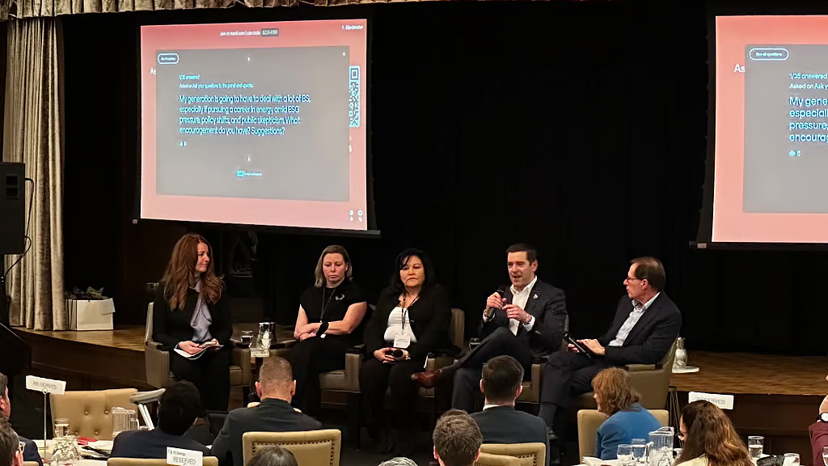
The panellists focused on what Canada can do to expand production of its rich energy resources to become an energy superpower for the benefit of all humankind. Canada is endowed with rich resources, well-educated people and a reasonable infrastructure that is underutilized.
They challenged the nay-sayers whose opposition to energy development has reduced Canadian business investment, productivity, and our standard of living. This article focuses on the remarks made bypanelist Bryan Gould, Founder and Executive Chair, Aspenleaf Energy.
Humanity Realities
“At the highest level, energy is about human flourishing. We can’t flourish without the foundations of security and prosperity. That foundation requires abundant, reliable, and affordable energy,” said Bryan Gould, Founder and Executive Chair, Aspenleaf Energy. “Energy policy is about life. It’s about survival, opportunity, and dignity. With that perspective, I have deep reservations about Canada’s energy policies and the Federal-Alberta MoU.”
Investor Realities
“Too many people forget that producers take risks in driving the energy engine. I’ve stewarded tens of billions of dollars in capital investment, with accountability to investors to deliver the results we promised,” said Bryan Gould. “Energy producers have to deliver returns to investors to keep capital flowing and deliver products to customers to keep revenue flowing.”
Producers don’t invest in lofty narratives, no matter how appealing those may sound. They invest in projects. Those projects live or die on economics, on risk, and on timelines.
Producers underwrite the whole value chain. They underwrite cost, the time to build, the producing asset, the customer, the price outlook, and the route to market.
Producers bear the risk when any link fails. If regulatory approvals are delayed, the route isn’t available, the rules change midstream, capital costs balloon, or the customer changes their mind, then capital becomes stranded, and investor returns collapse.
Oilsands projects are an obvious example of this lengthy value chain. They’re long-cycle and capital-intensive. They take many years of investment before free cash flow is finally achieved.
Canada’s history of mega-projects is replete with cost overruns. TMX and all the major oilsands projects went way over budget.
Small local disadvantages can quickly become major financial problems for Canadian producers because they face many competitors in the global market. For example:
- Oil prices are notoriously volatile and completely unpredictable.
- Customers have easy access to many alternative suppliers in a commodity market.
- Unanticipated regulatory changes create confusion and add cost.
Investors require a continuous, risk-adjusted return. That return has to be high enough to justify taking the risk amid all these uncertainties.
In a globally competitive market for investment capital, Canada cannot afford to impose additional avoidable disadvantages on itself.
Energy Consumer Realities
Customer requirements and expectations set the terms in the energy market.
“Roughly one billion people live on this planet with abundant energy and prosperity that energy enables,” said Bryan Gould. “Unfortunately, the rest do not enjoy this abundance of energy.”
For billions of other people, energy security, affordability, and availability come first. These customers won’t, and often can’t, pay producers a premium to cover government-mandated emission-reduction costs.
So when policy adds costs without adding revenue, those costs don’t magically disappear.
They show up in investment decisions. The added costs reduce investment, which in turn reduces production until prices rise.
Canadian Consumer Realities
“Now let’s bring the consumer discussion home to the Canadian citizen for a minute, because this is where it becomes urgent,” said Bryan Gould. “Canada’s economic performance has been slipping relative to its peers.”
Here’s a quick real-life illustration.
An average Canadian has to work 19 minutes to buy three basics: a loaf of bread, a litre of milk, and a kilogram of apples. An average American can buy the same basics in about 12 minutes.
So that’s 50% more work for a Canadian to achieve the same standard of living as someone south of the border: same work ethic, same basic food, 50% more time.
For young professionals, that gap is widening, not narrowing. A better Canadian energy policy could narrow that gap.
Every country, Canada included, has to live with the consequences of the policy choices it’s making today. We’re not thinking enough about those consequences in Canada.
Federal-Alberta MoU Realities
“Investors can’t ignore the commercial constraints imposed by the MoU,” said Bryan Gould. “My concern is that the MoU does not address the key federal barriers that preclude a free-market approach to the energy industry. Key federal barriers have become conditional, reversible, or deferred.”
I acknowledge that the MoU includes multiple concessions that reduce investment risk. The federal government shelved the proposed emissions cap and suspended the clean electricity regulations. However, we still have:
- A West Coast tanker moratorium.
- The indeterminant Impact Assessment Act.
- The Oilsands Pathways CCUS requirement.
The Pathways CCUS project is not a practical precondition for any stakeholder. It loads the system with a high-cost, high-risk project with no commercial payback.
This project has massive capital intensity and multi-year execution risk before anyone can even begin to solve the basic problem of market access.



The consequence is that the proposed crude oil pipeline is held hostage to the success of what will be the largest carbon capture project on the planet.
GHG Emission Realities
The rhetoric about decarbonized crude oil is misleading. The majority of life cycle emissions occur at end use, not at production.
Roughly 80% of the barrels’ GHG emissions occur during combustion. The Pathways CCUS project addresses only 20% of the barrels’ GHG emissions that occur during production.
The Pathways CCUS project is enormously costly for the small reduction in GHG emissions it proposes to deliver.
For an in-depth look at the Pathways CCUS project, please read: Mark Carney’s Slogan of “Decarbonized Crude Oil” is Not Currently Feasible and May Never Be.
Pathways CCUS Payment Realities
Who pays for the Pathways CCUS project? Who pays for the expensive, indeterminant Canadian regulatory approval process?
Energy customers won’t, because crude oil prices are their focus.
Investors won’t because their risk-adjusted returns will evaporate under this cost burden.
Taxpayers can’t afford it. Taxpayers are already paying for healthcare, education and debt servicing. Taxpayers are also experiencing an affordability crisis.
Governments can’t afford it even though they claim they can. They’re drowning in debt.
If nobody can pay for the Pathways CCUS project, energy projects will not be sanctioned by investors, capital will go elsewhere, and Canadians will continue to become poorer.
Climate Action Realities
Many people want climate action. However, net zero has become a slogan that pulls the conversation away from the fundamentals. The fundamentals are energy abundance, affordability, and reliability.
The world’s actual energy production and consumption trajectory isn’t matching the rhetoric we all hear. Quietly, governments from India to Indonesia are increasingly prioritizing what’s needed and what’s feasible:
- Modest climate adaptation rather than dramatic, high-cost net-zero actions.
- Improved energy access rather than restrictions through carbon taxes and regulations.
- Eliminating poverty and disease, which requires additional low-cost energy.
No one is prioritizing production-side decarbonization like Canada is, in various ways, including the MoU.
Consequences Are Inescapable Realities
When energy policies ignore trade-offs while focusing on expensive, idealized goals, they produce immediate unintended consequences, including:
- Higher consumer energy cost.
- Lower energy reliability.
- Market interference by governments faced with loud concerns about energy.
- Disappointingly small reductions in GHG emissions.
In a tough geopolitical setting, the broader unintended consequences include:
- Offshoring of energy production that turns a potential energy superpower like Canada into an importer.
- Deindustrialization due to higher local energy and labour costs, as we observe in Europe.
- Weaker national security due to reliance on riskier external suppliers.
- Less resilient supply chains due to increasing distances.
Competitive Realities
If governments insist on imposing emissions-related costs in Canada, they should be commensurate with those imposed by our major competitors. Otherwise, Canada will simply offshore production, jobs, and industrial capacity.
These realities point to the following conclusion: Let competition and price signals, not politicians, decide what energy facilities investors will build and what projects succeed.
That conclusion isn’t ideology. It’s the proven mechanism for turning private risk into public prosperity that’s served Canada and other nations well for centuries.
Buyers and sellers should determine the transportation technology and routing as part of the commercial arrangements. They bear the costs and risk of moving the products from production to consumption.
Recommendations for Responding to Realities
“What would a better path look like?” asked Bryan Gould. “Remove the barriers, let producers and sellers do business, let market conditions choose, and let Canada compete.”
Decouple the proposed crude oil pipeline from the Pathways CCUS project. Don’t make one hostage to the other.
Let market access stand on its own commercial merits. Let CCUS stand or fall on its commercial merits.
Replace conditional MoU promises with actual legislative and regulatory changes that give investors the certainty they need to commit capital.
We’re all citizens, and through your savings and pensions, we’re all investors too. The answer to the question of who pays is, we all do.
I’m proud of what this energy industry has built and what it can still build.
I believe in human ingenuity and Canadian grit. I fundamentally believe in free enterprise as the most durable path to broad prosperity.
Canada has what it takes to achieve enhanced energy security and prosperity, not just for our citizens, but for the world at large.
We owe ourselves a robust, thoughtful, public square dialogue about risk, uncertainty, and trade-offs.
We do need to look beyond boomers, to the next generation that will inherit the consequences. In the end, it’s all about human flourishing.
Yogi Schulz has over 40 years of experience in information technology in various industries. He writes for Engineering.com, EnergyNow.ca, EnergyNow.com and other trade publications. Yogi works extensively in the petroleum industry to select and implement financial, production revenue accounting, land & contracts, and geotechnical systems. He manages projects that arise from changes in business requirements, the need to leverage technology opportunities, and mergers. His specialties include IT strategy, web strategy, and systems project management.
Share This: