CDN NEWS |
  US NEWS









The massive Bay du Nord project, located outside the country’s 200-mile limit, is Canada’s first deep-water oil and gas development
By Gary Kean
The $14 billion Bay du Nord deal signed Tuesday will unlock a new frontier for Canada’s oil and gas sector, says one industry player.
The megaproject off Newfoundland and Labrador is the country’s first deepwater oil and gas development.
“Everyone thinks of the oilsands and the shales and all that, but, in terms of new reserves being added to the global energy mix, over 70 per cent are in offshore, and specifically in deep water. So, Canada has effectively entered the deep-water domain,” said Jim Keating, chief executive officer of the Oil and Gas Corporation of Newfoundland and Labrador, which manages the province’s existing equity shares in the existing shallow-water projects.
On Tuesday, the Newfoundland and Labrador government announced it had reached an agreement with Equinor ASA to develop the Bay du Nord oilfield, which is located some 500 kilometres east of the province and has oil reserves estimated at 430 million barrels. Project sanction is expected in 2027, with the first oil flowing four years later.
Extracting that oil will involve drilling 1,200 metres below the Atlantic Ocean surface.
Most of the world’s larger oil discoveries in the past 10 or 15 years have been made in deep waters like that, Keating noted, in places such as Norway, the United Kingdom, South America, Africa and in the Gulf of Mexico.
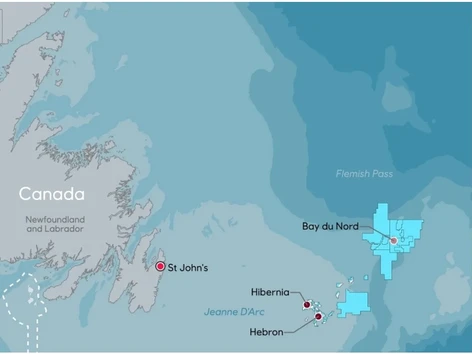
This map shows the sheer size of the Bay du Nord development, compared to existing offshore oil and gas projects off the eastern coast of Newfoundland and Labrador. EQUINOR
Equinor — with BP plc, its main partner in Bay du Nord — drilled 15 exploratory wells in an offshore area known as the Flemish Cap basin and found oil in eight of them, with Bay du Nord being the biggest.
Those results are considered “prolific” in the industry, Keating explained, adding that it is a signal for oil and gas companies to do more exploration in nearby areas.
“Companies, when we look to attract their investments for exploration, they know that there is a proven hydrocarbon system that’s being tapped into and is indeed commercial,” he said.
“That bodes well for international exploration companies because it’s not cheap. It’s a high-risk undertaking to know that this basin is what we call prolific.”
Ottawa lifting roadblocks to development
While promoting potential oil reserves off Newfoundland and Labrador to investors in recent years, Keating said he and colleagues were often met with hesitation, with the industry viewing Canadian regulations as roadblocks.
However, Ottawa’s elimination of the carbon emissions cap on the oil and gas industry in November changed that view. The Bay du Nord announcement will, too. It’s another positive signal to those who decide where spend exploration dollars.
“That really does open the door and de-risk offshore Canada for investments,” said Keating. “That’s the really important part I will be using as I travel around the world to Houston, to London, to Oslo, to promote the offshore.”

Investment in the offshore industry had been doing well leading up to COVID-19, with some $4 billion committed to exploration and 14 companies signed on to do it.
Once the pandemic struck, though, the investments dried up, and the push for an emissions cap advanced, contributing to the Bay du Nord project sputtering.
The silver lining during that period, continued Keating, was the still-useful seismic imaging and prospectivity work that took place.
“That data still exists, except companies weren’t interested in acquiring it,” he said. “Now that they see that the above-ground risks have been mitigated, that data is still there, we start to get calls of interest.”
In fact, within hours of the Bay du Nord announcement, Keating received congratulatory calls and texts from oil company representatives.
“I’m fairly confident that we will get this exploration story back on track as a result of these announcements,” said Keating.
First project in international waters
Bay du Nord is also significant because it is the first project outside of a country’s 200-mile limit.
Because of its location in international waters, the project is subject to the United Nations Convention of the Law of the Sea (UNCLOS).
The international treaty — adopted in 1982 and in force since 1994 — governs navigation, resource management, environmental protection and dispute settlement.
For a project such as Bay du Nord, it would mean charging a tax on resources extracted, a levy that would grow annually from one to seven per cent beyond the first five years.
To kickstart Bay du Nord, the federal government agreed to waive that obligation for Equinor and will cover the costs, according to a statement from Fisheries Minister Joanne Thompson.
It is exactly the kind of project government is proud to support, she said.
“It will be one of the cleanest oil projects in the world, it will mean thousands of good jobs for the skilled workers of Newfoundland and Labrador … and it is a major economic opportunity for Canada.”
Keating said Canada’s waiving of the extranational tax likely equates to more than a billion dollars, depending on the oil price assumptions used. It also removes yet another impediment to investment.
“It was a very significant contribution,” he said. “That’s important because Canada sometimes is considered not a great place to invest because of our rigorous, almost anti-development, anti-oil and gas regulations, but there’s been a clear change in tone … it’s a clear signal that Canada values these kinds of investments.”
Share This: