CDN NEWS |
  US NEWS







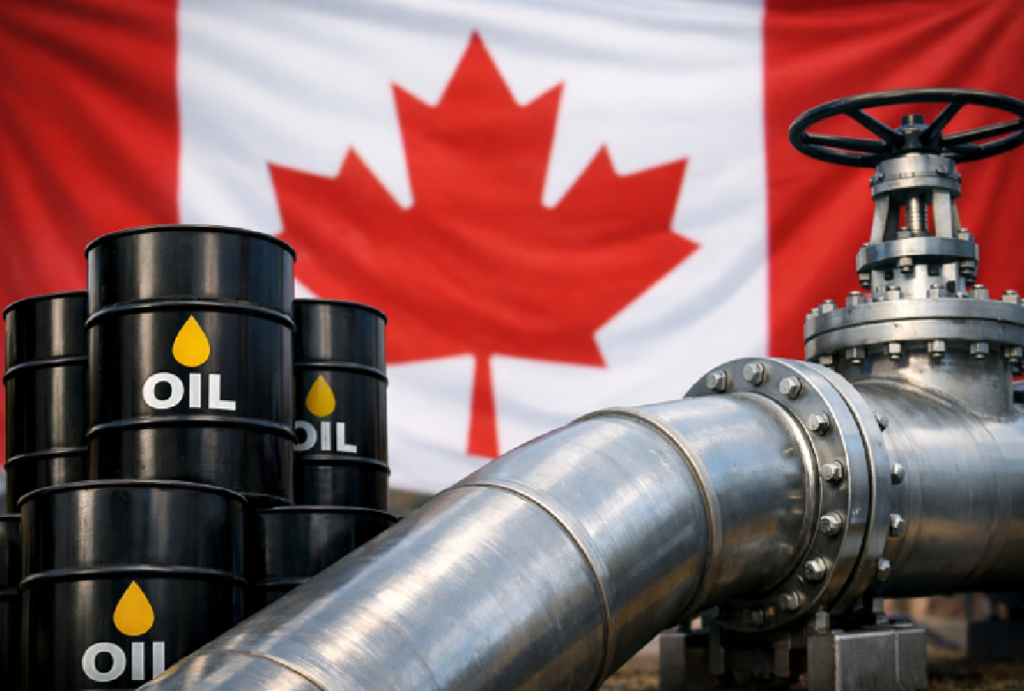
Build More Pipelines and a Strategic Petroleum Reserve: Lessons from Decades of Vulnerability
Also See the Special Feature by Tammy Nemeth – Canada’s Energy History in Bite-Sized Episodes – See the First “Teaser” Episode of 3 MINUTE HISTORY CANADA Here
In the midst of the 2026 U.S.-Israeli conflict with Iran, global oil prices have surged amid supply shocks, prompting the International Energy Agency (IEA) to orchestrate its largest-ever release of 400 million barrels from emergency reserves. Yet Canada, the world’s fourth-largest oil producer and a founding IEA member, finds itself scrambling. Without a national Strategic Petroleum Reserve (SPR), the government is reduced to pleading with private oil companies to release commercial inventories and delay oil sands maintenance to boost short-term output. Even then, the slight increase in supplies is limited in effectiveness by lack of excess pipeline capacity. This ad-hoc response underscores a glaring vulnerability: Canada is unable to reliably assist its allies in a time of global oil crisis, lacking a Strategic Petroleum Reserve or sufficient pipeline capacity to move surge production and contribute meaningfully to shared emergency supplies. It is time for a real energy security strategy—one that learns from half a century of complacency and builds resilience against an unstable world.
Canada’s exemption from the IEA’s 90-day oil stockpile requirement dates back to 1974, when the agency was formed in response to the Arab oil embargo. As an emerging net exporter, buoyed by Alberta’s growing production and prospects of Atlantic offshore developments, Canada negotiated an opt-out, arguing that ample spare pipeline capacity could enable emergency production surges to meet oil-sharing obligations under the IEA’s International Energy Program. This assumption held in the 1980s and 1990s, when infrastructure like the Interprovincial Pipeline had 20-30 per cent excess capacity, allowing quick ramps in output from the Western Canada Sedimentary Basin. Key players, including the Department of Energy, Mines and Resources and the National Energy Board, projected this flexibility into the foreseeable future, prioritizing production over costly storage.
But that spare capacity has vanished. Starting in the mid-2010s, bottlenecks emerged as production outpaced infrastructure. Projects like Keystone XL were delayed for years by regulatory hurdles and ultimately canceled in 2021, while the Trans Mountain Expansion (TMX) faced endless reviews, finally completing in 2024 after a decade of setbacks and eventual government purchase of the asset. These delays, spanning over 15 years, were driven largely by environmental and climate activists, whose protests, lawsuits, and blockades—such as the 2019 rail disruptions that caused propane shortages in Quebec and Atlantic Canada—highlighted how fragile Canada’s logistics are and how redundancies are necessary.



Compounding this, Canada has long dodged the expense of an SPR, estimated at billions for infrastructure like underground salt caverns. In 1977-1978 and in 1981, under Prime Minister Pierre Trudeau, officials floated a collaborative idea to the U.S.: Build part of their SPR in Canada in exchange for increased oil exports to the U.S. Midwest. Two different U.S. Energy Secretaries rebuffed the idea, not wanting to build part of the vital reserve in another country—not even Canada. The U.S. went on to amass an 800-million-barrel SPR, while Canada leaned on its exporter status, leaving Eastern Canada—import-dependent and storage-poor—to rely on American tanks. Analysts and industry groups have warned that Eastern Canada is exposed to disruptions like rail strikes or geopolitical shocks because it has limited crude oil storage capacity and is increasingly dependent on American and other imports.
This East-West divide persists, but the real irony lies in crisis responses. We’re constantly told the world is unstable—pandemics, price wars, invasions—yet every time a shock hits, net zero advocates dismiss calls for more pipelines or production capacity. During Russia’s 2022 invasion of Ukraine, which spiked global prices, they argued there’s no point: the energy transition is accelerating, and nothing can be built in time anyway. Fast-forward to 2026’s Iran crisis, and the script repeats—Canada taps industry for voluntary surges while the IEA draws from reserves elsewhere (Canada contributed zero barrels to the 2022 release). But the transition is not accelerating as claimed; renewables are being added, yet oil and natural gas demand hits records. Why assume there will be no more crises? As Robert Skinner, former Canadian representative to the IEA, aptly put it in 2020, these are “white swans that have been paddling around the pond for a long time”—predictable risks we ignore at our peril.
Canada is the only G7 nation without an SPR, a fact that has drawn renewed scrutiny amid the current turmoil. A 2008 report by Gordon Laxer, Freezing in the Dark, proposed using Ontario’s salt caverns for 31 million barrels to shield Eastern Canadians—feasible and cost-effective as well as storage locations in all provinces that are dependent on imported oil. Yet Canada has dithered, favoring other spending and advancing net zero over real energy security. The Iran war could bolster calls for pipelines like another Pacific export route, or extension to the Maritimes, enabling long-term growth. But without action, Canada will remain vulnerable.
It is time for bold steps: Fast-track pipeline expansions to restore surge capacity, and establish a Canadian SPR, perhaps starting with 90 days’ worth for Eastern imports. In a world where energy underpins everything from food prices to national defence, this is about pragmatic resilience not hydrocarbon favoritism. Energy security is national security. With crises mounting, delay is no longer an option. Let’s strengthen Canada’s energy security before the next white swan strikes.
Thanks for reading The Nemeth Report’s Substack! Subscribe for free to receive new posts and support my work.
Share This: