


 CDN NEWS |
  US NEWS







By Ron Wallace
“We are acting as though good intentions and aspirational net-zero targets provide sufficient protection in an increasingly competitive and unforgiving global system. It is worth asking whether countries such as China or India, or even Europe, are prioritizing carbon-neutral energy in the midst of an Iranian oil crisis, or whether energy security and affordability have once again moved to the forefront.” Martin Pelletier.
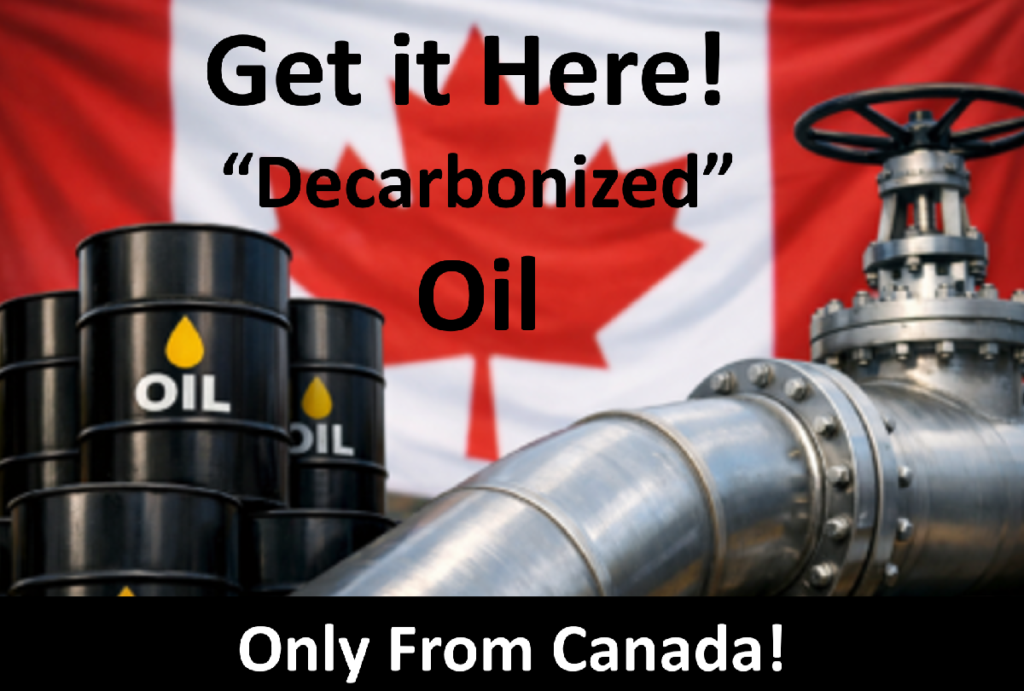
If the April 1st deadline to sign the Alberta-Canada MoU is missed or substantially delayed, it would significantly undermine the credibility of Canada’s climate strategy while risking widening the gap to national emissions targets. Equally as important, any agreement that does not meet the economic and financial expectations of the private sector and taxpayers would rightfully cause some to question whether a “decarbonized oil” pipeline will ever be commercially viable. Hence, there is a core political‑economic risk to the “Grand Bargain” reached by Premier Smith and Prime Minister Carney in November 2025: If the MoU can’t be translated into a deal that works for both private capital and taxpayers, the whole narrative around a “decarbonized oil pipeline” from Alberta to the west coast would begin to resemble a branding exercise more than an investable business model.
The Canada–Alberta MOU is an explicit attempt to expedite a proposed privately constructed and financed bitumen pipeline from Alberta to the B.C. coast with Indigenous co‑ownership. However, it ties the pipeline to the Pathways Alliance CCUS project that, once constructed at a cost estimated at $16.5 billion, would become one of the world’s largest proposed CCUS hubs. This essential linkage set out in the MoU aspires to produce “decarbonized” oil for an international market at sustainable prices. While the MoU does not constitute a final regulatory approval, or a Final Investment Decision (FID) from the private sector, it nonetheless leaves unresolved key questions of material interest to both the investment community, and most certainly to Alberta taxpayers. Will a pipeline designed to produce “decarbonized” oil that requires cost‑sharing, risk allocation and massive tax incentives be financeable, deliver acceptable returns and be marketable?
At a time of increasing international political instability that has caused uncertainty in international oil markets, investors will undoubtedly seek guarantees that future governments will not only maintain cost-sharing agreements but carbon pricing parameters that include incentives for CCUS projects. Importantly, can “decarbonized” Canadian oil adequately secure durable price premiums in a competitive international marketplace sufficient to justify the enormous initial capital outlay?
Private proponents and taxpayers, many of whom may be concerned about the massive costs required to “decarbonize Alberta’s oilsands production, may yet reasonably conclude that the proposed risk‑adjusted returns are not only unattractive but prohibitive. In that scenario, skepticism about the commercial viability of a “decarbonized oil” pipeline would be justified. The MoU seeks to achieve federal‑provincial alignment with Net Zero policies while meeting the test of marketability. As such, the MoU may become nothing more than a reality check about whether “decarbonized” oil is both technically and financially capable of meeting private-sector investment hurdle rates and be defensible to taxpayers. If not, failure of the MoU would force a much broader re‑examination of Canadian Net Zero policies. Indeed, the Alberta Enterprise Group considers the pipeline to be a test of Canadian federalism, arguing that Alberta’s ability to access global markets requires clear federal backing, provincial coordination and a shared commitment to national prosperity.
Meanwhile, Premier Smith has maintained that the pipeline proposal will be ready by June 2026 with a ”substantial Indigenous ownership stake.” Alberta’s working assumption is that an application to the Major Projects Office (MPO) for designation as a ‘project of national interest’ would set the clock running on a two-year time frame, where numerous federal agencies would work together to achieve a final investment decision and approval. That assumption creates a high‑stakes environment because it turns a procedural step into a de facto commitment in which Alberta could expect all regulators (provincial and federal) to coordinate and deliver a final investment‑ready approval for a “decarbonized” private-sector-Indigenous pipeline, within 24 months. This is a tall order indeed as it will require substantial regulatory, financial, political and Indigenous‑rights alignments.



Alberta and Ottawa have chosen to frame this new “one project, one review” approach as essential to increasing regulatory certainty needed to unlock major infrastructure investment. However, it remains to be seen if this scenario for a two‑year approval window will appreciably reduce regulatory risk and be sufficient to attract capital. As has already been demonstrated, if this proposed system fails to deliver timely cost-effective approvals, not just Alberta but Canada risks losing projects to jurisdictions with shorter timelines and more predictable outcomes. François Poirier the CEO of TC Energy Corp. recently commented that Canada risks missing out on opportunities to provide global markets with a secure supply of energy if permitting timelines aren’t significantly shortened. At a time when Canada and Alberta optimistically aim to cap regulatory timelines at two years, Poirier highlighted the Southeast Gateway Pipeline project that had a seven-month permitting process in Mexico, where no corners were cut, citing this as a strong example of what’s possible when government and industry work together.
Assumptions for success of the MoU only holds if federal regulators, Indigenous partners and provincial agencies all share the same interpretation of when the clock starts and what “approval‑ready” means. There is a potential conflict looming if Alberta considers the MPO application to be binding if the federal government views it as being conditional. While Alberta and Canada have publicly framed the MoU as a breakthrough, if the two‑year timeline fails in practice, Premier Smith could be blamed for over‑promising with Prime Minister Carney accused of failing to honour commitments made to Alberta.
Prior to the MoU, many were concerned about the impact of federal regulations, such as a proposed Emissions Cap and Clean Electricity Regulations, on Alberta’s resource‑dependent economy. The concern was that those regulations could create a potential investment flight risk that would significantly weaken Alberta’s competitiveness.
However, agreements under the MoU may pose even more significant economic risks for Alberta. Kaplan recently noted that the $16.5 billion Pathways Alliance’s CCUS project has been faced with rising capital and operating costs, factors that have led to growing pressure for additional provincial financial support. While public financial disclosures remain limited, independent analyses (IEEFA) suggest that total costs for Alberta CCUS projects may approach thresholds that could pose material challenges to profitability. If so, Alberta risks being drawn further into fiscal exposure while attempting to support marginal economics of CCUS in the oil sands. Given the intensive negotiations now underway under the MoU regarding an Industrial Carbon Price and the role of the Pathways CCUS Project, there are important questions that should receive a higher degree of transparency and disclosure. Indeed, there are some considerations that issues for decarbonization and CCUS infrastructure could even rise to the point of becoming a sovereignty issue for Alberta.
Is there a potential that the MoU could become a demon of our own design? As energy columnist Terry Etam recently noted:
“Several years ago, multiple nations including Germany and Japan came to Canada looking for our natural gas, and we told them to pound sand. Have some green hydrogen instead, our leader lectured, despite the inconvenient problem of developing an imaginary industry from scratch that is just incomprehensibly uneconomic from any vantage point. The countries went away.”
The MoU has effectively been proposed to address a misalignment with federal rules that could divert significant investment capital away from not just Alberta but Canada. It is aimed at reaching a stable, Alberta‑aligned regulatory pathway with predictable carbon pricing that recognizes CCUS infrastructure and hydrocarbon development to be part of Alberta’s constitutional jurisdiction over natural resources.
Hopefully, it will not yet prove to be a “demon of our own design.”
Dr. Ron Wallace is a former Member of the National Energy Board.
Share This:






















On The Verge: Energy Sector Primed for New Wave of Growth – ATB Economics