CDN NEWS |
  US NEWS







By Ron Wallace
“We are going to get to our greenhouse gas objectives, our climate objectives only through massive investment and so we need agreements like this in order to drive that massive investment.” – Prime Minister Mark Carney (November 27, 2025 at the signing of the Canada-Alberta MoU Agreement).
OVERVIEW
This revealing statement demonstrates an increasingly common theme in federal climate policies – that the federal government considers objectives to attain emissions targets not to be a regulatory problem but instead as a fundamental challenge for investment to, among other things, achieve “social license.”
Alberta is discovering the enormously high ‘entry fee’ required to enter into agreements with a federal government that has long-standing, highly developed regulatory and legal commitments to attain Net Zero. Federal legislation makes it easier to derail major projects than to build them. While there was a palpable sense of elation at the time of the signing of the Canada-Alberta MoU, with both governments framing the agreement as a turning point in their relations, there are growing concerns about the agreement and its impact – particularly heightened industrial carbon pricing requirements that are specifically, and uniquely, aimed at Alberta’s oil producers. Those costs, and the capital required to produce “decarbonized” oil, have material but largely undisclosed, economic ramifications for Alberta. Should Alberta be compelled uniquely to be a global producer of “decarbonized oil” and will the heightened costs of industrial carbon levies financially kneecap the industry and the province? These are material concerns for any corporate board tasked with assessing the substantial capital investment required to build and operate, proposed new export pipelines.
Enbridge, a major North American pipeline operator and the former proponent of the Northern Gateway Project that was cancelled by the federal cabinet recently announced its unwillingness to absorb any uncertainty that could derail a major infrastructure venture before it reaches a final investment decision. CEO Greg Ebel commented: “I don’t think investors or the infrastructure companies should be taking on the risk of development in jurisdictions that have historically created a challenge.” That comment captures the reality of corporations seeking regulatory consistency and economic fairness within Canada, as they deal with challenges in a highly competitive international marketplace.
These issues of economic fairness are not confined to the international markets. While Alberta oil producers would face material costs to achieve to produce “decarbonized” oil, eastern Canadian corporations are allowed to import and refine oil from jurisdictions that do not face these penalties.
In sum, the concessions required to reach an agreement in the MoU appear to come at a high price for Alberta because it effectively binds the province to national Net‑Zero emissions goals with conditions for “mutually assured construction” and “dependency timing” with requirements that CCUS projects be linked to new oil export pipelines. Each has components that depend on the other’s approval in sequence: There will be no pipeline approved without CCUS and, by definition, no CCUS without a pipeline.
SEVERAL DILEMMAS FOR ALBERTA
Canada continues to aggressively implement strategies for Net Zero, at a time when governments have reframed, delayed, or softened their Net Zero–related policies as part of broader deregulatory or pro‑growth agendas that address issues of energy security, industrial competitiveness and the cost of living. For instance, the U.S., Canada’s largest trading partner, recently announced a major deregulatory action to revoke the 2009 EPA ‘Endangerment Finding’ and all consumer mandates associated with it.
In 2023, Canada imported 1.1 million barrels of oil equivalent per day (BOE/d) of hydrocarbons. 83% of those imports (one third of which was crude oil) were from the United States. These competitive imports arrive from markets with few, if any, requirements for “decarbonization.” Meanwhile, international competitors like Norway’s Equinor, unincumbered with regulatory requirements for “decarbonization”, have targeted sharply increased output from its international oil and gas portfolio by 2030 to produce oil and gas from seven countries. This would boost their overseas petroleum production to more than 900,000 barrels of oil equivalent per day by 2030, a rise of at least 23%.
In the spring of 2025, Alberta’s Premier Danielle Smith provided the Prime Minister with a concise nine-point list of the legislative and regulatory measures that she deemed to be harmful to the Canadian economy. Smith’s “nine bad laws” laid out what her government and executives from the Canadian oil and gas sector said would be required to attract investment. Since then, Canadians have been treated to a unique spectacle with a federal government opting to pass legislation designed to overcome and circumvent its own standing legislation.
Bill C‑5 (2025): the One Canadian Economy Act – Part 2 the Building Canada Act was created specifically to expedite federal regulatory processes for projects of national interest by creating a Major Projects Office (MPO) designed to streamline federal approvals and potentially exempt projects from certain regulatory requirements. Broader legislation designed to achieve “Net Zero” emissions of GHGs, having failed in face of steadily rising national emissions, will nonetheless remain in place. The MoU does allow for possible relief, or suspension, of the Clean Electricity Regulation and an Oil and Gas Emissions Cap (aimed specifically at the oil and gas sector). However, as part of a broader methane‑equivalency agreement to be finalized by April 2026, Alberta has agreed to dramatically lower oilpatch methane emissions by 2035. This places Canada at the forefront among nations attempting to achieve material reductions of these emissions.



Meanwhile, other federal regulations continue to be advanced. The December 16, 2025 Budget Climate Competitiveness Strategy contains significant initiatives designed to limit investment in the hydrocarbon sector (Bill S-238). These actions attest to the undiminished zeal of the federal government to attain what has been termed a Canadian “net zero nirvana” while advancing 112 federal and 364 provincial/territorial climate initiatives that, in combination, are projected to cost $476 Billion from 2020–28.
THE COST OF THE MoU
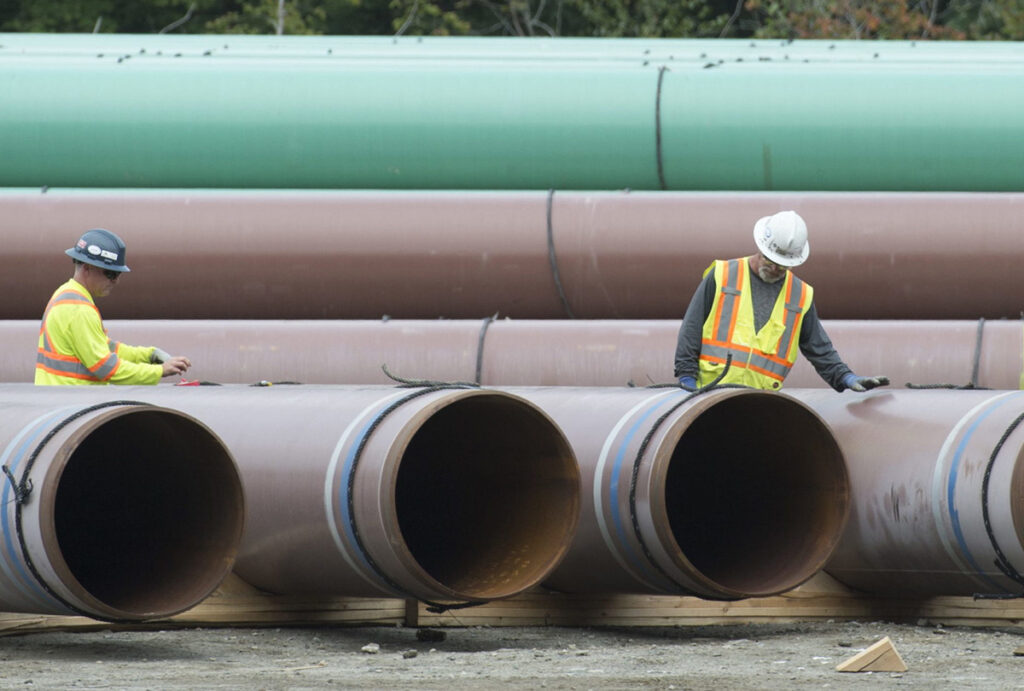
With a significant shift in Canadian opinion favouring energy and infrastructure development, Alberta has understandably pegged its hopes on a federal pipeline decision by year-end. While some observers are unconvinced that this will occur, others question if the MoU will allow Canada to be competitive in the international marketplace.
The Canada-Alberta MoU that has been advanced as a “grand bargain”, specifically designed to produce “decarbonized oil”, has the Pathways Project as its central condition. With largely untested at-scale technologies, and estimated (2023) costs of CAD $16.5 – $20 billion, there remain questions of how it will be financed. Although Ottawa and Alberta have provided investment tax credits for CCUS, those incentives have been insufficient for industrial proponents to reach a final investment decision. Unlike EOR projects which produce oil, CCUS projects are designed solely to sequester CO2. Accordingly, the Canadian CCUS Investment Tax Credit (ITC) was specifically created to stimulate investment in projects that would otherwise be uneconomic. Such capital-intensive capture and storage infrastructure projects lack traditional revenue streams because sequestration projects do not generate returns except through policy mechanisms (credits, ITCs).
Under the MoU, Alberta is proposing to negotiate an increase to the minimum effective carbon price, perhaps to reach $130 per tonne of emissions (up from the current $95 per tonne). These projected increases will impact the producers and the province as the costs of CCUS ultimately accrue to costs of production. While the federal government had previously demanded a rise in price to $170 a tonne by 2030, the MoU has allowed both sides to seek a mutual accommodation by negotiating commitments to net-zero targets by 2050. However, there are developing questions about the pricing required to reach those Net Zero commitments. Kaplan has estimated that Alberta carbon prices could reach as much as $233 per tonne by 2035 and $371 per tonne by 2050.
In short, the viability of huge decarbonization projects rests substantially on higher carbon pricing agreements that accrue revenues from the sales of carbon credits. These terms may have unintended economic consequences for conventional producers and could result in capital outflows from Alberta to less punitive jurisdictions. While Alberta is not the only jurisdiction experimenting with the production of lower‑carbon or decarbonized oil, it is the only major oil‑producing region where decarbonization would become a de facto condition for expanded production. Hence, the MoU is a political agreement that will explicitly hinge on prerequisites for oil to be decarbonized, meaning that new export pipeline will be contingent on a CCUS facility that is enabled by higher industrial carbon levies.
At a time when Alberta may be facing significant ongoing budget deficits, serious questions are emerging as to how these additional costs to achieve “decarbonization” will be met. Additionally, industry groups have expressed concern that the federal government’s proposed adjustments to industrial carbon pricing and methane regulation diverge from the collaborative intent of the MoU. The Canadian Association of Petroleum Producers (CAPP) has argued that the proposed federal framework would “introduce increased complexity and cost” while undermining competitiveness. It characterized the direction of federal policy as “misaligned” with the objectives originally set out in the MoU highlighting two areas of concern: the federal methane regulations and the proposal to significantly alter the industrial carbon pricing structure are dependant on reaching an equivalency agreement with Ottawa. In the absence of an agreement, they consider that, according to the federal government’s own analysis, the additional cost to industry could reach $14.6 billion,
The “hidden costs” of the MoU are material. Celebrated Canadian economist Jack Mintz has shown that while CCUS may add a meaningful incremental burden to costs of production per barrel of oil, the dominant cost driver is the proposed carbon tax increase. Mintz estimates that CCUS‑related costs alone could reach $USD 1.20–$3.00/bbl for mining production and $USD 3.60–$4.80/bbl for SAGD production. When combined with the carbon tax increase the total added cost could reach $USD 6.40–$10/bbl. These additional cost pressures on Alberta oil are emerging precisely when global competition is intensifying and benchmark prices are weakening, leaving producers with even less room to absorb new expenses. Significantly, the U.S. Energy Information Administration’s 2026 Short-Term Energy Outlook projects global oil inventory builds averaging 3.1 million b/d in 2026, easing slightly to 2.7 million b/d in 2027, indicating that the sustained surplus may push Brent prices sharply lower, with the agency forecasting $USD 58/b in 2026 and $USD 53/b in 2027.
Forecast and realised OPEC+ production increases (e.g., 411,000 bpd hikes) have pushed WTI to its lowest level since the pandemic as U.S. policies and actions, including recent interventions in Venezuela, have tended to supress global demand. As lower prices for WTI ripple through to producers and service companies they quickly impact the Alberta treasury. Recent reporting shows how sharply these dynamics can affect Alberta. At USD $60/bbl, the lowest in four years, Alberta faces significant fiscal impacts as every $1 drop in WTI costs the province roughly $750 million in lost revenue. With WTI hovering near USD $57–$60, the province faces a potential $7.5‑billion revenue hit.
REGULATORY CONSISTENCY AND ECONOMIC FAIRNESS
Meanwhile, as Alberta faces material legislative and financial challenges to produce, transport, and market “decarbonized” Western Canadian oil (with significantly discounted pricing), eastern Canadian refiners are allowed to import competitive oils produced abroad without comparable penalties for emissions. Quebec is historically the largest importer of offshore crude in Canada, having imported over CAD $228 billion in foreign oil since 1988. New Brunswick is second, with import costs of approximately CAD $136 billion in the same period. Both provinces rely heavily on offshore suppliers such as Saudi Arabia, Nigeria, Algeria and the U.K., although U.S. Gulf Coast crude has become an increasingly dominant source in recent years. This steady stream of more than 450 oil tankers that call at ports throughout Eastern and Atlantic Canada every year, draws little public attention or concern from the federal government.
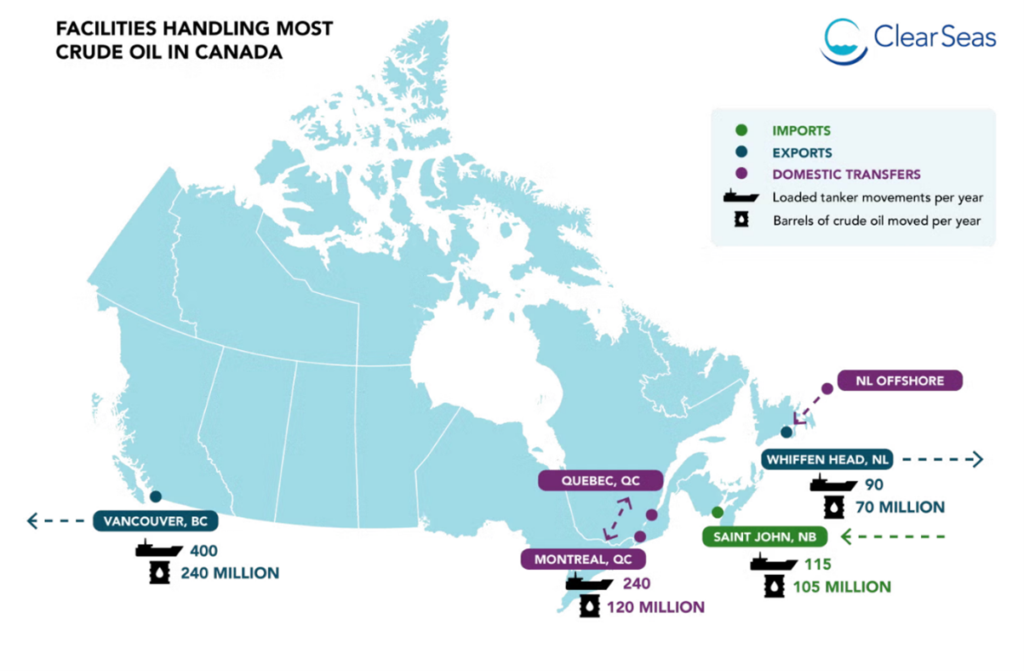
Map courtesy Clear Seas
Recently Quebec announced changes to its greenhouse‑gas reduction timeline, effectively postponing the regulatory pathway needed to reach its previously stated 2030 targets, insisting that it is not abandoning those targets but is extending the deadline to 2035 to “protect the economy during a period of global uncertainty”. Similar reasoning has apparently escaped incorporation in the Canada-Alberta MoU.
At the end of the day, the Canada-Alberta MoU exists within the broader context of Canadian environmental Laws and Regulations. The Carney government’s strategy for Canada to attain the status of an “energy superpower” cannot succeed without the active participation of Alberta. While the Carney government has appeared to have made a significant pivot away from Trudeau-era policies, it has nonetheless maintained, and enacted, legislation that is contrary to stated ambitions for Canadian energy superpower status. Legislation that has received second reading in the Canadian Senate (Bill S-238) proposes to advance regulations to require Canadian financial institutions to prioritize “climate alignment” in their core mandates. These measures appear crafted to engineer an effective debanking of the entire Canadian energy sector. Meanwhile the federal government has announced its intention to implement “investment guidelines” with a “green taxonomy” to further federal Net-Zero sustainability targets. These legislative measures, introduced in parallel with negotiations for the MoU, may yet present a direct challenge to Alberta’s economic interests.
Dr. Ron Wallace retired as a Member of the National Energy Board in 2016.
Share This: