CDN NEWS |
  US NEWS







By Ron Wallace
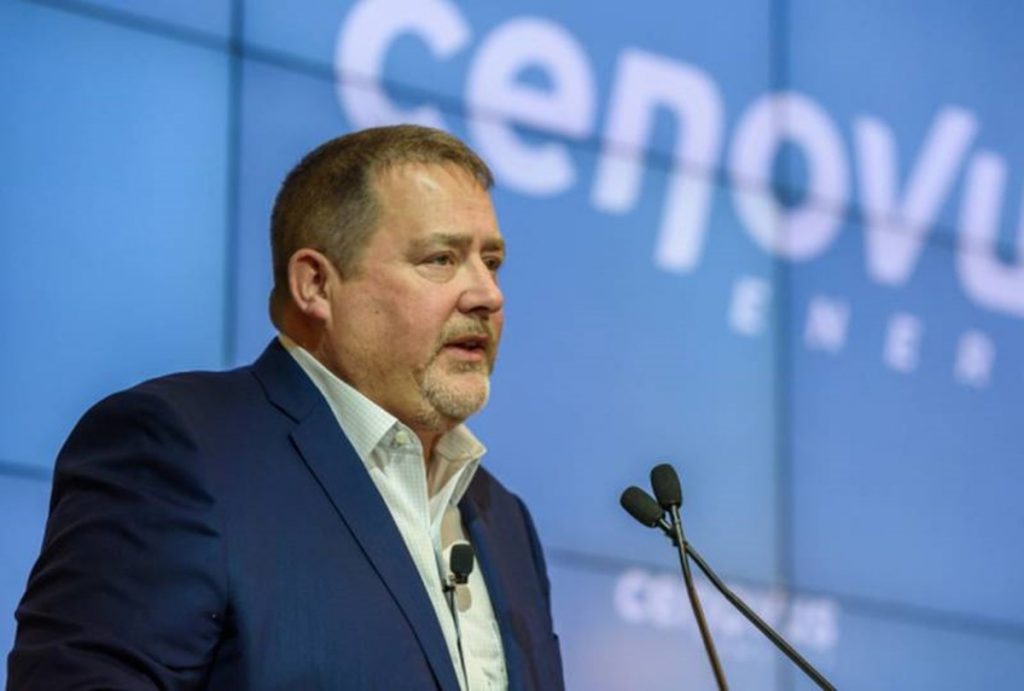
“It does not do my company or any company any good to materially grow production right now if we cannot get that production to global markets.”
– Alex Pourbaix, executive chair of Cenovus Energy
Alberta and Ottawa are presently engaged with implementation of the November 27, 2025, Canada–Alberta Memorandum
of Understanding (MoU), an agreement designed to reverse a decade of Canadian regulatory paralysis resulting from Trudeau-era regulatory policies. These policies caused a significant decline in oil and gas investment in Alberta due to regulatory uncertainty, higher compliance costs and barriers to project approvals. Capital investment in Canada’s oil & gas sector fell sharply from $84.0 billion in 2014 to $37.2 billion in 2023, representing an inflation-adjusted decline of 56%.
Despite these ongoing challenges, a surge in production from the Alberta oil sands region has led producers to examine opportunities for new pipeline export capacity (south and west). Enbridge, in late 2025, is reported to have reached a USD $1.4 billion final investment decision (FID) to increase capacity in its Mainline system by 100,000 barrels per day. Other reports indicate that Trans Mountain Pipeline is seeking to increase capacity from the current 890,000 to 1.25 million barrels per day.
While some have considered the MoU to represent an historic alignment between the two levels of government, one that could potentially enhance the attractiveness of Canada as a destination for energy capital, others have expressed reservations about the practical realities involved in implementing the terms of the MoU.
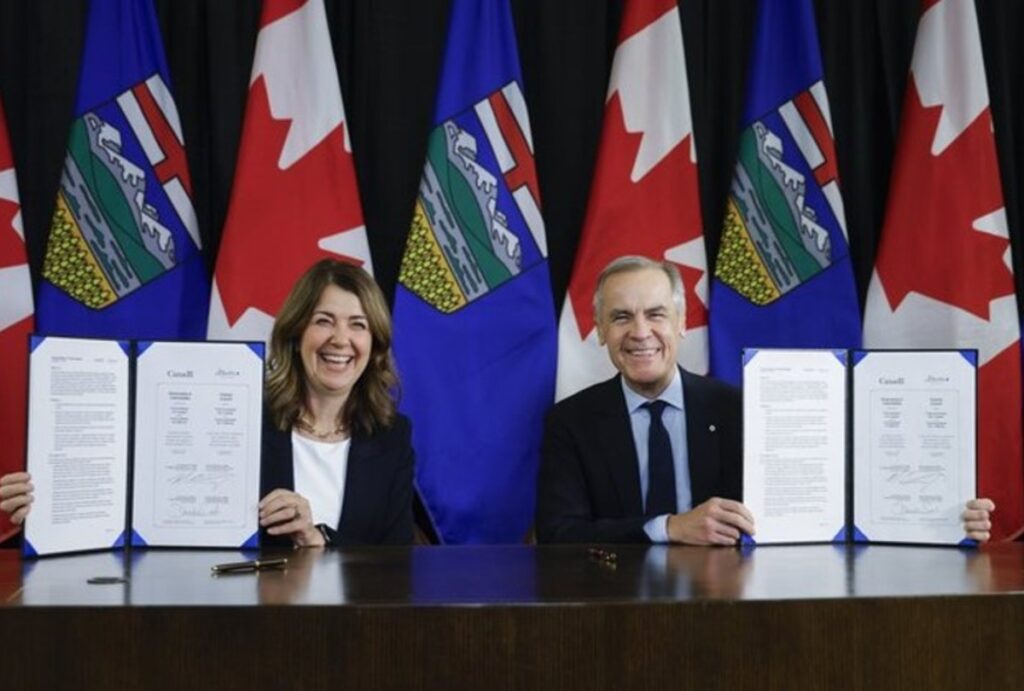
Alberta has committed to the MoU in the hope that it will remove barriers to development and restore investor confidence in, and the international competitiveness of, its oil and gas industry. Specifically crafted to address an oil pipeline from Alberta to the northwest coast of B.C. to carry up to 1 million barrels of heavy oil per day, the MoU explicitly links Alberta‑led pipeline proposals to the federal government’s Bill C‑5 (2025): the One Canadian Economy Act that includes the Building Canada Act that was created specifically to expedite major infrastructure projects and streamline federal approvals.
Although the MoU is understood to be a conditional, initial step but not a guarantee for any specific project, there was significant optimism expressed in Alberta at the time of the announcement because it was the first time Ottawa had signaled a willingness to consider the use of legislation to fast‑track a major oil pipeline from Alberta. This represented a rare and potentially meaningful moment of federal–provincial alignment on energy infrastructure and its importance to the Canadian economy.
While the Building Canada Act has been trumpeted as the federal government’s answer to decades of regulatory gridlock, one that may indeed represent a significant structural shift in federal policies, the MoU is far from a panacea with its vague, or perhaps even contradictory, language. As legal expert Andrew Roman observed:



“The MoU contains several cleverly worded provisions that are pipeline-investment killers.” The MoU says that if the pipeline is ultimately approved, then an export provision will be enabled; but only “if necessary” and “through an appropriate adjustment” to the tanker ban law.”
Moreover, the discretionary nature of the MoU provides little investment certainty for pipeline operators. To the contrary, unless and until port and tanker access is guaranteed sufficient to match the proposed capacity of a new pipeline there can be no certainty for exports.
In the absence of any private sector proposal for a new pipeline to the Pacific coast, Alberta has chosen to be a proponent to seek authorization from the federal government. In return, the federal government has committed to a streamlined federal review to accelerate a national interest determination by referring the project to the Major Projects Office (MPO). The Alberta government has “seeded” this process by funding three Canadian pipeline companies (Enbridge, South Bow and Trans Mountain) to advise the Government of Alberta on possible pipeline routes. The objective is to have a submission prepared for the MPO by July 1, 2026.
First, if a northern oil terminus is to be constructed, a resolution of obstructive federal legislation such as the Tanker Ban (Bill C-48 Oil Tanker Moratorium Act) and Indigenous and provincial opposition to the pipeline and to marine transportation of oil must occur. Bill C-48 established a permanent moratorium on oil tankers carrying more than 12,500 metric tonnes of crude or persistent oils along British Columbia’s north coast, from the northern tip of Vancouver Island to the Alaska border. Failing to achieve that resolution, another port, outside the tanker ban area, would be required. Perhaps unsurprisingly, Alberta’s Premier has already suggested several alternatives even though the advisory group established to make such recommendations has yet to report. Apparently Prince Rupert, Kitimat (now apparently ruled out), Nisga’a Territory (Ksi Lisims LNG area) and Roberts Bank (near Vancouver) are under consideration. Premier Smith considers a revival of the Northern Gateway corridor, using existing rights‑of‑way rather than a brand‑new greenfield route, as her “first preference” because it would target a deepwater port in northwestern B.C. These routes have historically been associated with Kitimat or Prince Rupert.
A possible alternative proposal would be to seek a U.S. port destination. However, this option involving a U.S. route to northwest Washington or Oregon would be subject to other significant, regulatory complexities involving U.S. Presidential Permits because it involves cross‑border oil infrastructure that falls under the jurisdiction of the U.S. Department of State. Precedents include the contentious Keystone XL pipeline authorization and the Enbridge Line 67 (Alberta Clipper) capacity amendment.
Whether Alberta will be able to apply under the terms of the MoU to the federal Major Projects Office by July 1, 2026, and secure a private-sector partner is still uncertain. Another challenge for the evolving MPO is the uncertainty of how it will integrate promised fast-tracked federal approvals within existing regulatory frameworks. The Building Canada Act (section 22) empowers the Governor-in-Council to exempt a project from the requirements of several key federal Acts and Regulations. The federal agencies involved could include the CER, IAA, DFO, ECCC, Transport Canada, and potentially others. The MPO will have to work with these federal regulators to combine all their regulatory requirements into a “condition statement” for a decision of the Governor-in-Council. Notably, while this process may advance regulatory timelines, there is the potential risk of significant legal challenges emerging to this untested, expedited process uniquely designed to circumvent an existing legislative base.
At the outset, Prime Minister Mark Carney stated that the MoU is ‘the first step’, one that will require a private sector proponent and ‘full partnership including equity ownership’ with Alberta, First Nations and the province of B.C. Unlike the publicly financed Trans Mountain pipeline, Alberta and Canada have jointly agreed through the MoU that any new pipeline to the Pacific coast must be privately financed and constructed.
Meeting all these preconditions is a tall order. Will the good intentions of the MoU to expedite, and simplify, the Canadian regulatory process achieve that end? While the MoU assumes that this expedited process may catalyse Indigenous and provincial agreements, and that an acceptable, viable port will be determined, it remains to be seen if these exceptional measures will attract substantive interest from private sector financiers for this pipeline.
Ron Wallace is a former Member of the National Energy Board.
Share This: