CDN NEWS |
  US NEWS







CAPP’s Lisa Baiton and the Macdonald-Laurier Institute’s Heather Exner-Pirot urge Parliament to resolve regulatory contradictions and attract capital

Heather Exner-Pirot (left) and Lisa Baiton were among recent visitors to Parliament’s standing committee on natural resources. Exner-Pirot photo by Resource Works News; Lisa Baiton photo by Business Council of British Columbia.
By Resource Works
More News and Views From Resource Works Here
MPs on Parliament’s standing committee on natural resources were told, strongly, that “if Canada truly wants to become an energy superpower, we need a new approach.”
That was from Lisa Baiton, president and CEO of the Canadian Association of Petroleum Producers (CAPP), who said: “The core question before us is not whether (world) energy demand will continue to grow, but whether Canada will choose to help meet that demand. . . .
“In this new era of economic nationalism, major policy change is required to attract the investment to rebuild our economy, create high-quality jobs, enhance our energy security, and strengthen our sovereignty.”
‘Critical to Canada’s economy’
Earlier, as the MPs began to look at exports and export policy, Heather Exner-Pirot of the Macdonald-Laurier Institute told them: “This topic, energy exports, is critical to Canada’s economy and to its global influence and power, and it’s essential we better position ourselves for success. Canada is a world-class energy producer with well over a century of reserves of oil, gas and uranium.”
She added: “Although the rhetoric and focus on being an energy superpower is much improved. There are mixed signals coming from the policy side, for example, in methane regulations, carbon pricing and Indigenous consent. These need to be addressed for us to meet the lofty goals Prime Minister Carney has set for us as a nation. . . .
“We must get our ducks in a row now.”
The economic argument
Dan McTeague of Canadians for Affordable Energy, a former MP and once a committee member, told MPs that exporting energy is necessary to pay down the national debt, strengthen our dollar and safeguard our sovereignty
“Most importantly, it would enable us to bring down the elevated cost of living, which is making it so difficult for Canadians to heat our homes . . . gas up our cars and pay for the basic necessities of life.”
And one submission, from Eric Nuttall of investment firm Ninepoint Partners, said: “Not making new pipelines an urgent, national priority, backed with action versus more talk, would be the equivalent of economic treason.”



By the numbers
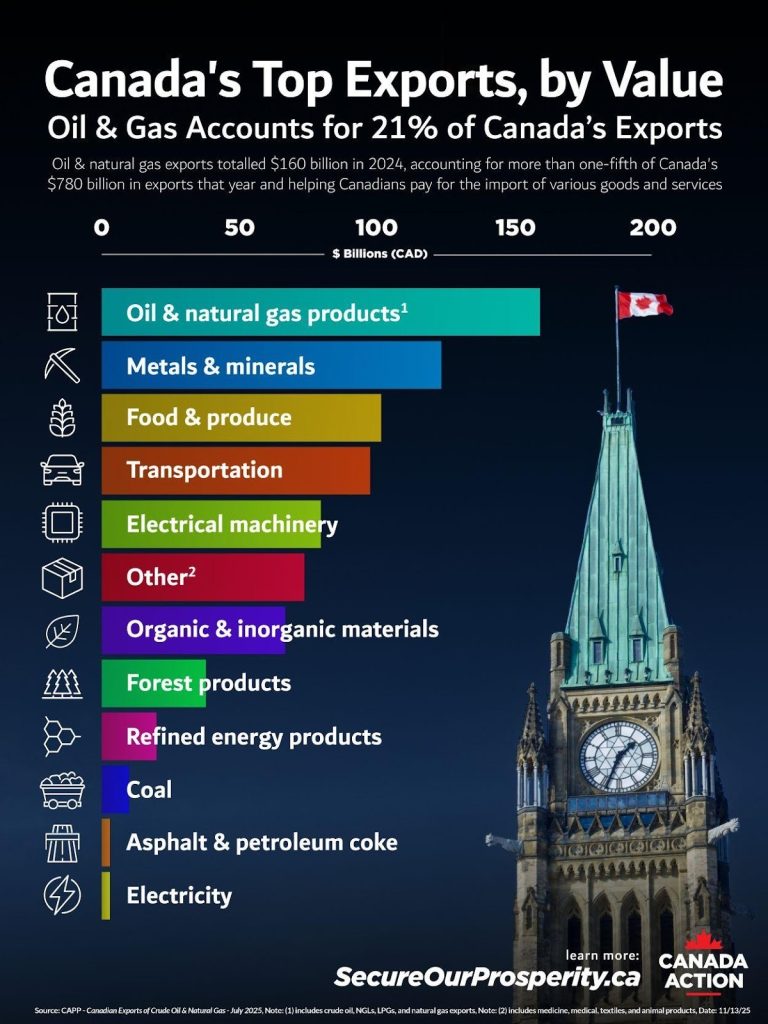
CAPP provided key statistics to the committee highlighting the sector’s contribution:
- Oil and natural gas represent more than 20 percent of Canada’s total balance of trade.
- Over just three years, the sector contributed approximately $116 billion in taxes and royalties.
- Since 2017, over $5 billion in Indigenous equity has been invested in energy projects.
- The oil-gas sector provides 450,000 direct and indirect jobs across the country and contributed over $85 billion to GDP last year.
Meeting global demand
Baiton told the committee: “Even with the growth of renewables, the world will continue to rely on conventional energy for decades. Over the last 35 years, the share of hydrocarbons in the global primary energy mix has barely shifted—from 85 percent in 1990 to roughly 80 percent today. . . .
“The growth of renewables will simply be layered on top of the growth of conventional energy to meet a voracious growing global appetite for all forms of energy.
“The core question before us is not whether energy demand will continue to grow, but whether Canada will choose to help meet that demand. It is an urgent question for a resource rich, trade dependent nation like ours.”
And from Exner Pirot: “It’s clear from Prime Minister Carney and (Energy) Minister Hodgson’s recent trips to China and India that there’s an appetite for more Canadian oil and gas in Asia, and that this will be key to any trade diversification strategy we advance. Canadian oil and gas producers are world-class operators, and will incrementally grow production and global market share when they get new pipeline space to fill the situation. . . .
“Now, we don’t need a new million-barrel pipeline today or tomorrow, but we will need it around 2031 or 2032, and that absolutely means that the planning and execution must start now.
“Alberta and Canada should take the necessary steps to develop a route, submit a project, conduct the duty to consult, clear initial legal and regulatory hurdles and financially de-risk a new oil pipeline through Indigenous loan guarantees to the point where a private proponent feels confident that the pipeline can be built in Canada in a reasonable amount of time, and that we are once again a safe place to invest capital.”
A ‘tightening noose’
Later, in a guest column on The Hub, Exner-Pirot wrote: “To approach anything resembling energy superpower status, Canada’s federal climate policy structure must undergo a rupture, not a transition, from the past.”
She said: “I genuinely appreciate the change in tone from what was endured for 10 years under Prime Minister Justin Trudeau. But the gap between what is being said and what is being done by the Carney government on energy is getting too big to ignore.
“The pancake stack of investment-killing climate regulations introduced by former ministers of environment Catherine McKenna, Jonathan Wilkinson, and Steven Guilbeault is not only largely intact; additional phases of their legacy policies are kicking in, and new ones are being added by Carney.
“The noose is tightening, not loosening. Any success our energy sector is having in this geopolitical moment is largely despite, not because of, Ottawa.”
- Committee video from Feb. 3 (includes testimony from Heather Exner-Pirot and Dan McTeague): https://bit.ly/4ktz3T6
- Committee video from Feb. 5 (includes Lisa Baiton): https://bit.ly/4rTg7zX
- Committee video from Feb. 10 (includes Eric Nuttall): https://bit.ly/3MkbwYn
Don MacLachlan is a writer for Resource Works, a non-partisan organization that champions responsible resource development in British Columbia and Canada. Reach Ian at [email protected].
Share This: