CDN NEWS |
  US NEWS







A look back at the 2022 worksite assault and the new reality: Indigenous-led LNG and pipeline stakes are reshaping the debate
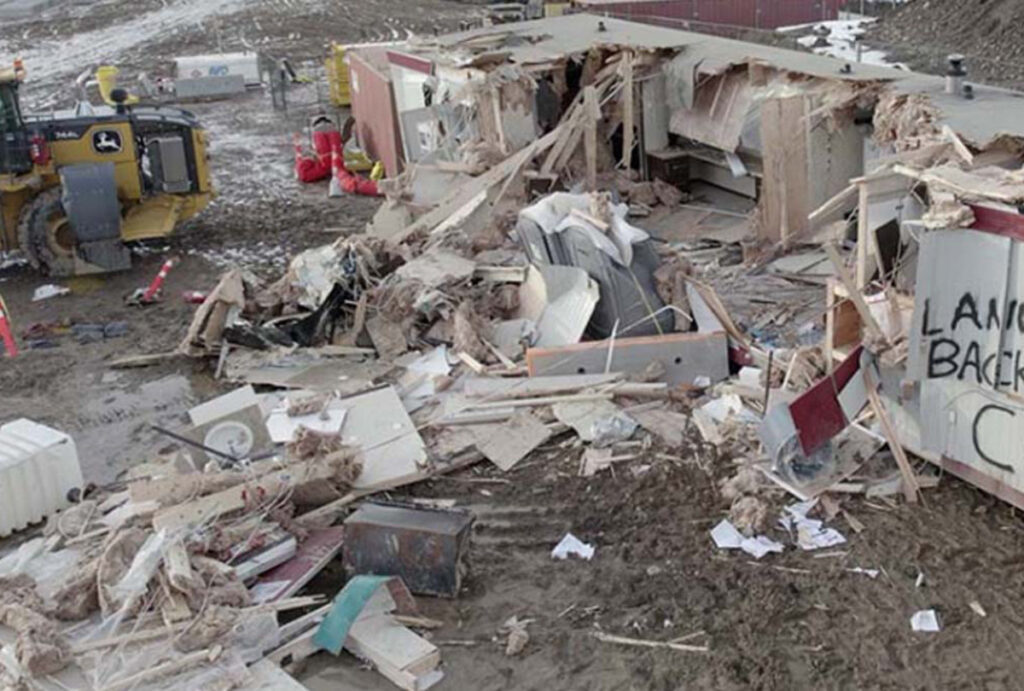
Fifteen to 20 masked individuals descended on the remote worksite overnight on Feb. 17, 2022, destroying $20 million worth property.
By Resource Works
More News and Views From Resource Works Here
Four years ago, in the darkest hours of the morning of Feb. 17, 2022, some 15-20 masked attackers invaded a worksite of the Coastal GasLink natural-gas pipeline in BC, and terrorized the workers.
The thugs wielded axes, swinging them at vehicles and through a truck’s window. As the 11 or so workers fled, some were briefly trapped in their vehicle while the invaders fired flares at them.
The terrorists went on to commandeer heavy equipment on the site, and used it to do an estimated $20 million in damage to contractors’ equipment and property, and to buildings and the drill pad. Trucks, including one in which a security guard was sitting, were damaged with axes.
One big trailer-building was spray-painted with “Land back” and “CGL evict.”
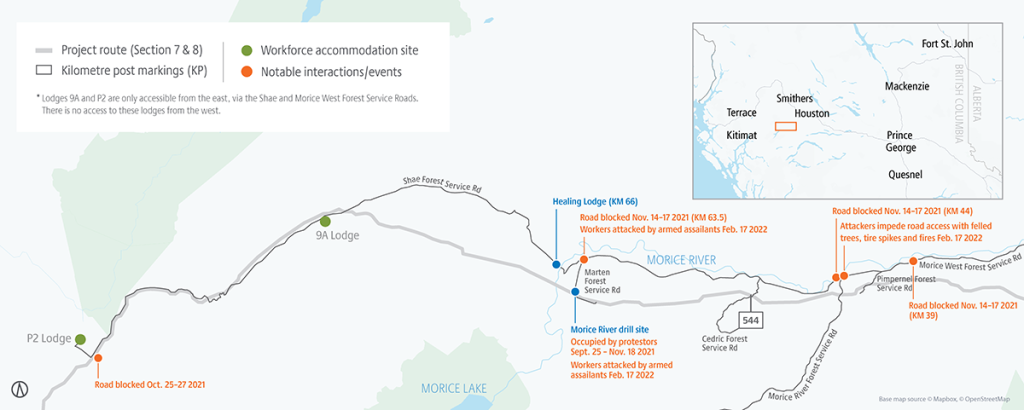
Coastal GasLink
A coordinated assault
On their way to the site, the assailants had placed a yellow school bus to block its access road. They also felled trees and set fires, and placed tire spikes on the Morice River Forest Service Road that serves the site. They used a grinder to open the chained-and-locked gate to the site, and disabled lighting and video surveillance equipment.
As RCMP responded to workers’ emergency calls, officers and their police cars encountered blockades. Smoke bombs and burning sticks were thrown at them as they approached the site. One officer was injured when stepping on one of several boards, placed by the attackers as booby-traps, that had nails sticking out.
Police said the masked attackers, all wearing white coveralls, escaped on snowmobiles.
Over time, police have identified a number of suspects, but there have been no arrests. RCMP say the investigation “remains active and ongoing.” The Independent Contractors and Businesses Association of BC and Crime Stoppers have offered a $100,000 reward.
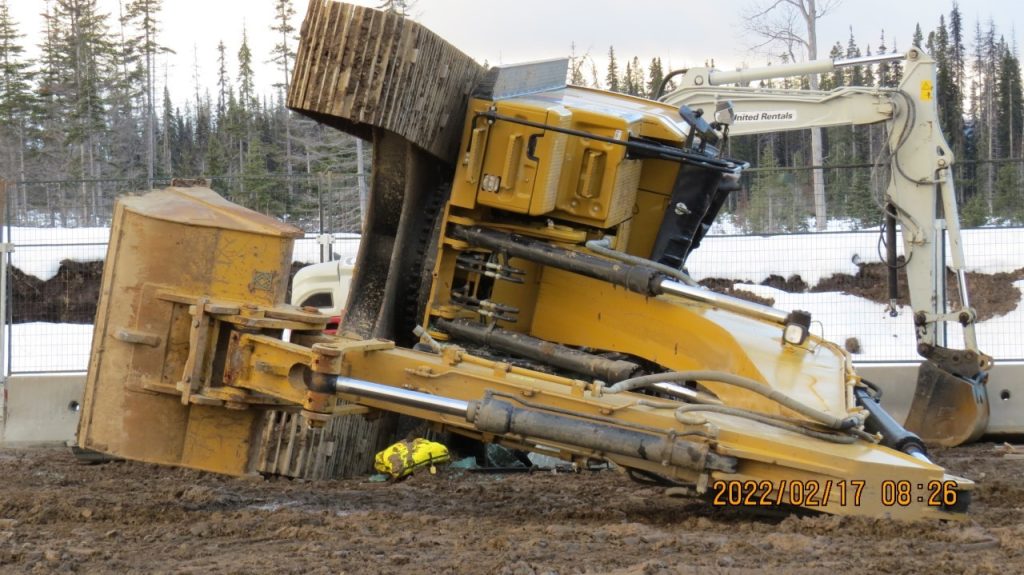
Aftermath of the midnight attack.
The root of the conflict
Coastal GasLink (CGL) and its equipment had been at the site to drill under the Morice River in north-central BC, to install part of the 670-km CGL pipeline to feed natural gas to the LNG Canada plant at Kitimat BC. (The river is known as Wedzin Kwa by the Wet’suwet’en people.)
The attack followed incidents in which people used forest trails to get to the site and confront and intimidate workers, and it followed blockades of the operation.
As early as 2010, while the CGL pipeline was a proposal but not a plan, members of the Wet’suwet’en Unist’ot’en clan set up the “Unist’ot’en Camp” and “checkpoint” at the Morice River Bridge. It was billed as a “decolonial healing centre.” Cabins were built along proposed pipeline routes.
A court injunction later prohibited people from blocking access to Coastal GasLink worksites. And in Feb. 2020, RCMP began to enforce the injunction by clearing blockades, dismantling checkpoints along the Morice service road and making arrests.
Then solidarity protests and blockades began across Canada.
Although CGL had benefit agreements with the elected councils of 20 Indigenous groups along the pipeline route, some Wet’suwet’en hereditary chiefs opposed the route through their traditional territory, over which they asserted Indigenous title. This created a sharp divide in the Wet’suwet’en community and led to protests and blockades.
Wet’suwet’en hereditary chief Na’Moks (John Ridsdale) said in 2021: “Even though they have started to illegally drill with illegal permits from the government of BC, the Hereditary Chiefs have never been supportive nor have given consent for this project. We will continue to oppose this pipeline using all means necessary, as it is our traditional law. No elected official nor an industry can overrule nor ignore our decisions as a nation who have never ceded, surrendered nor signed a treaty.”
CGL countered with this: “Our work is lawful, authorized, fully permitted and has the unprecedented support of local and Indigenous communities and agreements in place with all 20 elected First Nation councils across the 670-km route.”



And Wet’suwet’en hereditary leader Chief Wihaliy’te (Theresa Tait-Day) said her Nation was “disheartened” by what happened at the worksite. “We certainly don’t, as a Wet’suwet’en people, condone this type of action.”
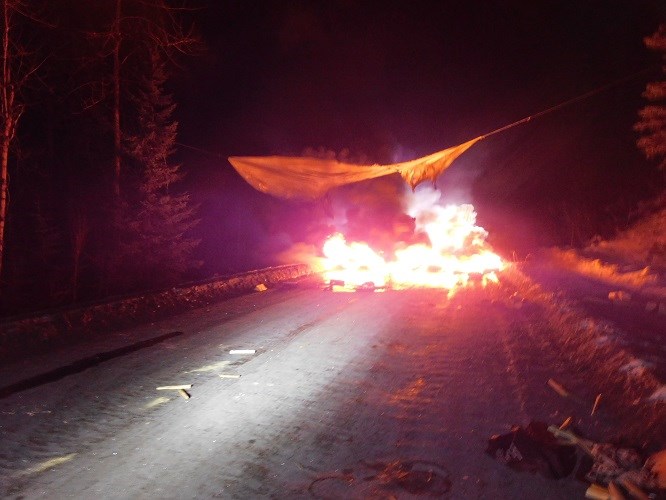
A fire is set to block this access road in the vicinity of the site.
She later went on to say: “Our community came to the world’s attention when a number of our hereditary chiefs loudly ]broadcast their opposition to Coastal GasLink, despite the fact that it has strong community support.
“These chiefs’ voices have been amplified by the skills and resources of outside
environmental activists, who say that they support the Wet’suwet’en but whose primary interest is stopping the pipeline.
“The protest organizers are conveniently hiding beneath our blanket as Indigenous people, while forcing their policy goals at our expense. This compromises our Nation’s social well-being and our people’s economic futures.
“They have held up the hereditary chiefs who oppose the pipeline as defenders of traditional governance, leaving the impression that the (elected) chief and council are running roughshod over the wishes of our community.
“It is not that simple. Hereditary chiefs in our communities do not rule alone. They make decisions collectively, gathered together in community halls. In these meetings, people are allowed to speak. An effort is made to work towards consensus. At the
end of the process, the community and band-elected chiefs inform the hereditary chiefs of the community’s message to be shared to the public.”
Surveys and referendums have indicated that as many as 80 per cent of Wet’suwet’en citizens supported CGL but many were and are reluctant to speak out due to the polarized environment.
On Nov. 14, 2021, some members of the Gidimt’en Clan of the Wet’suwet’en announced they were evicting CGL employees from Wet’suwet’en territory. Activists used heavy equipment to dig trenches in road surfaces and erect three blockades.
That afternoon, protesters blocked Canadian National Railway tracks near New Hazelton BC, and also blocked the highway. They said this was to support the eviction of CGL from Wet’suwet’en territory. Four trains were stopped before full service resumed.
Outside influence and the path forward
RCMP said local protesters with environmental and Indigenous land-rights concerns were infiltrated by “anarchist” outsiders who had been involved in other protests elsewhere in Canada and North America.
Spokespeople for the protests were often Indigenous citizens, and the protests had the support of some hereditary chiefs, but the majority of protestors were not Indigenous, Wet’suwet’en or from the region.
We then saw “solidarity” protests and blockades across Canada, including rail blockades that disrupted freight and passenger rail traffic.
And we saw environmentally focused media outlets amplify protestor messages and facilitate online crowdfunding campaigns. Philanthropic organizations, Canadian and foreign, provided substantial financial support. Some US organizations contributed tens of millions of dollars to anti-development campaigns in Canada.
The financial cost of the protests was significant, with millions spent on policing, legal defence, and economic losses from blockades and project delays.
Now we’re seeing a movement started by Indigenous citizens being adopted by the Shut Down Canada movement, attracting international attention, anarchist support and ideologically motivated violent extremists.
And today we’re seeing continued opposition from ENGOs (environmental non-governmental organizations) and activist networks as construction proceeds on the Prince Rupert Gas Transmission pipeline, which will feed natural gas to the Ksi Lisims LNG project in BC, in which the Nisga’a Nation is a partner.
Today, while the Coastal GasLink pipeline is in operation to LNG Canada (and is working on a connector to feed gas to the Haisla Nation’s Cedar LNG project) protests and court actions continue.
All this as the Canada Energy Regulator reports that Indigenous communities are increasingly becoming owners and leaders in energy projects, including LNG export projects, pipelines, and other LNG facilities.
“Overall, the growing role of Indigenous ownership in pipelines and LNG projects in Canada marks a significant shift in how major energy projects in the country are developed, financed, and managed.”
That message needs to be heard and accepted by the ENGOs, the protest groups, the foreign funders, and the activist hereditary chiefs.
Share This: