CDN NEWS |
  US NEWS







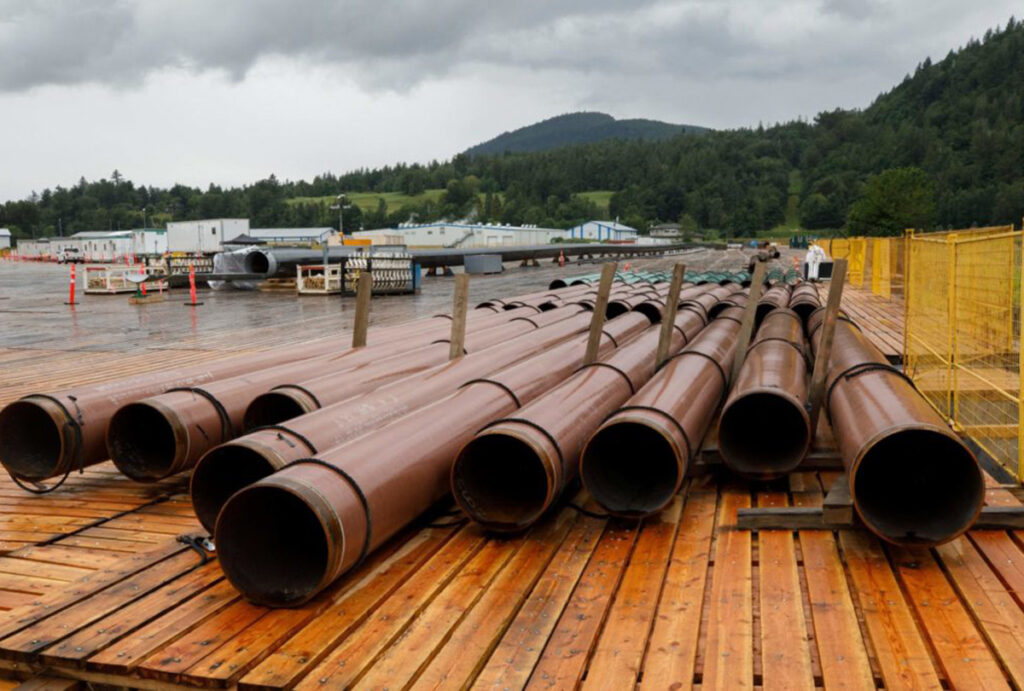
Pieces of the Trans Mountain Pipeline project sit in a storage lot outside of Abbotsford, British Columbia, Canada, on June 6, 2021. – The Trans Mountain Pipeline System is a pipeline that conveys crude and refined oil from Alberta to the coast of British Columbia, Canada. (Photo by Cole Burston / AFP) (Photo by COLE BURSTON/AFP via Getty Images)
By Katarzyna (Kasha) Piquette – Strategic Energy Advisor
Canada’s energy sector stands at a defining crossroads. On one hand, the country produces some of the world’s largest volumes of crude oil, with total production hitting a record 5.13 million barrels per day in 2024. On the other, Canadian producers have historically received far lower prices for their heavy crude than global benchmarks, a structural pricing gap known as the Western Canadian oil differential. This is not merely a theoretical issue of market economics. The differential represents real revenue left on the table, with direct, tangible consequences for industry investment, provincial budgets, and national fiscal strength. As global energy dynamics shift, the question is no longer just about closing the current gap, but about securing the infrastructure necessary to prevent billions more from evaporating in the future.
Understanding the Structural Discount
The primary crude benchmark for Canada’s oil sands heavy crude is Western Canadian Select (WCS), a heavy, sour blend priced out of Hardisty, Alberta. WCS routinely trades at a significant discount to West Texas Intermediate (WTI), the U.S. light sweet crude benchmark. While quality differences, heavy crude costs more to refine and is harder to move, account for some of this spread, transportation constraints have historically exacerbated the discount.
According to the most recent data from the Alberta Energy Regulator, the annual average WCS price was US $60.99 per barrel in 2024. In that same year, the WTI-WCS differential narrowed to approximately US $14.73 per barrel, down from a decade-average discount of about US $17 per barrel. While forecasts suggest this differential could average around US $11.00 per barrel in 2025, the gap remains a substantial economic hurdle.
The Cost of Constraints: Lessons from 2018
History provides a stark warning of what happens when production outpaces pipeline capacity. When producers cannot move crude efficiently, the differential widens sharply, transferring wealth from Canadian producers to foreign refiners. In late 2018, severe pipeline bottlenecks caused the WCS discount to spike to near US $50 per barrel. At that time, limited pipeline takeaway capacity forced producers to rely on higher-cost rail transport and limited export routes, squeezing margins and decimating government royalty revenues. This episode highlighted a critical reality: infrastructure constraints directly amplify pricing losses, turning a manageable quality discount into a crisis of market access.
The $21 Billion Equation
The economic impact of this differential is staggering when applied to Canada’s massive production volumes. Even conservative estimates put heavy crude production priced off the WCS benchmark at around 3.5 million barrels per day within the oil sands alone, with total heavy pricing affecting closer to 3.9 million barrels daily.
Let’s do the math: assuming a differential of US $15 per barrel, consistent with recent historical conditions, the lost price opportunity can be calculated as follows:



3.9 million barrels/day × US $15 = US $58.5 million per day
Annually: US $58.5 million × 365 ≈ US $21.3 billion per year
This is not a small accounting adjustment. It is a massive transfer of value. For the provincial government, the stakes are equally high. Alberta’s budget is highly sensitive to these fluctuations; it is estimated that every US $1 change in the differential impacts provincial revenues by approximately C$740 million.
How Tans Mountain Changed the Math
Pipeline capacity is not simply about moving volume; it is about optionality and pricing power. The Trans Mountain Expansion (TMX), which began commercial operations in May 2024, fundamentally altered the landscape. By increasing, TMX nearly tripled Canada’s west-coast export capacity. This additional capacity did more than just fill tankers; it eased constraints across the entire network.
Data confirms that the expansion directly contributed to narrowing the WCS differential by providing an alternative to the U.S. Midwest market. Canadian crude can now reach global buyers in Asia and beyond, forcing U.S. refiners to compete more aggressively on price. The narrowing of the differential from over $18 to near $11 is a testament to the value of market access.
The Case for Additional Capacity: Why One Pipe Isn’t Enough
While the completion of Trans Mountain is a historic achievement, it is not a permanent solution. Canada’s energy sector is growing, not shrinking. Statistics Canada reports another record year for crude production in 2024, and forecasts indicate continued growth in the oil sands. Without new takeaway capacity, the specter of apportionment, where pipelines are overbooked and crude is stranded, will return, likely widening the differential once again.
There is a compelling strategic case for further infrastructure expansion, potentially including new corridors to the west coast or expanded capacity to the south. First, the demand for heavy crude in Asian markets is robust. Refineries in China and India are specifically configured to process heavy grades, and they are seeking stable suppliers to replace declining volumes from traditional sources like Mexico and Venezuela. Second, continued reliance on a single major customer—the United States, which buys the vast majority of Canada’s oil—leaves the Canadian economy vulnerable to U.S. policy shifts and price dictation.
Alberta has already signaled interest in exploring additional export avenues. Recent discussions regarding indigenous-led pipeline initiatives and new corridor concepts suggest that stakeholders recognize TMX should be a beginning, not an end. The economic opportunity cost of delay is severe. If production growth outpaces capacity by even a small margin, the differential could easily slip back by US $5 per barrel. As the math shows, that $5 slip would cost the Canadian economy over $7 billion annually—money that could otherwise fund healthcare, education, and green energy transition projects.
The Western Canadian differential is not fixed by geology; it is shaped by market access and transportation capacity. At current production rates, the pricing gap represents over US $21 billion annually in unrealized revenue. Even modest improvements in market access yield significant real gains for provincial and federal budgets.
Infrastructure matters because it improves pricing power. Timing matters because lost revenue compounds over years. Opportunity cost matters because every year of constrained access leaves billions on the table.
For a country whose energy sector remains a major pillar of national income, pursuing the next phase of strategic pipeline capacity is not just an industrial ambition, it is an economic imperative.
Share This: