CDN NEWS |
  US NEWS








Canada’s headline inflation rate slowed to 2.3% last month, cooler than economist expectations for 2.4%, as gasoline prices fell on a yearly basis.
Statistics Canada’s consumer price index report on Tuesday showed the rate edging down a tick from 2.4% in December.
The consumer price index was flat on a monthly basis. Economists surveyed by Bloomberg were expecting prices to rise 0.1% from a month earlier.
The deceleration in annual price growth is attributed to a gas price base-year effect, as prices at the pump rose 0.5% month-over-month in January, compared with a 4% increase the same month last year. Gas prices dropped 16.7% on the year.
Meanwhile, the federal government’s temporary sales tax holiday on a range of products last year, such as restaurant meals and children’s toys, continues to push up the headline inflation rate.
The Canadian dollar touched the day’s low of C$1.3665 per US dollar, while bond yields also fell to session lows after January inflation report. The loonie was trading in the weakest level in a week, declining for a fifth session.
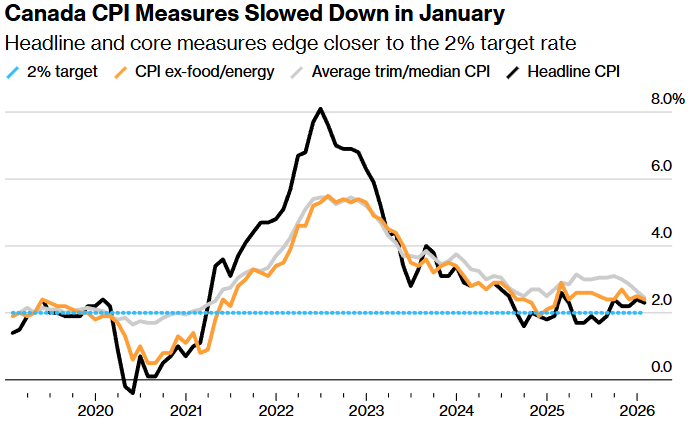
Source: Statistics Canada
While the report shows signs of inflationary pressures easing, it is unlikely to move the Bank of Canada from the sidelines as it continues to evaluate how US tariffs are affecting the economy. The central bank kept its policy rate at 2.25% last month for the second consecutive meeting and has signaled an aversion to juicing demand too much right now.
In a speech earlier this month, Governor Tiff Macklem warned cutting interest rates while the economy experiences a supply-side shock could stoke inflation.



The Bank of Canada’s preferred measures of core inflation decelerated, with the median gauge edging down to 2.5% from 2.6%, and trim falling to 2.4% from 2.7%.
Bank of Montreal chief economist Douglas Porter called the release “an encouraging result for the Bank of Canada, with inflation finally nearing the 2% target on a broader basis.”
“Still, the bank has made it abundantly clear that the bar to cut rates again is quite high,” Porter said in a report to investors.
While tariffs continue to fuel uncertainty for businesses and workers, Tuesday’s data included some positive silver linings for consumers.
Shelter price inflation slowed to 1.7% on an annual basis last month, marking the first time the measure has dropped below 2% in nearly five years. The slowdown was driven by a deceleration in rent prices and mortgage interest costs.
Cellular services prices fell on a month-over-month basis, declining by 0.8%, compared to an 8.3% increase in January 2025.
Grocery prices also rose at a slower pace, increasing 4.8% year-over-year compared with a 5% annual rate in December.
“The report is unlikely to be a source of worry for the Bank of Canada. Inflation is well within its target and underlying inflationary pressures are weak,” Charles St-Arnaud, chief economist at Servus Credit Union, said in an email.
“There is not much the Bank of Canada can do regarding continued acceleration in food prices, since it is driven by global prices. Nevertheless, it will need to be monitored given its possible impact on inflation expectations and holding back purchasing power.”
— With assistance from Mario Baker Ramirez and Anya Andrianova
(Adds more economist comment starting in the ninth paragraph.)
Share This: