CDN NEWS |
  US NEWS







Orginal Story from Financial Post Here

When Irfhan Rawji decided to launch his startup in Calgary back in 2018, the city’s allure was undeniable. With eager venture capitalists, a strong pool of top talent and a lower tax burden, the city was, by all accounts, a great place to start a business.
And MobSquad, a technology consulting firm, took off. It went on to launch other offices in Vancouver, Toronto and Halifax.
“(Calgary) wanted to build a place with great culture, with great support, with great quality of life,” Rawji said.
“The entire ecosystem, whether that’s community members and community organizations, to politicians to the universities, were all talking about wanting to build a bigger innovation economy. That energy made it a great place to found a business.”
Calgary remains among the top headquarter cities in Canada — the share of its workforce employed at head offices continues to outpace other major centres such as Toronto, Montreal, Edmonton and Vancouver.
But Calgary has been losing ground.
Even as MobSquad and other tech companies have thrown down roots in the city, the energy capital has been shedding head office jobs.
Calgary has about the same number of corporate headquarters as it did in 2012 — roughly 220 — but employment at those office behemoths is down by 5.5 per cent, to about 29,800 staff in 2024.
One major driving force behind this shift in head-office employment is the energy sector. For about a decade, it has consolidated, with a plethora of mergers and acquisitions, and has also carried out a relentless drive for efficiency to make more money with fewer suits, experts say.
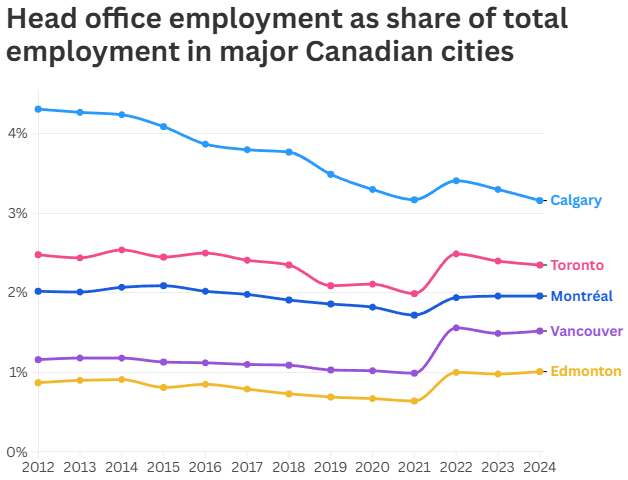
Source: Statistics Canada head office survey, labour force characteristics • Steven Wilhelm, Calgary Herald
Talk of separatism creates instability, says startup founder
But Rawji worries that a campaign pushing to have Alberta to separate from Canada — waged by activists who remain a minority in the province — could make the issue even worse.
“The talk of Alberta potentially separating has reduced stability, which I think will impact the decision for people to locate their head offices here, and potentially even keep them here,” Rawji said.
Although Rawji doesn’t think Alberta will actually separate, he points to an exodus of corporate headquarters from Montreal to Toronto decades ago, amid fears that Quebec could have voted to leave the country.
However, with talk of separatism in the prairie province being relatively fresh, it’s too soon to know how it could affect Calgary’s corporate headquarters numbers.
In recent years, other cities across the country, including Montreal and Toronto, have seen their numbers of corporate headquarters decline, while Vancouver and Edmonton have posted double-digit increases.



Head offices in major Canadian cities
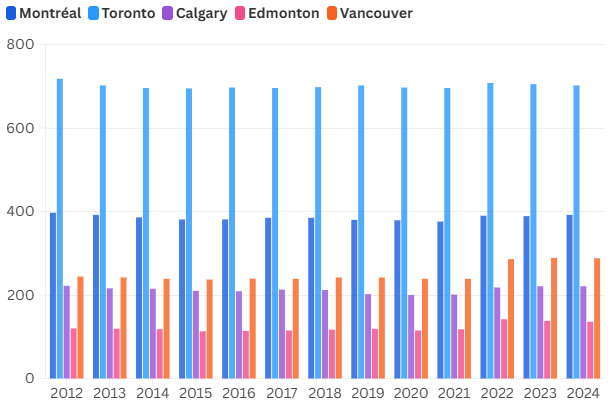
Source: Statistics Canada head office survey • Steven Wilhelm, Calgary Herald
Having a high concentration of corporate head offices doesn’t just mean more C-suite executives and fancy suits in Calgary — it also spurs activity beyond the crystal walls of a single office tower, according to Charles St-Arnaud, chief economist with Servus Credit Union.
“Those head offices also need services, whether it’s accounting services, consulting, law firms — it brings a whole ecosystem of professional services,” St-Arnaud said. “Those are well-paid jobs that bring a lot of economic activity to the city.”
Deborah Yedlin, chief executive at the Calgary Chamber of Commerce, said when companies have a head office in a city, they don’t become simply a “line item in a balance sheet.”
“You’re committed to the community that you are making your business in,” Yedlin said. “You’re embedded in Calgary, and whatever happens in Calgary is really important to you.”
St-Arnaud noted Imperial Oil Ltd.’s pending closure of its Calgary headquarters — which represents a loss of around 900 jobs in the coming years — as a symptom of the broader shift among the city’s energy sector.
“We’ve seen a big reduction in the sector. We’ve seen a lot of consolidation. We’ve seen some companies leaving Calgary,” St-Arnaud said. “Most of the energy companies, especially the oil and gas sector . . . they’re trying to cut costs.”
Even beyond the oil and gas industry’s wave of mergers and acquisitions, other large companies, such as Shaw Communications Inc. — which merged with Toronto-based Rogers Communications Inc. in 2023 — are no longer headquartered in Calgary, St-Arnaud added.
Calgary ‘gaining hundreds of emerging’ corporate offices, says venture capital executive
From 2012 to 2024, the number of command posts in Calgary has declined by just one, the data show.
Harish Consul, chief executive of venture capital firm Ocgrow Ventures, said the data reflect a rapid diversification of Calgary’s economy and an evolution of corporate offices.
“These are founder-led companies, and a lot of decisions across the country are now being made from here in Calgary,” Consul said. “So instead of a few larger legacy headquarters, Calgary is really gaining hundreds of emerging ones.”
Consul said the dip in head office staff is probably due to companies using things such as AI and tech outsourcing to optimize or automate certain functions.
“It allows more companies to start and flourish here,” Consul said. “You’re seeing far (more) smaller companies and mid-sized companies than the traditional legacy head office companies.”
“I see that trend continuing, and it bodes really well for Calgary’s digital economy,” Consul added.
But the separatist threat has created a cloud of uncertainty, said Rawji, who worries that even talk of cession amounts to “shooting ourselves in the foot,” when it comes to attracting corporate headquarters and talent.
If he were to do it all again with MobSquad, he said, fears of separatist-driven instability might have made him think twice about setting up shop in Calgary.
“Right now, I don’t know that we would have made the same decision,” Rawji said.
[email protected]
Share This: