CDN NEWS |
  US NEWS







By Ron Wallace
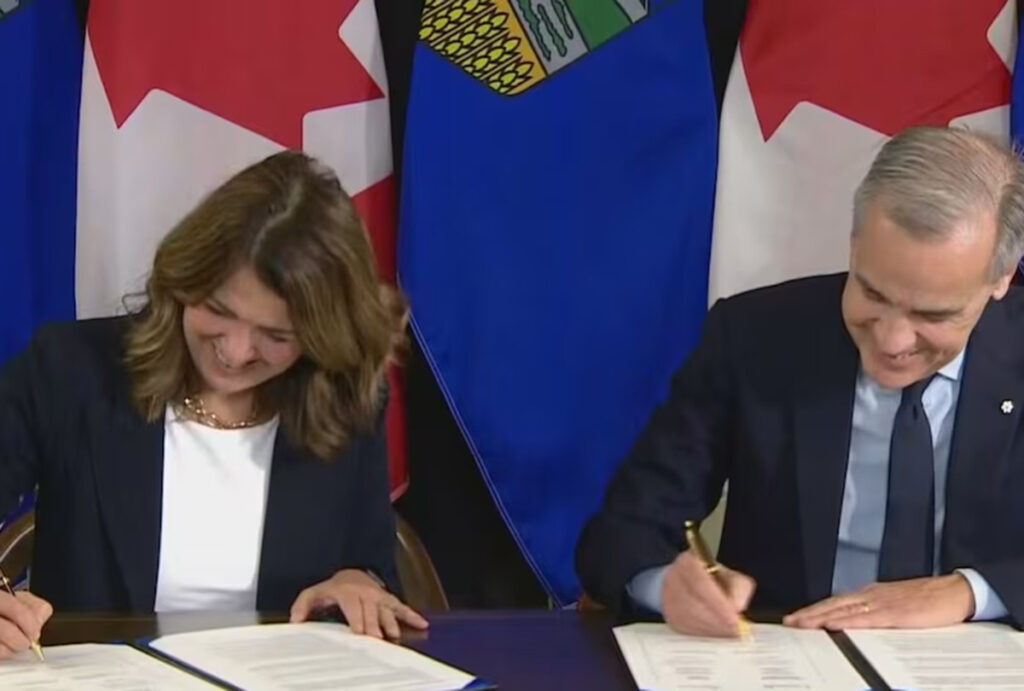
In a three-part series, former National Energy Board Member, Dr. Ron Wallace, examines the history and factors that have led to the signing of the Canada-Alberta MoU.
LINK TO PART 1
Part 2 of 3: The “Bad”
If the “rule of law” in Canada is meant to provide the certainty and predictability that capital demands, it is failing spectacularly. Investors seek clear title and dependable contracts. Canada is increasingly delivering the opposite. Investors don’t witness stability – they witness a fractured federation, a weaponized bureaucracy, and a legal system that injects profound uncertainty into the most basic elements of capitalism, like property rights. Richard Ciano, November 15, 2025.
While definitive agreement on conditions embedded within the six-page text of the MoU have yet to be negotiated, a process that may yet test the good faith and intentions of both parties, there is the significant realization that there is an agreement, at least in principle, to work together to reach net-zero emissions by 2050. The developing pact also extends into areas such as methane emissions, electricity interties, data centres, nuclear power and appears to be a backstop for possible Indigenous co-ownership of a new bitumen pipeline.
With a contrarian view, Terrance Corcoran characterised the MoU as a “Memorandum of Disunderstanding” one in which “disunderstanding occurs when two conflicting sides in politics deliberately claim to have reached an understanding when in fact there is no agreement beyond acknowledging and identifying the key areas over which there is ongoing disagreement rather than understanding.”
Given concerns related to vague, or perhaps even contradictory, language in the MoU as with any negotiation devils always lurk in the details. As legal expert Andrew Roman observed:
“The MOU contains several cleverly worded provisions that are pipeline-investment killers. The single most effective one is about the West Coast tanker ban. The MOU says that if the pipeline is ultimately approved, then an export provision will be enabled; but only “if necessary” and “through an appropriate adjustment” to the tanker ban law. Anyone spending tens of millions of dollars just to gain approval to start construction will want certainty before making any investment that it will be legal to transport the product to markets, and that enough tanker capacity will be authorized to match the pipeline’s capacity. The MOU’s backward sequencing is clearly an investment killer. What if Ottawa decides no change is “necessary?” And whose opinion determines what’s “appropriate?” Everything is totally discretionary. The required private-sector investor has no way of knowing whether there will be sufficient tanker capacity to justify an investment. So why bother trying to get one approved?”
A crucial requirement of the MoU will be for the two sides to work with the Pathways Alliance group of oilsands operators to reach a tri-lateral MoU for a proposed massive carbon capture network in northern Alberta. That CCUS system is, in turn, predicated upon a pledge by the Smith government to raise its carbon tax on heavy industrial emitters to an effective “headline” rate from $95 to $130 per tonne. Any agreement to enter an industrial carbon pricing system for oil production – with yet unrevealed details and costs – would bring associated, material implications for Alberta’s gas and electricity sectors. Have these costs been broadly assessed for Alberta businesses and consumers? Another, apparently overlooked, consideration is that the MoU does not appear to contain eligibility for the participation of Canadian manufacturers of carbon capture technologies in the Clean Technology Manufacturing (CTM) Investment tax credit.
The MoU sets out a requirement for a carbon-pricing-specific agreement (due on April 1, 2026), one that would see the federal government “suspend” the planned oil-gas emissions cap and Clean Electricity Regulations. Negotiations for $130-per-tonne “effective credit price” for industrial carbon emissions could prove problematic because the two levels of government could be calculating that figure in different ways. Energy Minister Tim Hodgson claims that the realised Alberta carbon price would be “far above” the current market price of roughly $20 per tonne, claiming that the MoU “means more than a six-times increase in the industrial price on carbon from its effective level”. Meanwhile, Alberta and some senior bureaucrats appear to be using another figure relative to the current $95-per-tonne price that the province collects from large emitters – making the new $130-per-tonne level appear to be a much smaller price increase.



Simon Donner at the University of British Columbia, who recently stepped down from his role as co-chair of the federal government’s climate advisory group, commented:
“It’s not clear to me, if you listen to the speeches from Premier Smith and the prime minister, they are really talking about the same thing, and so I get a feeling that this negotiation isn’t finished — that they haven’t really come to an agreement yet.”
While public attention has largely focused on the MoU, largely forgotten in the Alberta debate are the other material measures ongoing by Canada to meet objectives under the Paris Agreement. For instance, the Pan-Canadian Framework on Clean Growth and Climate Change and the 2030 Emissions Reduction Plan contain numerous, costly measures designed to reduce carbon emissions. While the MoU may, at least in part, effectively be designed to offset, or perhaps add to, these Regulations it remains to be seen whether a comprehensive agreement on emissions and pricing can in fact be achieved or maintained. The noisy resignation of Minister Guilbeault may signal that this debate is far from concluded within the Federal cabinet.
Despite these costly, ongoing policy and regulatory measures, Canada remains far off its proposed trajectory to reach its goals for emissions reductions with a growth of approximately 75 per cent of fossil fuel use in its energy supply. As Morgan noted:
“That dismal result wasn’t for lack of trying. The Fraser Institute has found that Ottawa and the four biggest provinces have either spent or forgone a mind-numbing $158 billion to create just 68,000 “clean” jobs, increasing the “green economy” by a minuscule 0.3 percentage points to 3.6 per cent of GDP – at an eye-watering cost of over $2.3 million per job.”
Will the MoU require costly “decarbonization” measures that will ultimately disadvantage Canadian oil producers? Emissions Reduction Alberta and Natural Resources Canada estimate that the “foundational” Pathways Alliance CCUS project network, pivotal to the MoU, is expected to reduce net CO₂ emissions by about 13.9 megatonnes (Mt) and capture up to 4.2 Mt CO₂ per year by 2030. Assuming a full build‑out of more than 20 capture facilities tied into the network, it would potentially capture up to 62 Mt CO₂ per year by 2050. In 2021 Canadian national emissions reached 708 Mt. At an estimated cost of from $16.5 to $24 billion the Pathways project would achieve national CO2 reductions estimated at 13.9 Mt (~2% of national emissions) to 62 Mt (≈ ~9% of national emissions). Coming at a time of declining oil prices these are serious costs, considerations that have led some to question the project economics of CCUS, not just for power generation, but specifically for the production of “decarbonized” oil from the Pathways project.
As Bennett observed, the MoU having effectively become part of Canada’s climate change strategy now appears to join policy and investment at the hip with two pipelines – one for oil and another for carbon dioxide:
“The MOU signed between Ottawa and Alberta two weeks ago ties a new oil pipeline to the Pathways Alliance, which includes what has been billed as the largest carbon capture proposal in the world. One cannot proceed without the other. It’s quite possible neither will proceed.”
Does the “grand bargain” embodied in the MoU, one that hinges so significantly on the “decarbonization” of Western Canadian oil, clarify the Canadian regulatory environment for major investors? Or does it instead threaten the economic viability of Alberta oil production without meaningfully reducing Canadian or global CO2 emissions?
Many economists warn of an increasingly fragile future for Canada, pointing to persistent deficits, rising debt‑service costs and chronically weak private‑sector investment. The Parliamentary Budget Officer, the Fraser Institute and federal fiscal data point to concerns about risks to long‑term sustainability. Since 2015 Canada has experienced a flight of investment capital approaching CAD$650 billion due to lost, or deferred, resource projects – particularly in the energy sector. While many economists are concerned about a fiscal future in which Canada drifts into a structural deficit environment, the Carney government appears to ignore these figures while they implement industrial policies that, for all intents and purposes, represent a significant regression into central planning. Will these policies and the MoU make Canada an “energy superpower”?
At a time when Canada’s fiscal trajectory is so worrisome, it would be unfortunate if public subsidies were required to help “decarbonize” Alberta oil. Carney’s November 2025 “Canada Strong” federal budget sets out $141.4 billion in new spending over five years with a projected $78.3 billion deficit for 2025–26. As Jack Mintz points out, while that budget claims to be “spending less to invest more”, annual capital spending is predicted to double from $30 billion a year to $60 billion a year over five years. As Mintz has argued, “state capitalism” employed in the name of “nation building” does not have a history of success. Will an MoU based on the production of “decarbonized” oil suffer the same fate?
Share This: