CDN NEWS |
  US NEWS







However, we need to stop debating about pipelines and just build one if our oil industry is to thrive down the line.
By Geoff Russ
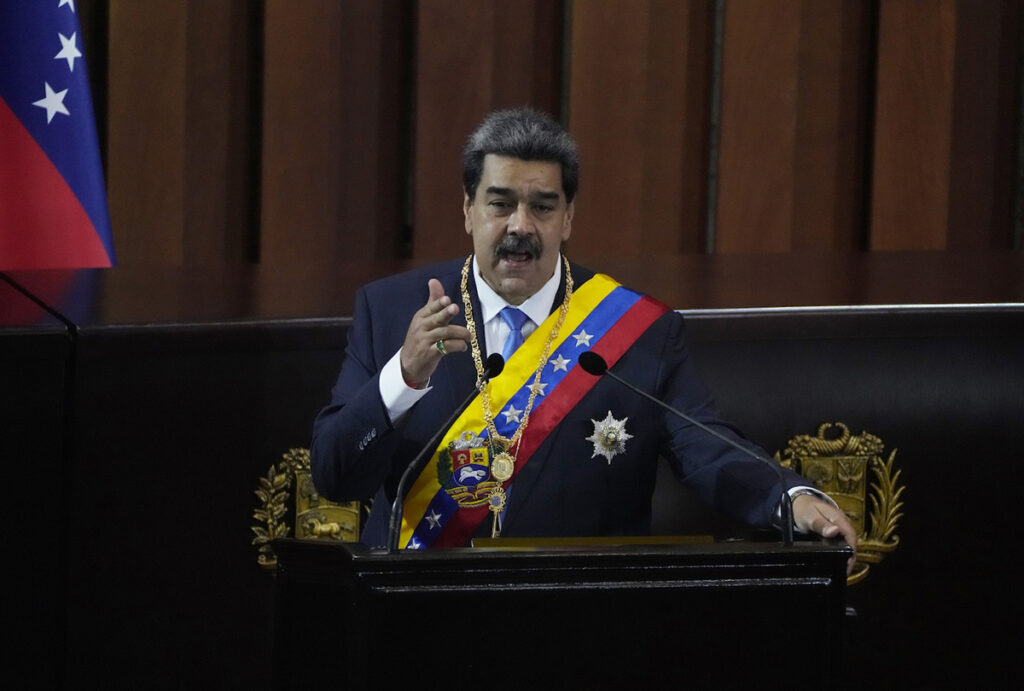
Venezuelan President Nicolas Maduro speaks during a ceremony marking the start of the judicial year at the Supreme Court in Caracas, Venezuela, Tuesday, Jan. 31, 2023. Supreme Court President Gladys Gutierrez stands second from left. (AP Photo/Ariana Cubillos)
By Resource Works
More News and Views From Resource Works Here
Canada’s pipeline debate has a habit of looping endlessly, right up until the world reminds Ottawa, and the provinces, of what energy security looks like when it breaks.
The weekend capture of Venezuelan leader Nicolás Maduro, and U.S. President Donald Trump’s declaration that the United States would take control of Venezuela’s oil sector, is the latest reminder. It has also exposed, again, how vulnerable Canada remains when almost all of its oil exports still move to one customer.
The market reaction on Monday, January 5, 2026, was immediate.
Canadian energy stocks sold off, with Canadian Natural Resources, Cenovus Energy and Suncor all taking steep losses, as investors tried to price in the risk of Venezuelan barrels returning to U.S. refineries.
A massive overreaction?
Eric Nuttall of Ninepoint Partners called the selloff a “massive overreaction,” arguing Venezuela’s production cannot rebound quickly after “many years of chronic underinvestment,” and that global demand will still require every barrel Venezuela can produce, as well as Canada’s.
Others were more measured, but pointed to the same strategic weakness.
BMO’s Randy Ollenberger warned that if U.S. capital flows into Venezuela and heavy oil starts moving to Gulf Coast refineries, Canada could be forced to place more of its crude elsewhere, and “we have some pipeline capacity to the West Coast that’s available, but not enough to fully move that oil.” He framed the potential displacement risk as a medium-term issue, not an overnight shock, with a meaningful impact taking 24 to 36 months.



The long road to recovery
CTV News reporting over the same weekend underscored why markets should not assume a quick Venezuelan revival. Heather Exner-Pirot, director of energy, natural resources and environment at the Macdonald-Laurier Institute, said, “Just because they have oil in the ground doesn’t mean that they can get it out logistically,” pointing to Venezuela’s corruption, violence, and deteriorated production base, while also noting the Rubio backtracking that signalled Trump’s threat was just that, a threat.
Another report noted the infrastructure has been decaying for years and would require major investment and a stable political regime before international oil companies pour in capital, with analyst Francisco Monaldi estimating roughly a decade and about US$100 billion to lift output toward four million barrels per day.
Stop talking, start building
For Canada, the lesson is not to panic about Venezuela and stop pretending that talking is a substitute for building.
That theme has been building across 2025. Trump’s tariff threats and trade uncertainty exposed how dependent Canadian oil exports remain on the United States, and called for pipelines to more than one coast to reduce exposure.
By June 27, Exner-Pirot took on the claim that Canada “will never build another pipeline,” pointing to a project already moving ahead, the Prince Rupert Gas Transmission line intended to feed the proposed Ksi Lisims LNG project, after B.C.’s Environmental Assessment Office confirmed its certificate remains valid.
In early July, Prime Minister Mark Carney, speaking at the Calgary Stampede, said a new pipeline to the West Coast was “highly likely,” after discussions with premiers that included Alberta’s proposed “grand bargain” of a privately funded line and green investment.
The political combat
By December, the debate had moved from theory to open political combat.
A CKNW panel hosted by Mike Smyth featured B.C. Green leader Emily Lowan calling a new Alberta to B.C. oil pipeline a “fantasy,” while Resource Works’ Margareta Dovgal argued market access is central to affordability and national unity. If one thing is clear, it is that Canada will not fix affordability by blocking its own economic potential.
Venezuela is not Canada’s problem to solve. Canada’s problem is Canada’s habit of indefinite process. Events in Caracas, and the market jitters they triggered in Toronto, are another flashing warning light. If leaders now believe a West Coast pipeline is necessary to diversify away from U.S. leverage, they should stop treating it as a permanent talking point and start treating it like infrastructure.
The country has done enough debating to last a decade.
Share This: