


 CDN NEWS |
  US NEWS







Soil samples in province show stronger results than in Quebec and Ontario
By Andrew Rankin
Original Article Appeared in Financial Post Here
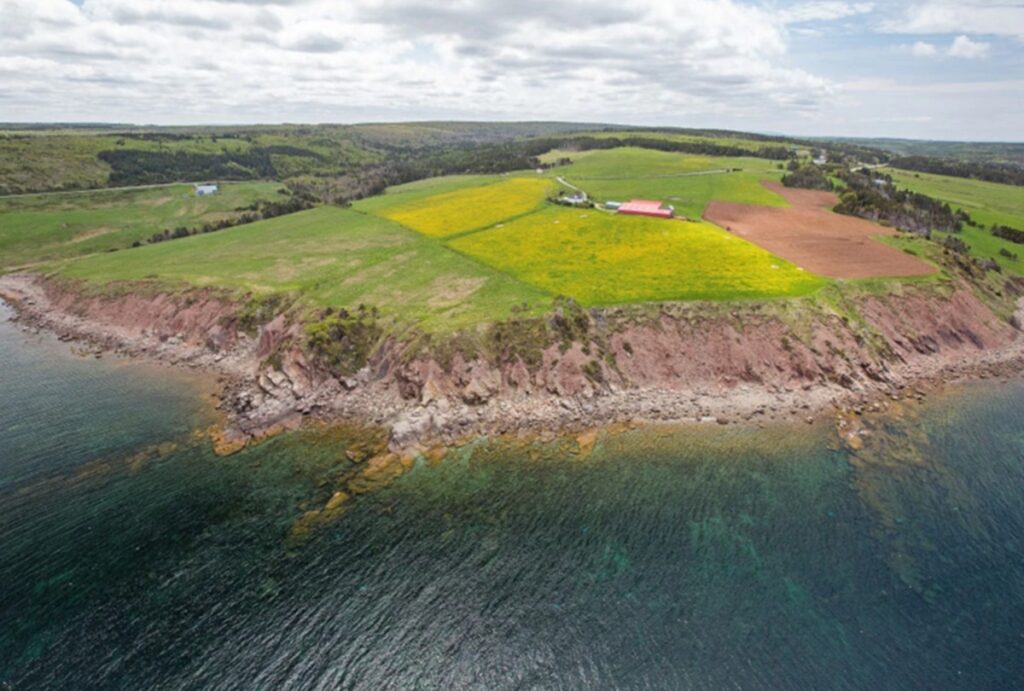
The rapid expansion of claim staking in Nova Scotia has fuelled speculation that the area’s geology could host commercially recoverable hydrogen. Photo by Province of Nova Scotia
Nova Scotia is staking a claim in the Canadian white hydrogen race as a surge of companies floods Cumberland County to explore whether the naturally occurring resource can be turned into a viable industry, joining efforts already underway in Central and Western Canada.
Over the past year, thousands of new mineral claims have been registered across the province as companies position themselves to make and exploit potential discoveries. One is Koloma Inc., a Denver-based natural hydrogen company backed by investors including Jeff Bezos and Bill Gates through their respective venture funds.
The global white hydrogen market is projected to jump to US$56.8 million in 2030 from $39.2 million in 2024, according to a report from BCC Research.
Interest in natural hydrogen is growing across Canada. Last month, Max Power Mining Corp. completed the country’s first well specifically targeting natural hydrogen near Central Butte, Sask. In Ontario, the Timiskaming District is being explored for its hydrogen potential, while parts of the Western Canadian Sedimentary Basin are promising for natural hydrogen generation and storage, according to an InnoTech Alberta study released in October.
The rapid expansion of claim staking in Nova Scotia has fuelled speculation that the area’s geology could host commercially recoverable hydrogen, even as experts caution that early land grabs are no guarantee of success.
Energy analyst Heather Exner-Pirot said Nova Scotia’s white hydrogen activity is at the early research stage instead of something that will pay off soon. She said there is value in allowing private companies to drill and test the geology because the resource potential remains uncertain until that work is done.
“While locally used white hydrogen could eventually support small-scale regional development, it is unlikely to become a major economic driver for Nova Scotia in the near term,” she said.
White hydrogen, also known as natural hydrogen, is a gas that occurs underground rather than being cracked from water using electricity or burning fossil fuels. It is generated by geological processes deep in the Earth’s crust and can migrate upward along faults.
Proponents say it could offer a low-carbon and relatively inexpensive energy source, but the resource remains largely unproven at a commercial scale.
White hydrogen has long been touted as a potential power source, but challenges such as limited confirmed reserves, high exploration and extraction costs, and a lack of established infrastructure have so far prevented it from becoming a viable, large-scale energy option.
Exner-Pirot said staking rush aside, Nova Scotia has some challenges in becoming a major hydrogen exporter, particularly compared with areas closer to large markets or existing infrastructure, such as Alberta and Saskatchewan.
Transporting hydrogen is costly, she said, and building new systems from scratch can cancel any economic advantage over conventional fuels. Still, she believes hydrogen has potential over time.
“In 20 years, hydrogen will play a bigger role than it does today,” she said. “The medium- and long-term prospects for hydrogen are good,” she said.



One of the companies pushing ahead is Québec Innovative Materials Corp. (QIMC), which holds more than 3,000 exploration claims covering roughly 428 square kilometres in the Cumberland Basin.
Chief executive John Karagiannidis said there’s skepticism around white hydrogen, but that the doubts are typical of emerging industries.
“Of course, there are always naysayers when you’re first movers in an industry,” he said. “What we know is that it’s possible to extract hydrogen as a primary source, because it exists; it’s been there for 12 years.”
Karagiannidis said QIMC’s strategy differs from traditional energy projects by tying hydrogen extraction directly to local energy use, particularly off-grid power for artificial intelligence (AI) data centres.
“As you’re building the off-grid energy, you’re scaling up at the same time the AI data centre scales up,” he said.
Community feedback has shaped the approach, Karagiannidis said, including assurances that “there’s no fracking here” and that local residents want the energy produced to be used locally.
He said initial drilling in Eatonville, N.S., about 250 kilometres northwest of Halifax, is expected early this winter, and that a small-scale data centre pilot project using hydrogen to power AI systems could follow within three to six months, depending on the results.
The company doesn’t have any offtake agreements yet, but is in discussions with some of the biggest names in the AI industry, he said.
Additional wells would follow as subsurface data guides expansion, he said.
“That drill hole then is going to lead us into the positioning of the second drill hole, the third drill hole and then the multi-phase approach,” he said.
Richard Ursino, QIMC’s director of operations, said soil samples of hydrogen in Nova Scotia have been very promising so far, some more than 4,000 parts per million, which are stronger results than those seen in Quebec and Ontario.
He said hydrogen is a primary, renewable energy source.
“You’re not producing it with electricity; it’s constantly being generated underground,” he said.
Ursino said QIMC is targeting AI data centres as early customers because they require massive amounts of electricity and often cannot rely on existing power grids.
“We’re scaling the hydrogen extraction alongside off-grid energy production,” he said, adding that demand is likely to follow once local energy becomes available. “If you have the electrical energy, then you can entice pretty much anyone to come there.”
Email: [email protected]
Share This:






















COMMENTARY: Ottawa Provides Glimmer of Hope and Streamlines Review Process for Energy Projects