


 CDN NEWS |
  US NEWS







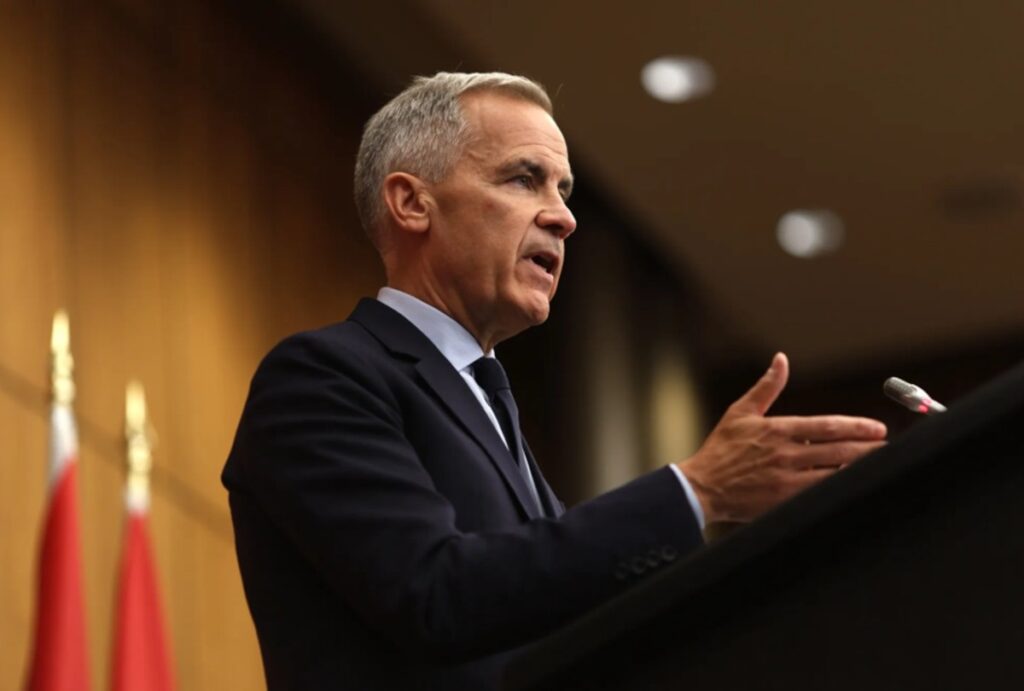
In his first months as Prime Minister he has shown signs of pragmatism compared to his previous rhetoric
Goldstein: See all the all the articles from Lorrie Goldstein Here
Prime Minister Mark Carney has the opportunity to craft a climate policy that makes sense to Canadian taxpayers – versus the political insanity of the Justin Trudeau era – but the question is whether he is ultimately a pragmatist or an ideologue.
Prior to becoming PM, Carney was definitely an ideologue on climate change.
As the United Nations Special Envoy on Climate Action and Finance, and co-chair and founder of the Glasgow Financial Alliance for Net-Zero, Carney argued carbon taxes were too low, and that his organization was “relentlessly, ruthlessly, absolutely focused on the transition to net zero” emissions of industrial greenhouse gases.
But in his first months as PM, Carney has shown signs of pragmatism compared to his previous rhetoric.
No doubt he’s aware that for Canada to achieve net zero emissions on Trudeau’s timelines it would devastate our economy, given that we are a big, cold, northern country with a relatively small population and huge oil and natural gas resources that form a significant part of our economy.
Early indications of Carney’s shifting stance were his decisions to eliminate Trudeau’s consumer carbon tax and Trudeau’s mandate that at least 20% of all new vehicle sales had to be zero emission starting next year.
His government is now conducting a 60-day review of Trudeau’s 60% target for 2030 and 100% target for 2035 to “consider potential amendments to the annual sales targets … and explore possible additional flexibilities.”
Meanwhile, Carney has not committed to Trudeau’s targets of reducing Canada’s emissions to at least 40% below 2005 levels by 2030 and 45% by 2035.
While the government remains committed to achieving net zero by 2050, in reality that won’t be decided by any of our current crop of political leaders.
Carney’s initial announcement of five “nation building” projects last week did not include any new oil and gas pipelines, but he hasn’t ruled out government support for them in future if they’re feasible and if the proponents take measures to curtail emissions.
Alberta Premier Danielle Smith, who frequently clashed with Trudeau on this issue, has praised Carney for his openness to new pipelines and both have described their recent meetings on this and other issues as positive.
The Reuters news agency reported last week, based on sources, that Ottawa is in discussions with energy companies and the government of Alberta about eliminating Trudeau’s cap on emissions, if they reduce their carbon footprint in other ways, such as carbon capture.



Carney’s evolving positions on climate change have certainly been noticed by his own Liberal MPs, with some expressing concern he is backing away from Trudeau’s commitments and his own positions prior to becoming PM.
That’s one of the reasons for the creation of a Liberal caucus on climate change.
Senior Trudeau advisor Supriya Dwivedi complained in a Toronto Star column last week that Carney isn’t who he said he was when running for PM and that “environmentalism – a core value of Carney’s – seems to have completely fallen by the wayside” on climate change.
Alternatively, Carney is recognizing the reality that Trudeau’s climate change targets were always unrealistic, despite his government having earmarked more than $200 billion as of 2023 on 149 government programs to achieve them.
Federal environment commissioner Jerry DeMarco reported last year that the Trudeau government was falling far short of achieving its own targets.
The numbers tell the same story.
Trudeau’s targets were to reduce emissions to 20% below 2005 levels by 2026, at least 40% by 2030 and at least 45% by 2035 on the way to net zero by 2050.
According to the latest government data, Canada’s emissions in 2023 were 8.5% below 2005.
Hitting the 20% target next year would require the equivalent of shutting down Canada’s entire buildings sector.
Hitting 40% by 2030 would require the equivalent of shutting down Canada’s entire oil and gas sector.
Hitting 45% in 2035 would require the equivalent of shutting down Canada’s entire oil, gas and agriculture sectors.
Federal Industry Minister Melanie Joly said last week that the Carney government will soon announce its “competitive climate strategy.”
This will presumably clarify what Carney intends to do about his election promises of replacing the consumer carbon tax with an expanded and more efficient industrial carbon tax, as well as creating a carbon border adjustment mechanism – essentially a tariff on imported goods from countries without emission abatement programs that would be paid by Canadian consumers in higher prices.
Perhaps that will clarify whether he’s an ideologue or pragmatist on climate change.
[email protected]
Share This:





















COMMENTARY: Varcoe: ‘Do No Harm’: Should Alberta Step in to Fix Gas System Constraints, Given Past Energy Interventions?