CDN NEWS |
  US NEWS









New legislation allows Ottawa to override past laws in order to get nation-building projects built faster
Prime Minister Mark Carney’s government is looking to soothe Ottawa’s strained relationship with the oilpatch, but not in the way company executives had initially hoped. The industry and its backers have called for the end to a number of Trudeau-era policies they say have impeded the sector’s growth, including one derided as the “no more pipelines” bill. But Carney is keeping those controversial laws on the books, at least for now. Instead, he has empowered himself and his cabinet to override those laws when reviewing big projects they consider to be in the national interest. So why are these bills widely hated in the oilpatch, what impact are they having on the industry and how could Carney neutralize them? The Financial Post explains.
What is Bill C-69?
If there was one piece of legislation that defined the oil industry’s tense relationship with the former Trudeau government, it would be C-69. Passed in 2019, it laid out a new environmental assessment process for big resource and infrastructure projects, including pipelines.
The regime considers not only the environmental impacts of a given project, but also the social, health and economic effects. The process, which pays attention to Indigenous rights and climate change targets, can drag on for years. And, at the end, the federal government can decide to reject projects, even if the formal review considers them to be in the public interest.
The Trudeau Liberals had said the changes would restore public trust in the review process, while speeding up decision-making for industry. But opponents rejected those talking points, arguing the bill would stop resource development and kill jobs.
One of the leaders of the opposition campaign was Jason Kenney, then the premier of Alberta. He coined a phrase that framed the debate over C-69, and it remains shorthand for the resentment surrounding the bill to this day: Kenney called it the “no-more pipelines act.”
Among other opponents, Kenney’s government challenged the law in court — and eventually won. The Supreme Court of Canada ruled that C-69 overstepped provincial jurisdiction and was largely unconstitutional, forcing the federal government to make changes.
Did C-69 actually stop new pipelines?
The oil industry has access to two fairly new projects to transport their fuel: an expanded Trans Mountain pipeline to the B.C. coast, and Enbridge Inc.’s Line 3 replacement that runs from Alberta to Wisconsin. Both were approved under the previous environmental review regime.
Companies haven’t tried to build another one, but that’s not necessarily a result of C-69, said Andrew Leach, an energy and environmental economist at the University of Alberta. The industry lacked confidence the Trudeau government would approve a big new project, even after an expensive, years-long review.
Oil executives had also watched other massive pipeline proposals fail for various reasons, including Energy East and Northern Gateway. The graveyard of dead projects was a foreboding sign for the industry.
Beyond political uncertainty, historic changes in oil markets were taking shape at the same time. Spending in Canada’s oil and gas industry hit a peak in 2014, which marked the end of a boom and the beginning of a crash in prices.
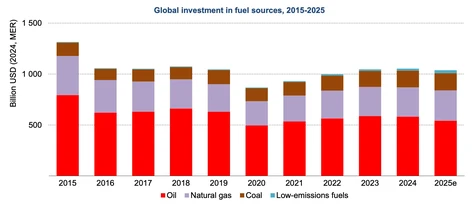
Global investment in the oil industry has still not recovered from the price collapse that started in 2014. Photo by IEA
Investment never fully recovered, not even after Russia invaded Ukraine, which spiked oil prices to above US$100 a barrel and pumped record profits for Canadian producers. Awash in cash, companies used the largesse largely to pay down debt and reward investors with share buybacks and increased dividends. They weren’t green-lighting big new projects.
This is where one might think the critics have a point about C-69 and bills like it. But Leach said the industry’s reluctance to splurge was not just a Canadian phenomenon: It was global.
Investors have become increasingly reluctant to back new oil and gas development, especially those projects that require big upfront investments and take years to build.
“Post 2015, when investments fell through the floor, everybody’s looking for something to blame,” Leach said. Government regulations, he said, were an easy scapegoat.
What is Bill C-48?
Bill C-48 is the so-called tanker ban, which came into effect around the same time as C-69. It says ships carrying more than 12,500 tonnes of oil are not allowed to stop along B.C.’s northern coast.
The law is designed to prevent oil spills near the sensitive coastline, which is home to the Great Bear Rainforest.

Enbridge’s ill-fated Northern Gateway project would have shipped oil from Alberta to a terminal in Kitimat, B.C., which is inside the scope of the tanker ban. Even before becoming prime minister in 2015, Justin Trudeau was a vocal critical of the pipeline, because of its proximity to the rainforest.
During his first term in office, Trudeau’s government approved two pipeline expansion projects, Trans Mountain and Line 3, while effectively killing Northern Gateway.
The project faced other major obstacles, but the industry and its supporters, including Kenney, argued that C-48 and the scrapping of Northern Gateway were another broadside against the Canadian oilpatch.
But the industry’s supporters are not backing down. Alberta Premier Danielle Smith is pitching a new pipeline to B.C.’s northern coast. But her vision of a shipping terminal at the Prince Rupert port would violate the tanker ban.
Smith wants the new Liberal government, under Prime Minister Mark Carney, to scrap C-48.
What is the emissions cap?
The federal emission cap is a proposed set of regulations that would force oil and gas producers to cut their emissions below a certain threshold. According to an early draft of the rules, these emissions would have to drop by about a third below 2019 levels by the early 2030s.
The proposed scheme would establish a cap-and-trade system. It would allow heavy emitters to buy credits from those that pollute less, or invest in a decarbonization fund if they don’t reach their targets.
The federal environment ministry ended public consultations on the proposed rules in early January. It said it would use the feedback to inform the final rules that it will release sometime later this year, with plans to launch the new system in 2026.
In the meantime, the Carney government could decide to tweak or scrap the plans altogether.
Critics want to see the plans scrapped, arguing the proposal amounts to a cap on production. They say the industry would be at a disadvantage in global markets, given that Canada would be the only major oil-exporting country with an emissions cap.
According to the Parliamentary Budget Officer, the oilpatch could raise production by 11 per cent beyond current levels without hitting the cap. But the report says the industry would not be able to realize its full potential under the scheme, putting a lid on economic growth and employment.
For the industry, the proposed cap is another attack from Ottawa, layered on top of C-69, C-48 and other policies. Those include anti-greenwashing rules that are meant to penalize companies for making dubious claims about their environmental record, but have also been condemned by critics as a gag order.
What is Bill C-5?
So far, Bill C-5 is Prime Minister Mark Carney’s signature piece of legislation. Having received royal assent in late June, it marks a dramatic step away from the Trudeau-era approach to major projects and the oilpatch.
Carney is looking to capitalize on what he considers a moment of crisis to push through nation-building projects that could have a lasting impact on the economy. He hasn’t released a list of proposals that would get this treatment, but provincial premiers have pitched various mines, offshore wind projects and a pipeline to B.C.’s northern coast.
For the projects that ultimately get the green light, the proponents will know they have political support — at the beginning. It’s a big shift from C-69, which makes companies wait until the end.
Under the new legislation, the prime minister and his cabinet get new powers to fast-track major projects. It does not repeal C-69 or C-48, but it allows top decision-makers to override those laws and get stuff built more swiftly.
In practice, Carney and his ministers will create a list of projects they consider to be in the national interest. The cabinet promises to give these projects federal approval within two years, much faster than Enbridge’s Northern Gateway application, which inched its way through the review process for six years before Trudeau killed it.
Smith says she hopes to have a new proposal − backed by private-sector partners − to build a pipeline from Alberta to the B.C. coast by the fall. Carney says it’s “highly likely” the pipeline would make the list of nationally significant projects.
Bill C-5 gives the federal cabinet the authority to create regulations that could, in theory, exempt the pipeline from the tanker ban, allowing ships to move oil from the sensitive coastline to overseas markets.
Many Indigenous groups are fiercely opposed to Bill C-5, arguing it threatens to run roughshod over their treaty rights and skirt environmental protections. Some First Nations leaders have vowed to protest, which means the fight over new pipelines in Canada is likely far from over.
- Email: [email protected]
Share This: