


 CDN NEWS |
  US NEWS







By Jim Warren
Living with uncertainty can be worse than getting the bad news.
It’s been six months since Justin Trudeau resigned. Yet here we are little to no wiser about what Prime Minister Carney has in store for the oil and gas sector in the West. If Ottawa truly intends to pave the way for new pipelines, great! If not, it’s better to know now so we can get on with Plan B.
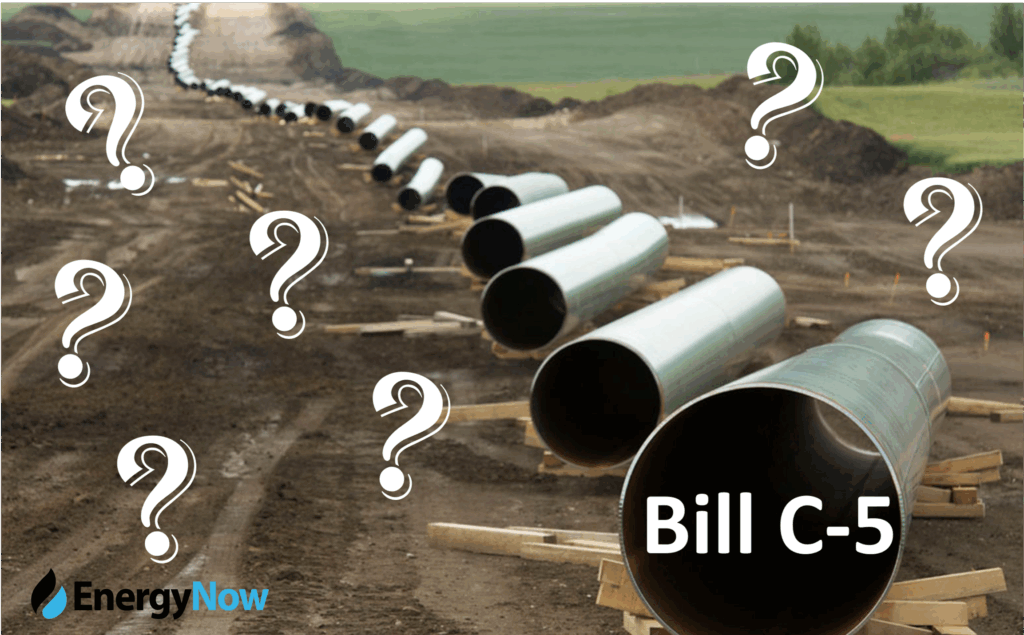
Those optimistic people who breathed a sigh of relief when the Building Canada Act (Bill C-5) became law are still at risk of disappointment. Bill C-5 might indeed herald a brighter future for Canadian gas and petroleum. But it’s also possible it will do nothing at all for the conventional energy sector.
The new law purports to be all about getting big development projects, that are in the national interest, more promptly approved than was the case when approvals were adjudicated under the auspices of the Impact Assessment Act (Bill C-69) and the tanker moratorium (Bill C-48).
Section 4 of the Building Canada Act states that its purpose “is to enhance Canada’s prosperity, national security, economic security, national defence and national autonomy by ensuring that projects, that are in the national interest, are advanced through an accelerated process that enhances regulatory certainty and investor confidence, while protecting the environment and respecting the rights of Indigenous peoples.”
Cabinet will have the final say on which projects will be considered for fast-tracked evaluation. Those lucky enough to be chosen are placed in Schedule 1. A project isn’t even in the game if it is not named and briefly described in Schedule 1.
The Act describes Schedule 1 as a list of projects seeking final approval. Providing the necessary information to appear on Schedule 1 seems pretty straightforward. Cabinet-anointed projects need only provide their name and the location of their principal activities and a brief description of what they intend to do. It almost seems too simple for projects purporting to advance critical national interests.
One of the big sticklers is that the Act is frustratingly opaque when it comes to specifically identifying what constitutes a national interest project (NIP). Subsection 5(6) provides a list of five conditions or goals that Cabinet might find relevant for the elevation of a project to Schedule 1. It doesn’t say a project has to meet all or any of those conditions—just that acceptable projects could include one or more of them. The wording is vague enough to suggest a project could include none of them, or include something nobody has thought of yet.
When deciding whether a project will be one of the lucky winners, the Act says Cabinet may consider any factor it considers relevant, “including the extent to which the project can:
(a) strengthen Canada’s autonomy, resilience and security;
(b) provide economic or other benefits to Canada;
(c) have a high likelihood of successful execution;
(d) advance the interests of Indigenous peoples; and
(e) contribute to clean growth and to meeting Canada’s objectives with respect to climate change.”
Smith makes the case
You certainly can’t fault Alberta Premier Danielle Smith for thinking a bid to get a million barrels per day Northern Gateway 2.0 onto Schedule 1 might succeed. The project clearly checks four of the five boxes, assuming they actually count. The new pipeline combined with plans for massive projects like the Pathways Alliance carbon sequestration initiative in the oil sands meets the contribution to climate change mitigation objective.
Check item “e”.
Speaking at Calgary’s Global Energy Show in early June, Smith explained a new million BPD oil pipeline running from Alberta to Prince Rupert has the potential to generate up to $20 billion in annual revenues. According to Smith, those new revenues will help make decarbonization projects like the Pathways Alliance plan feasible. Additionally, the new revenues will contribute to economic benefits for all Canadians, enhancing our ability to cope with the effects of US tariffs.
Check item “b”.
Alberta has taken significant steps to support First Nations participation in economically significant projects. Smith proudly points to the Alberta Indigenous Opportunities Corporation (AIOC) as an existing mechanism that will ensure Indigenous groups have a beneficial stake in energy projects and new pipelines.
Check item “d”.
No less important are the benefits the new pipeline will offer when it comes to Canada’s resilience as a resource exporting nation. Northern Gateway 2.0 will provide an outlet for exports to new international customers—as opposed to our heavy reliance on a single customer for almost all of our oil. If this doesn’t satisfy the goals stated in item “a” from the list, “strengthen Canada’s autonomy, resilience and security,” nothing can.
Check item “a”.



The likelihood that the project will succeed (as per item “c”) is a bit of a Catch-22. If the project is approved for Schedule 1, its chances for success are potentially good. If it is excluded they could be bleak.
Check “maybe” for item “c”
Assuming the federal government was being sincere when listing the five goals identified in Subsection 5(6,), getting industry players to sign on to the proposal is probably the most significant barrier to success.
This time might be different
Smith has said government and industry are, “working hard on being able to get industry players, private sector players, to realize this time might be different.” She’s optimistic that a private proponent or a consortium of companies will emerge to make a bid for approval.
Again, assuming the government is sincere about goals laid down 5 (6), the second most significant barrier is probably BC Premier David Eby’s, opposition to Northern Gateway 2.0.
The Building Canada Act is mute with respect to overriding the objections of a province to a project.
Smith recalls that Alberta was able to overcome opposition from the Government of British Columbia and obtain its approval for the original Northern Gateway project. She is confident that negotiations and common sense will prove successful this time around.
Danielle Smith doesn’t have stars in her eyes with respect to the chances for success. She simply recognizes what appears to be the opening of a window of opportunity. Considering the dearth of alternative options at the moment it makes sense to see if it’s real. If the opportunity proves illusive there are supporters of the oil industry in the West who will simply move on to Plan B. That option could include focusing Albertans’ disappointment and attention on the upcoming separation referendum.
It’s not the Cabinet who decides, it’s the PM and the PMO
Much of the foregoing assessment could be moot should Cabinet determine a new export pipeline is a bad idea. Unfortunately, there is cause to worry that if a proposal is made, it won’t be approved. Last week, for example, the Liberal government doubled down on one of its least successful, most impractical green transition initiatives – the EV mandate.
Mark Carney’s new environment and climate change minister, Julie Dabrusin, embarrassed herself in Question Period last week, by refusing to admit to any of the well-documented defects in the government’s handling of the Electric Vehicle and EV battery file. Bankrupt battery makers, Canadians’ reluctance to purchase EVs, and auto makers’ warnings about plant closures and huge job losses come to mind. Dabrusin appeared oblivious to any problems in these areas.
Julie Dabrusin isn’t the only climate-alarmed fanatic in cabinet, Steven Guilbeault is still there. Furthermore, most members of the current Liberal caucus are veterans of the Justin Trudeau caucus. These are the same people who backed the Liberals’ ten-year assault on conventional energy. The current Liberal cabinet and caucus are potentially just as environmentally pure as Justin’s. If so, they could prove reluctant to approve any new pipelines or override the tanker ban.
Some political commentators have expressed alarm over the powers Bill C-5 grants to Cabinet. The official decision making process grants the minister selected to oversee the Building Canada Act authority to make recommendations to Cabinet for which proposals should be advanced to Schedule 1. But, Cabinet is empowered to confirm or reject the proposals. Similarly, the minister responsible gets to provide Cabinet with recommendations for the final approval or rejection of projects listed in
Schedule 1. But, again Cabinet gets to accept or reject the recommendations.
The fact that these decisions can be made in the absence of parliamentary debate and media scrutiny has been cause for further alarm.
On the other hand, it appears opposition amendments approved by the House may have remedied some of the concerns about transparency. Omissions from the Bill such as the lack of transparency around conflicts of interest have been addressed. And, there will apparently be an effort to clarify exactly what the criteria for project approval actually are.
Nevertheless, efforts to lift the veil on the realities of government decision making may not count for much. Democracy at the federal level has long been eroded by the growing power of the Prime Minister’s Office (PMO). It is unlikely that the minister in charge of the Act or Cabinet members will do anything that runs contrary to the wishes of the PMO. Defy this rule and risk being booted from Cabinet. Protest too much and the prime minister could refuse to sign your nomination papers for the next federal election.
In the final analysis, the success or failure of a proposal for a new export pipeline touching on tidewater, will depend on what Mark Carney really wants. And who knows what that might be?
Share This:






















COMMENTARY: Varcoe: ‘Do No Harm’: Should Alberta Step in to Fix Gas System Constraints, Given Past Energy Interventions?