CDN NEWS |
  US NEWS







By: Tegan Hill, Jake Fuss and Spencer Gudewill
As governments across Canada unveil their 2025 budgets, outlining their tax and spending plans for the upcoming fiscal year, they have an opportunity to reverse the trend of deficits and increasing debt that has reigned in recent years.
Indeed, budget deficits, which fuel debt accumulation, have become a serious fiscal challenge for the federal and many provincial governments, primarily due to high levels of government spending. Since 2007/08—the final fiscal year before the financial crisis—combined federal and provincial net debt (inflation-adjusted) has nearly doubled from $1.2 trillion to a projected $2.3 trillion in 2024/25. And you can’t blame COVID, as combined federal and provincial net debt (inflation-adjusted) increased by nearly $600 billion between 2007/08 and 2019/20.
Federal and provincial net debt (inflation-adjusted) per person has increased in every province since 2007/08. As shown in the below chart, Newfoundland and Labrador has the highest combined (federal and provincial) debt per person ($68,516) in 2024/25 followed by Quebec ($60,565) and Ontario ($60,456). In contrast, Alberta has the lowest combined debt per person ($41,236) in the country. Combined federal and provincial net debt represents the total provincial net debt, and the federal portion allocated to each of the provinces based on a five-year average (2020-2024) of their population as a share of Canada’s total population.



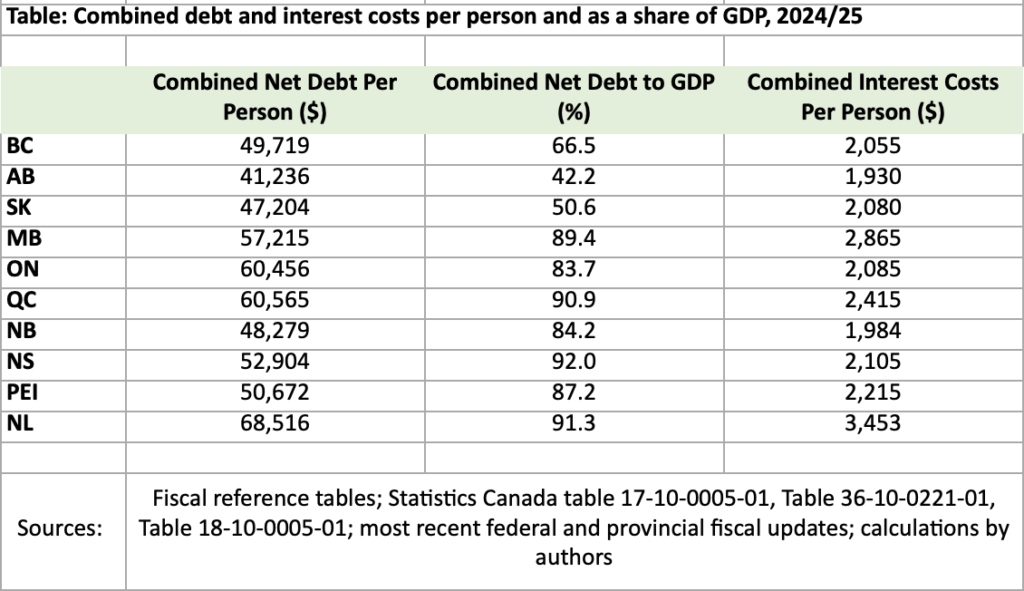
The combined federal and total provincial debt-to-GDP ratio, an important fiscal indicator that compares debt with the size of the overall economy, is projected to reach 75.2 per cent in 2024/25. By comparison, the ratio was 53.2 per cent in 2007/08. A rising debt-to-GDP ratio indicates government debt has grown at an unsustainable rate (in other words, debt levels are growing faster than the economy). Among the provinces, the combined federal-provincial debt-to-GDP ratio is highest in Nova Scotia (92.0 per cent) and lowest in Alberta (42.2 per cent). Again, the federal debt portion is allocated to provinces based on a five-year average (2020-2024) of their population as a share of Canada’s total population.
Interest payments are a major consequence of debt accumulation. Governments must make interest payments on their debt similar to households that must pay interest on mortgages, vehicles or credit card spending. When taxpayer money goes towards interest payments, there’s less money available for tax cuts or government programs such as health care and education.
Interest on government debt (federal and provincial) costs each Canadian at least $1,930 in 2024/25. The amount, however, varies by province. Combined interest costs per person are highest in Newfoundland and Labrador ($3,453) and lowest in Alberta ($1,930). Similar to net debt, combined federal and provincial interest costs are represented by the total of the provincial and federal portion with the federal portion allocated to each of provinces based on a five-year average (2020-2024) of their population as a share of Canada’s total population.
Debt accumulation comes with consequences for everyday Canadians as more and more taxpayer money flows towards interest payments rather than tax relief or programs and services. This budget season, federal and provincial governments should develop long-term plans to meaningfully address the growing debt problem in Canada.
Share This: