CDN NEWS |
  US NEWS









Leveling the playing field with the US is a daunting — likely impossible — task because the tax incentives in the Inflation Reduction Act are uncapped, meaning the spending could top $1 trillion over the next decade.
And it’s not just the dollar figure. Biden’s approach allows any firm to tap into production tax credits. By contrast, Canada typically requires companies to apply for incentives or it negotiates bespoke deals for large factories, as it did with Volkswagen AG last week.
“The US is offering very clear incentives that are available to everyone,” Michael Bernstein, executive director of Clean Prosperity, a climate policy think-tank, said in an interview. “If Canada is only putting in place a tailored approach for a select set of companies, we’re simply not going to take advantage of this massive opportunity that’s in front of us.”
Clean Prosperity and another think tank, the Transition Accelerator, released a report last month detailing the gap between the US and Canadian incentive regimes for specific industries. In cases such as carbon capture, the gap is relatively small. For other industries, it’s a chasm. The paper found that US tax credits for a battery plant equate to around C$2 billion ($1.5 billion) annually over what Canada currently offers.
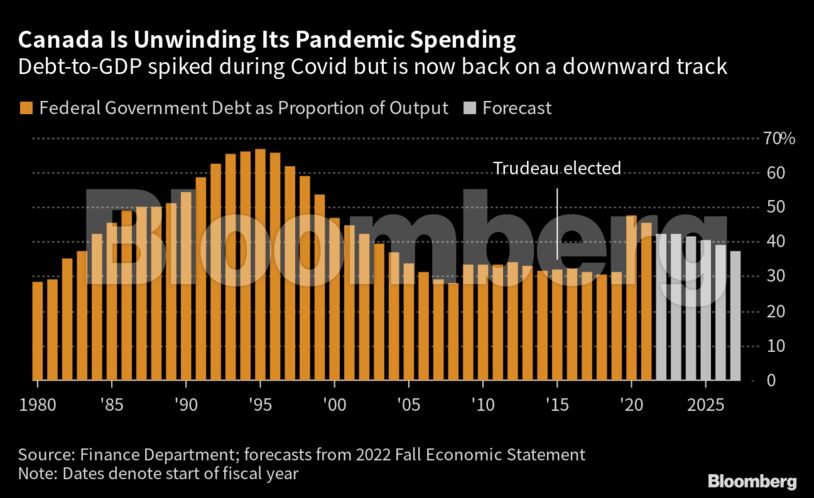
Given the government is now constrained by sharply higher debt-service costs on its pandemic spending, Trudeau is being forced to pick his lanes. Freeland acknowledged that recent turmoil in global financial markets is adding another headwind, but said Canada faces a generational opportunity to invest in its green industries.
Government officials remain tight lipped on exactly what’s in store but suggest it will involve new types of incentive programs, not just doubling down on the existing approach.
Canada currently relies heavily on negotiating up-front capital grants, often through what’s known as the Strategic Innovation Fund. One option could be to expand these agreements to make them richer and include more infrastructure, such as connecting the facilities to a clean source of power.
But if Freeland does opt for more broad-based incentives, there are other tools available.

One would be production subsidies similar to what the US is offering, but with tighter constraints to limit their fiscal impact. This could mean restricting them to specific industries, or capping the overall amount that can be claimed.
Although this would be the simplest solution, it would also be a departure from Canada’s usual practice. Finance officials generally resist using broad tax measures as incentives, preferring to have more control over how the money is spent.
Goldy Hyder, president of the Business Council of Canada, nonetheless believes the finance department is considering production incentives. If they come, the subsidies will be “very targeted, very specific — probably even to projects exclusively — because they can be very expensive,” he told reporters last week.
In a policy briefing released Tuesday, the government-established Canadian Climate Institute recommended the use of profitability indicators to adjust and eventually withdraw public spending.
Another potential measure is using contracts for differences, where the government provides a backstop to its carbon pricing regime. This could take the form of a guaranteed minimum price for selling carbon credits from de-carbonization projects. Oil-sands companies including Suncor Energy Inc. and Cenovus Energy Inc. see this as a potential subsidy for the operating costs of carbon capture.
The problem is that such contracts are complex. If they’re made widely available and markets are flooded with carbon credits that collapse their price, the cost to the treasury could be enormous. On the other hand, restricting access may make them ineffective as an incentive.
Trudeau’s strategy to stay competitive with the US was in action when Volkswagen announced it would build its first non-European battery plant in Canada. Neither the government nor the company released dollar figures yet, but Trudeau hinted he had to put significant money on the table.
“We need to make sure that the financial incentives are there to make us competitive around the world,” the prime minister told reporters last week.
Share This: