


 CDN NEWS |
  US NEWS







By David Yager
The Canadian oil and gas industry has always been a process of continuous improvement and innovation. New ways of drilling, completing and producing hydrocarbons creates new challenges at every stage of the process which then require new solutions.
One area in need of advancement is how to treat and economically dispose of well drill cuttings covered with oil-based drilling fluid, commonly called “invert.”
Drill cuttings are the small pieces of cut and pulverized rock brought to surface while drilling wells. One of the challenges with modern extended-reach horizontal drilling is the total volume of cuttings created has never been greater, and due to increased “penetration rates” (the speed at which the drill bit passes through the rock), cuttings have never appeared at surface in greater volumes.
This leaves drillers with large quantities of oil-covered cuttings that must be treated and disposed of safely at the lowest possible cost.
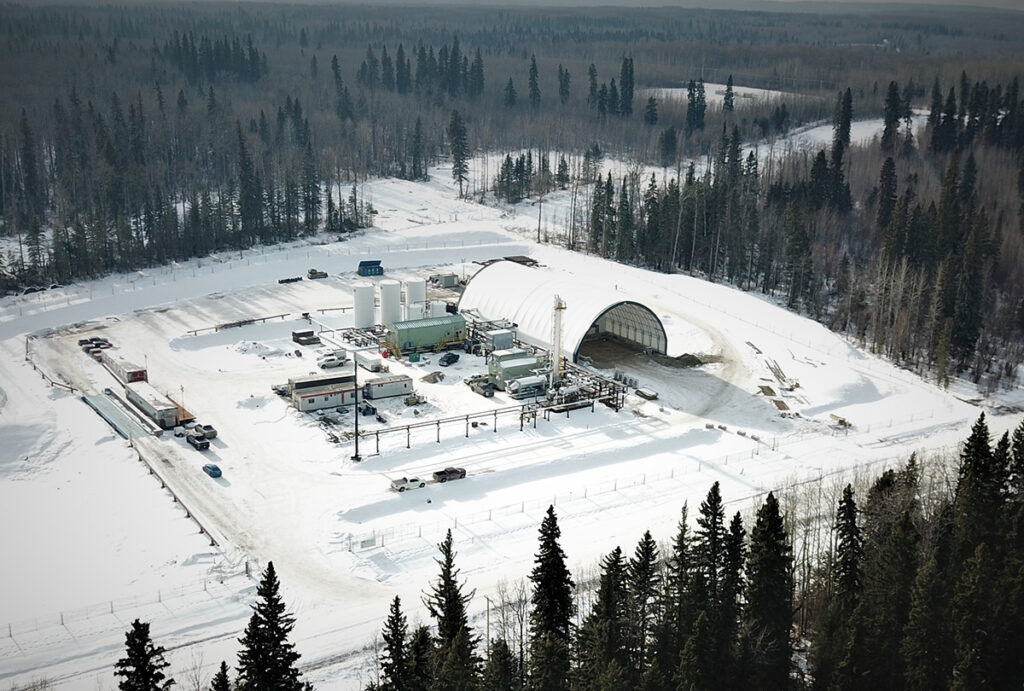
This is a new challenge in need of new methods. Calgary’s Recover Inc. has developed what it calls, “A new solution to a long-standing drilling waste liability.” Recover has built a demonstration facility near Lodgepole that turns black goop from the drilling site into clean and dry piles of cut and crushed rock and reusable fluid.
Recover commissioned the Lodgepole facility in 2018. Based on success, it now believes North America could support 24 more in strategic locations across the continent.
But like all new ideas, it faces an industry not always eager to embrace totally new concepts.
Here’s the story.
Sumpless Drilling Changes Everything
In 1994, Alberta’s Energy and Utilities Board (today’s Alberta Energy Regulator) released the Guide 50 discussion document and in 1996, issued Directive 050 titled “Drilling Waste Management.” After three years of consultation with industry and other stakeholders, it was determined that it was time for drillers to find a better way to handle returned drilling mud and wellbore cuttings than the classic “sump” – a pit dug near the drilling rig into which drilling mud and cuttings were dumped and buried.
The result was the development of “sumpless drilling,” tanks and other holding vessels which ensured that drilling fluid returns from the wellbore never touched the ground. Included in Directive 050 was the description of acceptable methods of treating and disposing of the fluids and cuttings at surface. Options include “mix-bury and cover,” “land-spreading,” and a variety of offsite treatments such as landfarming and specially designed safe disposal sites, more commonly called landfills.
A new oil services subsector emerged to handle drilling waste – everything from onsite cuttings handling systems to transportation to new safe disposal sites at convenient locations across the province.
The desired result was achieved. After a well was drilled, there would be virtually no surface contamination of the location.
The industry went in two directions.
When a lot of shallow gas wells were drilled, drilling fluid companies developed environmentally benign water-based fluids which could be disposed of locally by spreading them on nearby land. This was known as Landspray While Drilling and the chemicals employed were conducive to plant growth.
However, when drilling long-reach horizontal wells where refined oil-based drilling fluids were needed, the drilling waste would have to be hauled away and disposed of in an industrial Class II landfill.
Invert drilling fluids have always been attractive because of improved penetration rates, lubricating ability for the drill bit and drill string, and their versatility in accepting chemical additives that would lift cuttings to surface, reduce friction, and prevent formations like shales from swelling during drilling, thus improving wellbore stability.
Another advancement was recycling drilling fluids to use over and over again. This was particularly useful for invert fluids which were, by nature, more expensive than water-based fluids. Better and higher volume centrifuges removed the smallest particles meaning invert could be treated and re-used.
As a result, today 90% of the wells drilled in the popular oil and gas exploitation regions of western Canada employing extended reach horizontal drilling are drilled with invert.
Higher penetration rates, better drill bits and advanced mud motor performance created another challenge – the volume of cuttings and the rate at which they came to surface exploded.
Drilling a 4,000-meter vertical wellbore thirty years ago took 90 days if things went well, 180 if they didn’t. The total volume of drill cuttings created was about 200 cubic meters, or about 2.2 cubic meters per day or less. Typically, the cuttings pile below the “shale shaker” (the vibrating screen providing primary cuttings separation from fluid) could be handled by a rig worker with a shovel every few hours.
Today’s horizontal wellbores and penetrations rates are totally different. A 6,000-meter measured depth (total length) wellbore can be drilled in 12 days. The total volume of cuttings is about 260 cubic meters arriving at surface at the rate of a whopping 3 cubic meters per hour.
Because of this phenomenon, the number of rigs drilling is no longer related to the amount of meters drilled. The Petroleum Services Association of Canada (now Enserva) has tracked wells and meters drilled for years. In 2010, the average measured depth was about 1,700 meters whereas today, the average measured depth is double that.
Another twist is the size of the cuttings is getting smaller. The movement of cuttings along the horizontal borehole results in a level of pulverization that never took place in vertical wells. This means that the surface area as a ratio to the volume of the cuttings is greater than before. As a result, more invert is adhering to the cuttings.
Conventional methods of managing large volumes of invert-coated cuttings is to mix them with sawdust and haul them off to a Class II landfill. Costs include transportation, mixing with sawdust, and disposal. This is perfectly acceptable and is common practice.
However, from an environmental and economic perspective, this could be improved. Invert mud is expensive. It would be great if the fluid attached to the cuttings could be recovered and used again.
Second, although the Class II landfill is a proven and practical solution, the environmental impact is not over. Over time the sawdust and invert will decay releasing more methane and carbon dioxide into the atmosphere.
In an industry determined to be a world leader in environmental protection and compliance, there was a compelling need for a better mousetrap.
Recover To The Rescue



Recover was conceived by energy services veteran Stan Ross. A native of Fort St. John, Ross started his oilfield services career in 1991 as a truck driver. From there, he founded a surface equipment rental company that offered new environmental protection products and technologies. Following the sale of a successful waste-water treatment business, Ross identified drilling waste as an area in need of modernization.
In 2008, Ross decided to turn his idea into a company. The first step was finding the right partner. This was Mike Biersteker who had spent 20 years in the regulatory and environmental areas of oil and gas. Ross and Biersteker met in Fort Nelson, BC when Encana needed a waste-water treatment technology.
Next, the search began for a solution for oil-based drilling waste contamination. That started by investigating what had previously been developed and tested and why they failed. From there, Recover investigated a broad range of processes including enhanced biodegradation techniques and thermal technologies.
They then experimented with chemical solutions. This involved over fifty solvents, surfactants, and emulsifiers, ultimately settling on solvent extraction. The winner was hexane which was used extensively in the petrochemical industry for similar applications.
Recover’s founders then discovered that the process they had conceived was sufficiently new and novel that it could potentially be patented. So they applied for patents in Canada and the US.
With a suitable solvent identified, they needed to develop a process that could demonstrate the technology on a larger scale and continuous basis. Recover then spent five years building and testing two pilots. This is when they discovered that due to the erratic nature of waste creation, the continued growth in horizontal drilling, and the importance of the recovered product quality, the solution resided in a controlled and centralized facility.
For that, they were going to need a lot more money.
After nearly two years of searching, in 2013, Azimuth Capital Management expressed interest. Headquartered in Calgary, Azimuth had a two-pronged investment strategy consisting of oil and gas production and sustainable energy technology. Following an extensive diligence process – that included the treatment of waste provided by Azimuth’s existing portfolio companies – they agreed to provide the capital to build the first large scale facility.
Azimuth later seconded Nathan Kunec, who had worked on the Recover file on behalf on Azimuth, to work at Recover.
With capital in hand, Recover needed a team. Shane Kozak is Recover’s VP of Finance and Chief Financial Officer. His experience with oil and gas producing companies brings the knowledge of the economic and corporate governance driver behind what customers want and need in terms of cost and ESG performance.
Brian Coston, Sales and Marketing, is a 40-year veteran of the drilling fluids business, most recently in the drilling additives and chemical supply sector. He has vast knowledge of what customers need to drill their wells, the chemical composition of invert-based fluid systems, and why Recover has developed a better mousetrap.
Paul Sudlow is a professional engineer and serves as VP Projects. He spent his career in the oil and gas processing sector, and understands the equipment and processes required for Recover’s plant and facilities to do what they are designed to do safely, efficiently, and economically.
The board of directors also includes Dave Pearce and Jim Nieuwenburg of Azimuth Capital, successful energy service entrepreneur Ric Peterson, Canyon Technical Services co-founder Joe Peskunowicz, and Seven Generations co-founder Mark Brown. In late 2016, Recover approached Canada’s former Prime Minister, Stephen Harper, to join their board.
Construction of the commercial demonstration facility began.
History of the Demonstration Plant
Building Recover’s demonstration facility began in 2016. Lodgepole was selected due to a combination of infrastructure, supply chain networks, commodity access, diversity of hydrocarbon formations, diversity of potential customers and proximity to the home office.
In 2018, Lodgepole was completed. Similar to all first-of-a-kind technologies, Recover ran into a number of challenges scaling up its commercial demonstration facility. While the technology worked immediately, the facility needed fine-tuning to exceed 50% of its design capacity.
In the spring of 2019, Business Development Bank of Canada provided the capital for Recover to undertake debottlenecking. Later that year, the work was complete and appeared successful. But the startup coincided with the Covid-19 pandemic and drilling activity began to decline.
In late March 2020, the difficult decision was made to shut the facility and wait for industry conditions to improve.
Eighteen months later, drilling activity started to recover. In November of 2021, the facility was restaffed and resumed 24-hour operations.
In the past year, Recover has processed over 40,000 tonnes of drilling waste and recycled more than 40,000 barrels of refined distillate oil that would have otherwise been disposed of in landfills. That is a lot of recycled oil and Recover could do even more. Unfortunately, many operators have been slow to adopt a new drilling waste recycling strategy.
Recover’s business model is to process cuttings delivered to its facility at no additional charge to the operator. However, some segregation of drilling waste is required. Cuttings from drilling with water-based drilling fluids during surface hole are not suitable for treatment. Other location waste that is often mixed with the cuttings because they are bound for a landfill must be separated before delivery to Recover’s treatment plant.
Recover has attracted its current clientele by providing a cost-competitive environmental treatment and disposal services. Without recycling the oil, operators have to stabilize the waste with additives like sawdust before delivery to a landfill. Landfill operators will not accept oil-soaked cuttings in the raw form state that Recover is keen to process. This can save the operator up to $25,000 per well.
Further, there are emissions from the breakdown of the waste oil and sawdust at the landfill. Who is responsible for these?
Recover believes that when all factors are considered, all drilling waste within a 150-kilometer radius of its facility should be treated this way with the oil recovered. Oil companies that agree are Tourmaline Oil Corp. and Spartan Delta Corp.
If the upstream oil and gas industry is serious about its environmental footprint and reducing all emissions from all sources, Recover offers a unique and competitive solution. With customer support, Recover is prepared to expand across Western Canada and beyond.
Plans for Expansion
While Lodgepole continues to be a key focus, Recover believes its investment could yield a far larger opportunity for itself and its clients. The company thinks it could build up to 24 more in strategic locations across the continent. Beyond Western Canada, the most compelling location on Recover’s radar is the Permian Basin due to its high concentration of active rigs creating tons and tons of invert laden cuttings on a daily basis. The company hopes that it will commence construction in 2023.
Recover is an example of another made-in-Alberta technology that will move the needle in this market, the US and around the world.
David Yager is a Calgary oil service executive, energy policy analyst, oil and gas writer, and author of From Miracle to Menace – Alberta A Carbon Story.
Share This:




















REALITY: Carney’s EU Deal Threatens Alberta, Energy, & Sovereignty – 170,000 Reasons to Reject Canada’s EU “Associate Membership”