


 CDN NEWS |
  US NEWS








Extract the oil the world still needs – faster, more economically, and with reduced emissions – via breakthrough nanocatalyst technology.
As the energy sector in Alberta continues to face moderate bitumen recovery rates, high emissions and water usage, Calgary-based energy transition company, NanosTech, has developed a remarkable solution that petroleum producers have been seeking for decades – ISUT.
ISUT is a bolt-on, on-site oil extraction and upgrading process that improves sustainability and saves producers both time and money. It produces a less viscous, more desirable product – with significantly increased yields. In fact, ISUT extracts the oil that other processes leave in the ground, maximizing wells up to 90%.
For producers who want to maximize their investment and reach ESG goals, ISUT can reduce site emissions by up to 35%. The patented nanocatalyst-based process converts bitumen to a low-viscosity, easily transportable, diluent-free product, translating to significant cost savings.
ISUT™ benefits
- Reduced emissions. ISUT cuts GHG emissions by up to 35%.
- Improved oil recovery. Increase total oil recovery-up to 90%.
- Enhanced oil quality. In-reservoir catalysis increases heavy crude’s API gravity.
- Reduced diluent. Higher quality crude requires less diluent to meet pipeline specs.
- Better economics. ISUT increases volume & quality of sales oil, reduces steam & diluent input costs.
- Bolt-on benefits. When used as EOR at brownfield operations, ISUT improves recovery (up to 90%) & NPV.
How ISUT™ Works
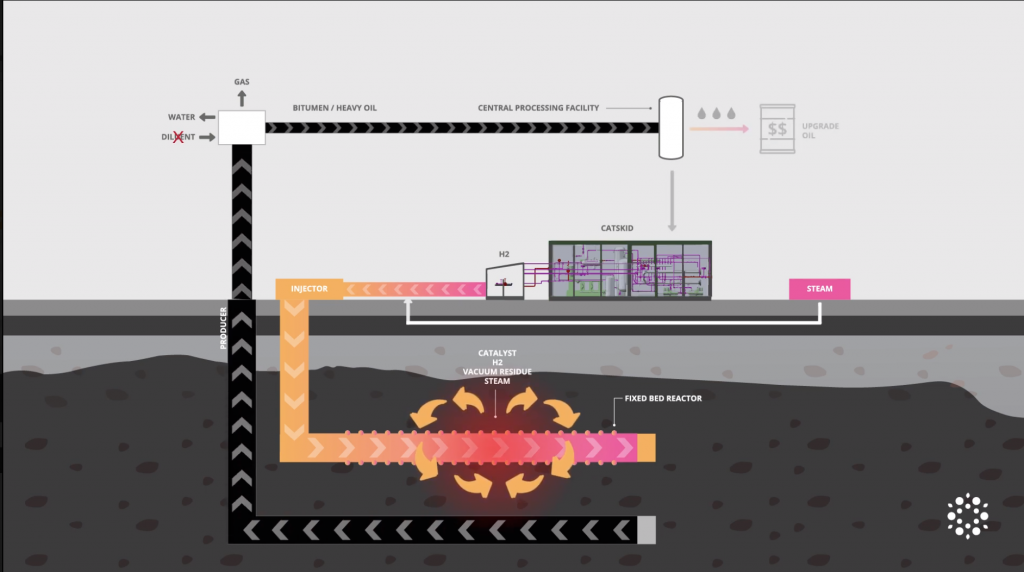
STEP 1: Injection
ISUT utilizes a compact catalyst preparation module, called a CatSKID,™ to combine vacuum residue with hydrogen and nano-catalyst particles before injecting the mixture into the reservoir.

STEP 2: Catalyst
Once in the reservoir, the catalyst particles permanently attach to the sand grains surrounding the injection well, creating a fixed bed reactor. With the catalyst in place, the injection of hydrogen with steam enables an upgrading reaction in the reservoir, resulting in increased oil quality, production rate and total oil recovery while reducing steam usage by more than half.
STEP 3: In-Situ Upgrading
As vacuum residue is continually reinjected into the reservoir as a heat and catalyst carrier, it’s gradually upgraded into lighter and higher value oil. This in-situ process reduces emissions and improves energy efficiency versus surface upgrading. Eliminating diluent, saves significant transportation costs and increases pipeline capacity.
To learn more about ISUT and NanoTech’s other transformational catalyst technologies for the energy industry, visit: https://www.nanos.tech/
Share This:























OPINION: The Iran War Energy Crisis is Just Getting Started: Bousso