CDN NEWS |
  US NEWS








Application Note: BENKE CFPP- 4 Cold Filter Plugging Point Process Analyzer
Understanding the challenges of the measurement for the Cold Filter Plugging Point and the reasons as to why reproducibility (R) is such a complex topic. The BARTEC BENKE CFPP-4.2 analyzer is designed to be compliant with the ASTM D6371 (Standard Test Method for Cold Filter Plugging Point of Diesel and Heating Fuels). The CFPP of a fuel is suitable for estimating the lowest temperature at which a fuel will give trouble-free flow in certain fuel systems.
During the winter season, the topic of determining the CFPP value and its reproducibility (R acc. to ASTM D6371) becomes always of more interesting nature. The Cold Filter Plugging Point is the indication of a diesel fuel or heating fuel at which the fuel becomes of waxy or gelling nature. The CFPP is a temperature, which lies typically a couple of degrees above the actual pour point temperature of a sample and therefore indicates the point of blockage due to crystallization in a filter assembly. In fact, the measurement is conducted by providing diesel fuel or heating fuel through a defined sized filter (acc. to ASTM D6371 mesh size of 45µm) until no flow at the outlet side of the filter can be detected. The focus of this application note is mainly on European standard based final diesel according to the EN590. This standard clearly manifests the quality a final diesel has to fulfill being allowed to be sold to the commercial market.
Different approaches are possible to overcoming the challenges
Nevertheless, different approaches are possible to overcoming the challenges of the Cold Filter Plugging Point. One would be to use fuel pre-heaters to extend the fluid characteristics of diesel fuel as an example. This is predominantly used in vehicles that operate in arctic weather conditions; however, these systems can fail. Therefore, a second and third approach is possible to solve the challenges of the everchanging environment vehicles might be used in.
The second approach is mainly used in North America and foresees blending diesel fuel with e.g. gasoline, kerosene or naphtha. Downside for using gasoline is, it destroys injection devices, which can be found in nearly all modern diesel-powered vehicles for the commercial sector due to the high volatility of the gasoline.
The third approach is the most effective and widely spread approach to changing the CFPP of diesel fuels and it foresees to use special chemical designed additives which are being added at ppm concentration levels to final diesel sample stream trying to enhance the CFPP performance i.e. lowering the CFPP value of a diesel.
With increasing demands for different grades of diesel and heating fuels the sample matrix changed over time and that resulted in new requirements for additives. The effects that additives in diesel have are mostly visible for winter-based products as the requirements for low temperature applications require an increased requirements and concentrations of additives added to final diesel streams. That means during summer the reproducibility of the measurement of CFPP according to ASTM D6371 is better compared to measurements conducted during winter.
The direct effect on the reproducibility
This is a complex topic and many studies have been conducted in the past (e.g. 2003 German conglomerate of refiners, additive suppliers and BARTEC BENKE) which proved that many of the following topics have a direct effect on the reproducibility.
Based on past experiments and experience the following most important factors influence the reproducibility of the CFPP measurement:
- The composition of the actual additive being used
- Quantity of the additive being used
- Temperature at which the additive is being introduced to the sample stream
- Degree of homogenous solution of additive with sample stream
- Duration of exposure of the additive in the sample stream
Table 1: CFPP values acc. to ASTM D6371 and effect of storage
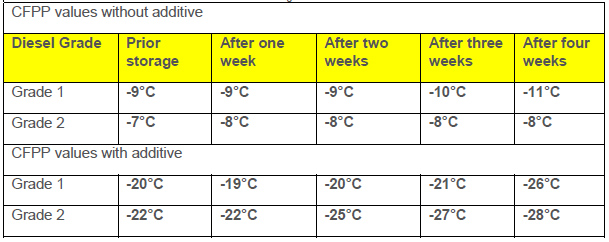
All of the above have critical effects on the reproducibility of the measurement because whereas the analyzer is located at a certain point in the process the sample grabbing for the laboratory sample might take place at a different location. In addition, the exposure of the additive might be considerably longer when sample is being grabbed and transported to a laboratory for analysis. The sample take off point for the analyzer sample line might not be located ideally to consider all of the above and therefore major differences can be possibly obtained when comparing results between process analyzer and laboratory analyzer.
Improvement of the reproducibility for results obtained according to ASTM D6371 process vs. laboratory
As a basis of discussion therefore BARTEC BENKE recommends to the following actions which could most likely lead to an improvement of the reproducibility for results obtained according to ASTM D6371 process vs. laboratory.
As primary step the additive could be mixed and exposed to diesel at a controlled temperature and might be diluted prior with kerosene in small quantities to ensure that the final diesel is still suitable for modern injection devices in vehicles.
The next step could include an inline blending and mixing arrangement of considerable length to ensure a homogenous mixture of diesel and additives is being produced at a repeatable quality.
An easy improvement to reproducibility could also include placing the laboratory sample take off point close to the actual process analyzer (i.e. after filters and coalesces where additives might be filtered or washed out of the diesel). In addition to this step the laboratory analysis should be carried out as soon as possible after the sample has been collected from the process.
Many different factors influence lastly the reproducibility described and defined by the ASTM D6371. This application note is to highlight different factors, which could have substantial effects on this, and to offer possible approaches to optimize it too.
The BARTEC BENKE CFPP-4.2 process analyzer meets the modern requirements and provides excellent repeatability figures according to the ASTM D6371. Therefore, BARTEC BENKE is convinced that together with our partners and customers around the globe the best solution can always be found by working jointly together and optimizing our resources together.

More Information
For more information on our BARTEC Process Analyzer Technology please visit our website at westech-ind.com or call to speak to one of our technical representatives at 1-800-912-9262.
Share This: