


 CDN NEWS |
  US NEWS







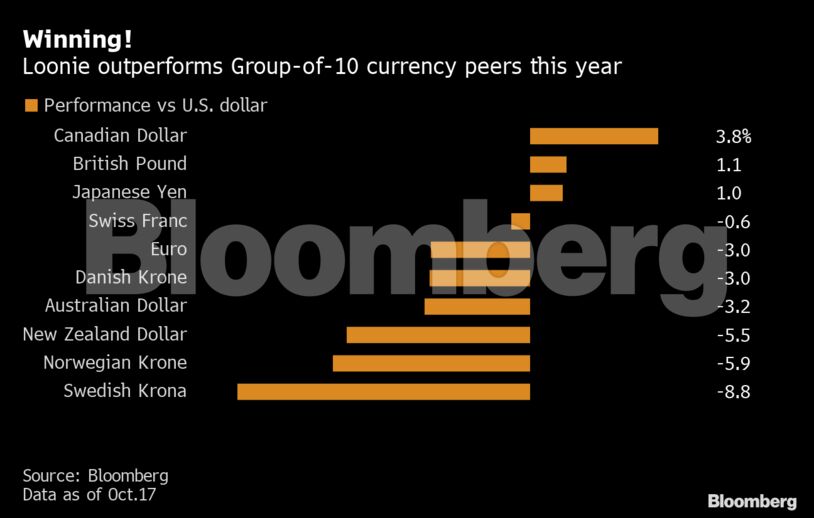
The loonie has been in the No. 1 spot among Group-of-10 currencies this year, rising almost 4% against the U.S. dollar amid a sound economy and a low unemployment rate. Canada’s benchmark equity index has rallied 15% in 2019, making it one of the top gainers among developed markets.
A Conservative minority government would be better for market sentiment than a Liberal minority administration, according to Pesole. He said this is in part because it would likely exclude smaller parties that oppose more oil pipelines, a subject that has been a focus of political debate.
A rebound in housing, solid economic growth and one of the strongest job markets in recent times has helped give Trudeau something positive to talk about during his campaign. While major central banks in other parts of the world have been cutting interest rates, the Bank of Canada has been reluctant to do so thus far — strengthening the Canadian dollar’s position as one of the highest yielders among G-10 currencies.
Michael Hsueh, a currency strategist at Deutsche Bank AG, says a Trudeau-led minority government could be negative for the Canadian dollar given the reduced capacity to pass legislation. It could also potentially hinder growth in oil, a key industry for Canada, one of the world’s largest energy exporters.
The Oil Factor
Stewardship of the energy industry has become a central issue of the elections. The Conservative Party has portrayed itself as a champion of the sector and has promised to remove regulations Trudeau implemented. The Liberals, meanwhile, are trying to strike a balance between developing Alberta’s energy resources and making Canada a leader in combating climate change.
The loonie, often seen as a petrocurrency, has benefited from the nation’s massive oil exports. Still, bringing more oil reserves to market has divided Canadians — with two pipelines being scrapped on Trudeau’s watch.
Foreign-exchange strategists are concerned that a Trudeau-led government, propped up by other left-leaning parties, could be an obstacle in passing legislation favorable to business leaders and the country’s energy sector.


A Liberal minority government is “likely to push for more regulation and rules on capital inflows into Canada,” which could be negative for the Canadian dollar, Mark McCormick, global head of currency strategy at Toronto-based TD Securities, said in an email.
Stock Market
While Canadian politics rarely play a significant role in the nation’s equity market, a minority government could be positive for stocks, according to Brian Belski, chief investment strategist at BMO Capital Markets.
“Although on average the market has posted relatively strong performance post federal elections, there appears to be little to no performance preference around the outcome,” he said in a September report. “The only potentially meaningful outcome appears to be a minority government versus a majority government.”
Since 1935, Canadian stocks have returned on average 12% in the 12 months after the election of a minority government, compared with 8% in the year following a majority victory, according to Belski’s research.
For others, volatility is the name of the game. Stripping out the global rout in 2008, National Bank Financial’s Warren Lovely said that Canadian stocks had a “mixed/choppy” performance after a minority government was formed from 2004 to 2011.
“In terms of capital markets, the formation of a minority government creates greater potential uncertainty – especially if a coalition government is the end result,” Credit Suisse’s equity analyst Andrew Kuske said in an Oct. 8 report.
Canadian sectors to watch: |
|---|
|
|
|
Still, election-related market moves might be short-lived this month with both the Bank of Canada and the Federal Reserve reporting their monetary policy decisions on Oct. 30. Futures traders are pricing in almost no probability of a rate cut at the BOC meeting, while a quarter point reduction from the Fed is seen as likely by the market. Canadian two-year yields on Wednesday climbed above their U.S. equivalents by the most since 2017 — a good sign for loonie bulls.
Trade deals will also have an impact on the Canadian dollar. The U.S. and China are still working to finalize their trade deal, which is likely to boost investors’ appetite for risk, a positive for the currency. And on Thursday, U.S. President Donald Trump’s economic adviser Larry Kudlow said on CNBC that he expects the U.S.-Mexico-Canada trade agreement to be approved in Congress before the American Thanksgiving holiday.
Share This:






















INSIGHT: Canada’s Natural Resource Sector is at the Heart of the Government’s ‘Export & Diversification’ Plan