


 CDN NEWS |
  US NEWS







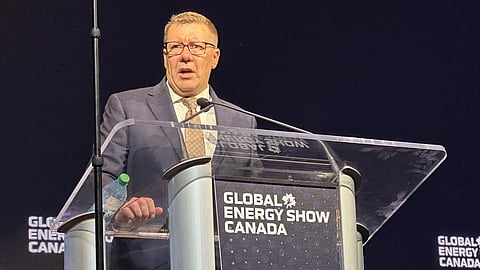
Introduced by Michael Binnion, President and Founder of Questerre Energy, Saskatchewan Premier Scott Moe delivered a strong message at Global Energy Show Canada in Calgary: Canada stands at a pivotal moment where the right policy decisions could unlock unprecedented investment, strengthen national prosperity, and position the country as a true global energy superpower.
Speaking to industry leaders gathered in Calgary, Moe argued that Western Canada possesses the natural resources, innovation, workforce and entrepreneurial spirit needed to drive the next generation of economic growth. The challenge, he said, is ensuring governments create the conditions necessary for investment to flourish.
“We have an opportunity to build Canada into the strongest economy in the G7 and to be truly a global energy superpower,” Moe told attendees.
Saskatchewan’s Transformation
Moe began by reflecting on Saskatchewan’s economic transformation over the past two decades.
For many years, Saskatchewan was known as a province that people left in search of opportunity elsewhere. Today, he said, the province has become one of Canada’s most affordable places to live, raise a family and build a career.
The turnaround, according to Moe, has been driven by a commitment to encouraging private-sector investment rather than government intervention in business.
“Governments realized that they should not be in the business of being in business,” he said. “Our job is to create an environment where investment can flow.”
That approach has helped Saskatchewan attract more than 60 major projects representing over $62 billion in investment, the largest project pipeline in the province’s history.
Resources the World Needs
Throughout his remarks, Moe repeatedly emphasized a simple message: Saskatchewan and Western Canada have what the world needs.
From food and fertilizer to oil, natural gas, potash and uranium, the province’s resource base is increasingly important to global energy and food security.
“Saskatchewan has what the world needs,” he said. “We don’t have resources that we hope somebody might want someday. We have what the world needs today.”
Moe argued that resource development creates more than economic growth. It also contributes to global energy security, food security and geopolitical stability.
As global trade relationships become increasingly uncertain, he said countries are looking for stable and reliable suppliers.
“Saskatchewan has earned a reputation as a strong, stable, sustainable and ethical trading partner,” he said.
Diversification and Global Trade
The premier highlighted Saskatchewan’s growing international presence, noting the province now exports products to more than 160 countries worldwide.
Over the past decade, Saskatchewan has deliberately diversified both its economy and its export markets.
That diversification, Moe said, has helped build resilience against geopolitical disruptions while creating opportunities for long-term growth.
“We need to diversify our economy, diversify the products we’re producing, diversify the industries we’re involved in and diversify our export markets around the world,” he said.
Supporting those efforts are nine Saskatchewan trade offices located internationally, helping expand market access and attract investment.
Regulatory Certainty Matters
One of the strongest themes in Moe’s speech was the need for stable and predictable regulation.
He contrasted Saskatchewan’s approach with what he described as the tendency in some jurisdictions to continuously layer new regulations and policies on top of existing ones.
“We have chosen not to layer regulation on top of regulation on top of regulation,” Moe said.
Instead, Saskatchewan has focused on creating a competitive environment that encourages long-term investment.
That certainty, he argued, is one reason Western Canada remains one of the few places in North America where large resource projects can realistically move from exploration through development and into production.
“Western Canada is one of the few places where you can still bring a project from exploration to production within a realistic timeframe and at a realistic cost,” he said.
Powering Growth Through Nuclear Energy
Moe also addressed one of the most pressing issues facing resource development: electricity supply.
With industrial expansion accelerating, Saskatchewan is preparing for significantly higher power demand in the coming decades.
To meet that challenge, the province is moving ahead with plans for large-scale nuclear power generation.



“We need to get these decisions right,” Moe said. “Reliability and affordability are the two most important considerations.”
Nuclear power, he argued, will allow Saskatchewan to support industrial growth while providing reliable and low-emission electricity.
A Changing Tone in Ottawa
While critical of several federal policies, including Bill C-69 and aspects of Canada’s carbon pricing framework, Moe acknowledged what he described as a meaningful change in tone from Prime Minister Mark Carney’s government.
He pointed specifically to the recent memorandum of understanding signed between Prime Minister Carney and Alberta Premier Danielle Smith regarding energy development.
“The MOU is a first step,” Moe said. “It’s an example of a change in tone and a change in direction.”
While stressing that more work remains to be done, Moe said governments must continue collaborating to create conditions that encourage private investment.
“It isn’t fast enough and it isn’t far enough for what I would like to see,” he said. “But it is a marked change in direction.”
Carbon Policy and Investment Decisions
Moe devoted considerable attention to the impact of carbon policy on investment decisions.
He said investors increasingly ask practical questions about how carbon pricing systems work, how costs are recovered, and how quickly investment incentives can be accessed.
Those questions, he argued, will directly influence future investment decisions in Western Canada’s energy sector.
“If we can attract that investment and increase production, the egress will come,” he said. “Whether it’s to the west coast or to the south, we will find our place.”
Moe expressed confidence that pipeline and export infrastructure will follow if governments establish the right investment environment.
Canada’s Resource Advantage
The premier spent significant time highlighting Saskatchewan’s leadership in uranium and potash production as examples of how responsible resource development can support global needs.
Saskatchewan currently supplies approximately 20 percent of the world’s uranium and about 35 percent of global potash production.
Those industries, he noted, are among the most sustainable and ethically produced resource sectors anywhere in the world.
He pointed to the uranium sector’s Indigenous participation rates, where Indigenous and northern employment and procurement account for roughly half of industry activity.
“You would be hard-pressed to find another industry globally that has that type of statistic behind it,” Moe said.
He argued the same principles apply to Canada’s energy industry.
Canadian oil and gas producers have made significant progress in methane reduction, carbon capture, enhanced recovery technologies and emissions reduction initiatives.
“We are already in the low-carbon oil space,” Moe said.
A Historic Opportunity for Western Canada
As he concluded his remarks, Moe returned to the broader opportunity facing Canada.
He argued that if governments can provide regulatory certainty, encourage investment and facilitate market access, the scale of future investment in Western Canada’s energy sector could exceed anything seen in recent decades.
“If we get this right, the level of investment in the Western Canadian energy industry is going to dwarf any of the investments that I mentioned earlier,” he said.
Moe believes Western Canada is uniquely positioned to drive national prosperity while helping address growing global demand for secure, reliable and responsibly produced energy.
“If we get this right, Canada will truly become the strongest economy in the G7,” he said.
“And we truly will become a global energy superpower.”
For Moe, that future is not merely possible—it is within reach, provided governments, industry and communities work together to seize the opportunity.
Share This:






















INSIGHT: The Northern Shield Energy Corridor Provides Energy Security for All Canadians – Yogi Schulz