


 CDN NEWS |
  US NEWS







Chris Varcoe: Export projects on the British Columbia Coast can offer shorter shipping times to markets in Asia than U.S. rivals
By This Article and More by Chris Varcoe Here
Alberta and British Columbia battle frequently over a proposed oil pipeline to the Pacific coast, yet they’re not playing the part of squabbling siblings on another critical energy file — natural gas.
More specifically, they’re on the same page with the federal government on expanding the country’s liquefied natural gas (LNG) sector, allowing Canada to export more supercooled gas to customers around the world.
With two major final investment decisions looming on the second phase of the existing LNG Canada development, and on the proposed Ksi Lisims LNG project, the goal of significantly growing the country’s gas-export sector is picking up steam in 2026.
“This is something that Canada will need to take advantage of quickly, but we’re not the only player in the LNG game,” Ian Archer, a gas industry expert and associate director at S&P Global Energy, said Wednesday.
“If Canada wants to take advantage of this, if they want to get serious about being an energy superpower, then they have to take advantage of this, strike while the iron is hot.”
The conflict in the Middle East and effective blockage of the Strait of Hormuz, through which about one-fifth of global LNG supply transits — along with the transactional nature of relationships with the U.S. administration — has some customers looking for a diversity of gas supply, he added.
These factors could help grow LNG exports from Canada. The country has large reserves of natural gas, and export projects on the British Columbia Coast can offer shorter shipping times to markets in Asia, compared with gas coming from U.S. Gulf Coast terminals.
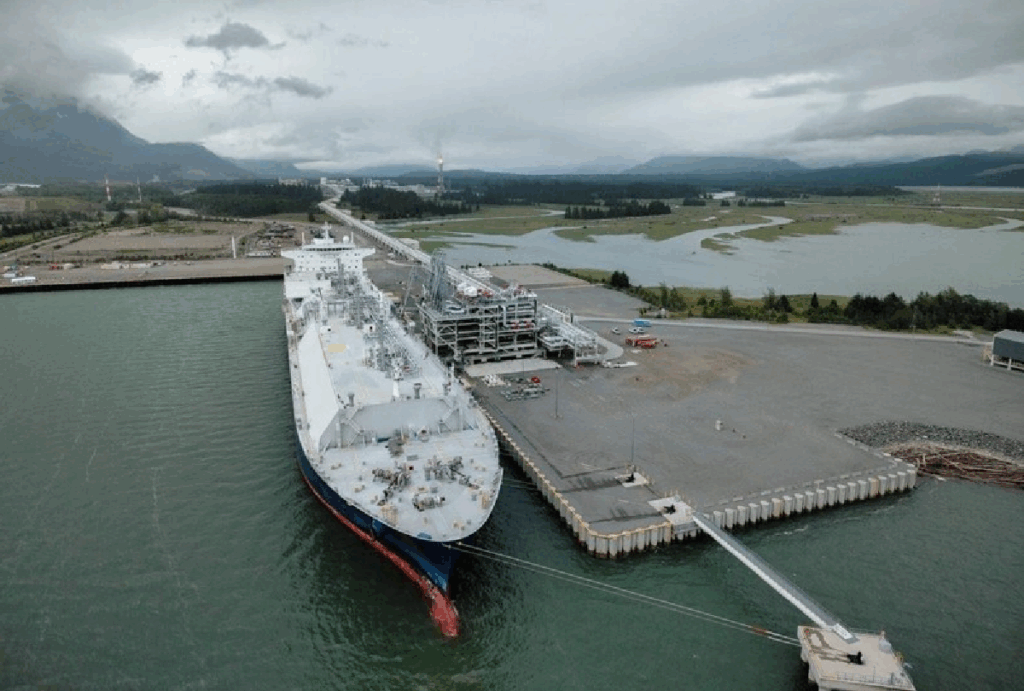
The Shell-led LNG Canada facility began operating last summer, becoming the first major export terminal in the country.
In the past year, almost 100 cargoes have been shipped from the facility to Asia, “connecting Canadian energy to global markets in a tangible way for the first time,” Shell Canada president Stastia West told the Global Energy Show on Wednesday.
Partners in the LNG Canada consortium are now examining an expansion to double its capacity, with a potential final investment decision (FID) expected sometime in 2026.
Ryan Hickman, Shell’s global gas fundamentals manager, noted that in the past decade, the LNG market has expanded by more than 60 per cent. Shell recently projected that LNG demand in the world will increase by more than 50 per cent by the end of the next decade.
“Even with a lot of supply coming online over the next couple of years, there is still a large need for new liquefaction investment, including here in Canada,” Hickman said at the annual energy conference.
“We get a lot of interest from buyers in Asia for Canadian LNG.”



Two smaller projects on the Pacific coast are also being built — Woodfibre LNG and Cedar LNG.
And a larger project, Ksi Lisims LNG, is moving toward a final investment decision. It’s a co-development between the Nisga’a Nation, U.S.-based Western LNG and a partnership of Canadian natural gas producers.
Earlier this month, Ksi Lisims announced separate LNG supply deals with the German utility firm Uniper, and with Germany’s state-owned Securing Energy for Europe group. The project proponents are also looking to sign up more long-term agreements with customers.
“Everything’s looking very well to get us to FID before the end of the year,” Charles Morven, secretary-treasurer for the Nisga’a Nation, told reporters at the show.
“Our project is not just for us, it’s for other Indigenous Nations, it’s for the whole Northwest Coast and also all of Canada. Our project is going to be a nation (building) project where everybody benefits.”
The two proposed projects have another advantage: strong alignment between provincial and federal governments on promoting LNG.
“For decades, Canada had the natural gas, the geography, the workers and the expertise. What we did not have is access to global markets from our own Canadian ports,” federal Natural Resources Minister Tim Hodgson told the conference on Tuesday.
“Ksi Lisims LNG . . . is an important example of what comes next.”
The potential for Ksi Lisims LNG and for the expansion of LNG Canada to get the green light has the support of Alberta and B.C., in spite of the recent clashes between the provinces over a proposed bitumen pipeline.
“There are lots of ways that Alberta and British Columbia can collaborate. We’ve been in agreement on the expansion of the Trans Mountain pipeline,” Premier Danielle Smith noted in her speech to the three-day event on Tuesday.
“We’ve been also supportive of the development of all the LNG export opportunities.”
While speaking at the Global Energy Show, B.C. Energy Minister Adrian Dix touted the “historic development of an LNG industry in B.C.” He pointed out that by 2030, based on projects under construction, the province will become the sixth-largest gas exporter in the world.
“I think there is an immense opportunity here, and time is of the essence,” Dix said.
“We are winning the LNG race right now.”
Chris Varcoe is a Calgary Herald columnist.
[email protected]
Share This:






















On The Verge: Energy Sector Primed for New Wave of Growth – ATB Economics