


 CDN NEWS |
  US NEWS







By Yogi Schulz

Quebec political leaders rail against supposedly ‘dirty oil’ produced in other parts of Canada, especially Alberta, and loudly oppose its consumption in Quebec. They’re even against a crude oil pipeline to the Irving Oil refinery in New Brunswick. At the same time, they say nothing about the ‘dirty oil’ that Quebec imports routinely from other countries. It sure sounds hypocritical. Why are these politicians misleading Quebecers?
Let’s consider some related facts.
Methane emissions performance
The chart below illustrates the relative methane emissions performance of the top 10 oil and natural gas producers. The USA, where almost all of Quebec’s current crude oil imports originate, ranks first in terms of worst performance. Other major producers perform dramatically worse than Canada. In the past, Quebec has also imported from Saudi Arabia and Nigeria.
Canada’s methane emissions performance is significantly better than that of ‘dirty oil’ producers. Nonetheless, Quebec politicians claim otherwise.
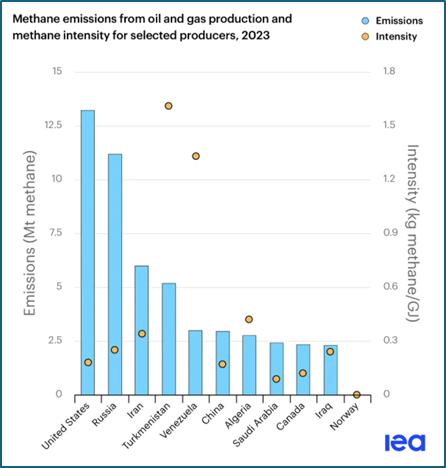
Source: Methane Emissions From Fossil Fuels in the Top 10 Countries, Voronoi, March 16, 2024
GHG emissions intensity performance
The chart below illustrates the average emissions-intensity performance of many oil- and natural gas-producing nations. The USA and Canada perform about the same.
Almost all of Quebec’s current crude oil imports originate from the USA. In the past, Quebec has also imported from Saudi Arabia, which performs better, and Nigeria, which performs worse.
Canada’s GHG emissions intensity performance significantly exceeds that of ‘dirty oil’ producers. Nonetheless, Quebec politicians claim otherwise.
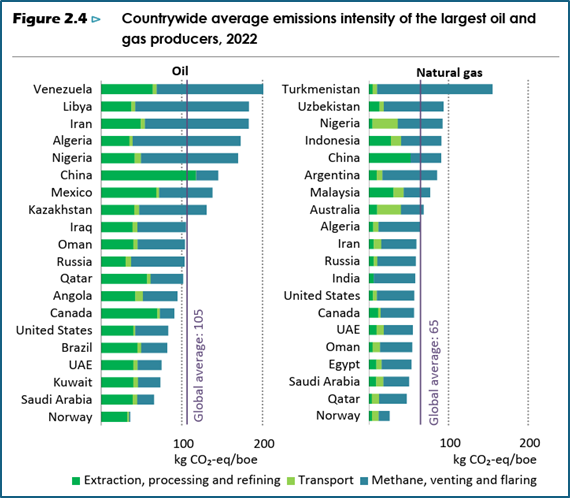
Source: The Oil and Gas Industry in Net Zero Transitions, IEA, page 69.
Financial considerations
This chart illustrates the $228.4 billion value of Quebec’s crude oil imports over 32 years. That amount would represent significant value to the Canadian economy if Quebec refineries were to purchase Canadian crude oil rather than imported crude.
A 2018 study by the Canadian Energy Research Institute (CERI) concluded that Eastern Canada refineries could save hundreds of millions of dollars annually if they replaced about half of their imports with Canadian crude oil. The report did not explicitly reference the need to add a coker to a Montreal refinery to process heavier Western Canadian crude oil. In 2020, Suncor estimated the cost at $2 billion.
Given that a few Canadian provinces, especially Alberta, subsidize Quebec with billions of dollars annually, switching to Canadian crude oil would offset some of that subsidy. Quebec politicians never mention this economic opportunity, which could be large enough to boost the value of the Canadian dollar.
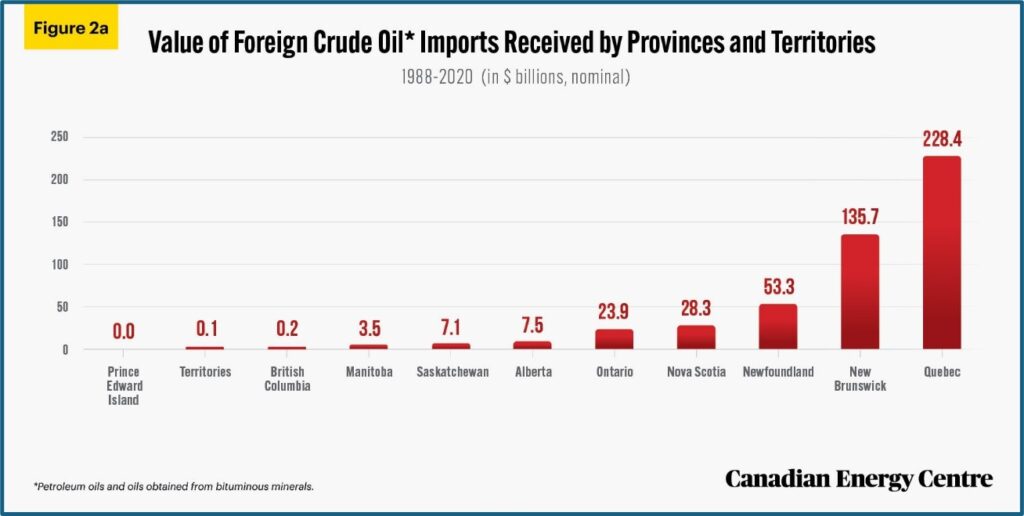

Source: Foreign oil imports to Canada: $488 billion between 1988 and 2020, Canadian Energy Centre, September 24, 2021
Almost all of this crude oil originates from the USA. In the past, Quebec has also imported from Saudi Arabia and Nigeria.
Energy security considerations
At the moment, Quebecers don’t seem concerned about the risk of disruptions to the continuity of their imported crude oil supply. However, potential sources of disruptions include:
- The current war with Iran has blocked the Strait of Hormuz, which Saudi Arabia uses for part of its crude oil exports.
- Nigeria is subject to periods of political instability that can reduce crude oil exports.
- The current war with Iran has curtailed crude oil exports to the Far East and started conversations in the USA about banning crude oil exports.
In recent years, Canadian events, such as a railway employee strike and a First Nations blockade, prompted Premier François Legault to declare a “state of emergency” in Quebec because the province would run out of propane within 4 days.
Quebec political leaders are likely to stop worrying about the supposed ‘dirty oil’ if a future event threatens Quebecers’ energy security.
Quebec’s environmental performance
The chart below illustrates Quebec’s favourable environmental record compared to other Canadian provinces. That record is due to hydroelectric generation and consumption.
However, Quebec’s favourable environmental record is marred by major Quebec cities, notably Montreal and Quebec City, discharging billions of litres of untreated sewage into the St. Lawrence River during wastewater infrastructure maintenance. These actions have faced public outcry and criticism.
Somehow, Quebec political leaders never reference these events when they criticize Alberta for its supposedly ‘dirty oil.’
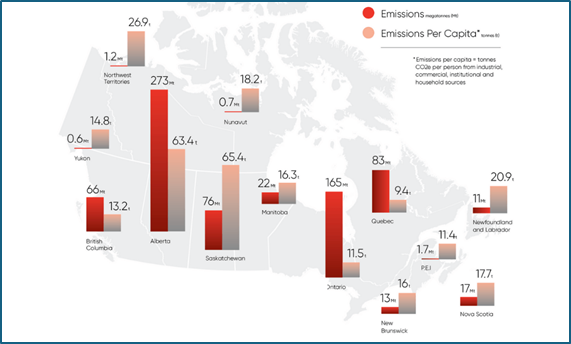
Source: Net-zero report card: How future-friendly are Canadian provinces?, Shawn McCarthy, Corporate Knights, April 19, 2021
Political leadership vs. followership
To maintain their popularity and reelectability, it’s safer for politicians to follow the polls than to show leadership on current issues.
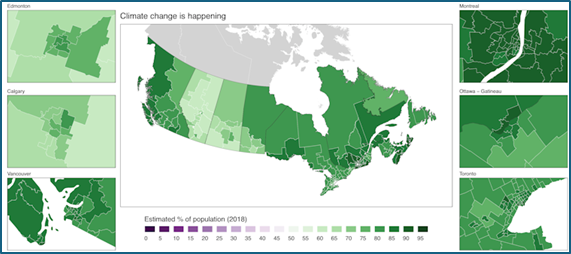
Opinions on the need for action to address climate change exemplify this phenomenon. This chart illustrates that Quebecers are among the most concerned Canadians about climate change. Quebec shows the most dark areas of any province.
Quebec political leaders can maintain or build their popularity among Quebecers by railing against supposedly ‘dirty oil’ with little downside risk. There is no incentive for politicians to show leadership by correcting non-factual opinions.
Source: Canadians in every riding support climate action, new research shows, The Conversation, September 11, 2019
Conclusion
Quebecers and Canadians will be better off if Quebec politicians stopped their inaccurate claim that supposedly ‘dirty oil’ is being produced in Western Canada. A crude oil pipeline to Quebec and New Brunswick will produce the following benefits for all Eastern Canadians:
- Reduce the cost of crude oil.
- No change to current GHG emissions.
- Improve energy security.
- Repatriate economic activity related to crude oil production to Canada.
It’s time for Quebec politicians to quit misleading their electorate and perhaps even themselves.
Share This:






















INSIGHT: Trump Wants Keystone XL Revived, Canada Wants Lower Tariffs – Meanwhile a Trade Deal Looms