


 CDN NEWS |
  US NEWS







Negotiations are set to ramp up between both governments and the Oil Sands Alliance on a multibillion-dollar Pathways carbon capture network in northern Alberta
By Chris Varcoe • Calgary Herald
This Article & More by Chris Varcoe Here
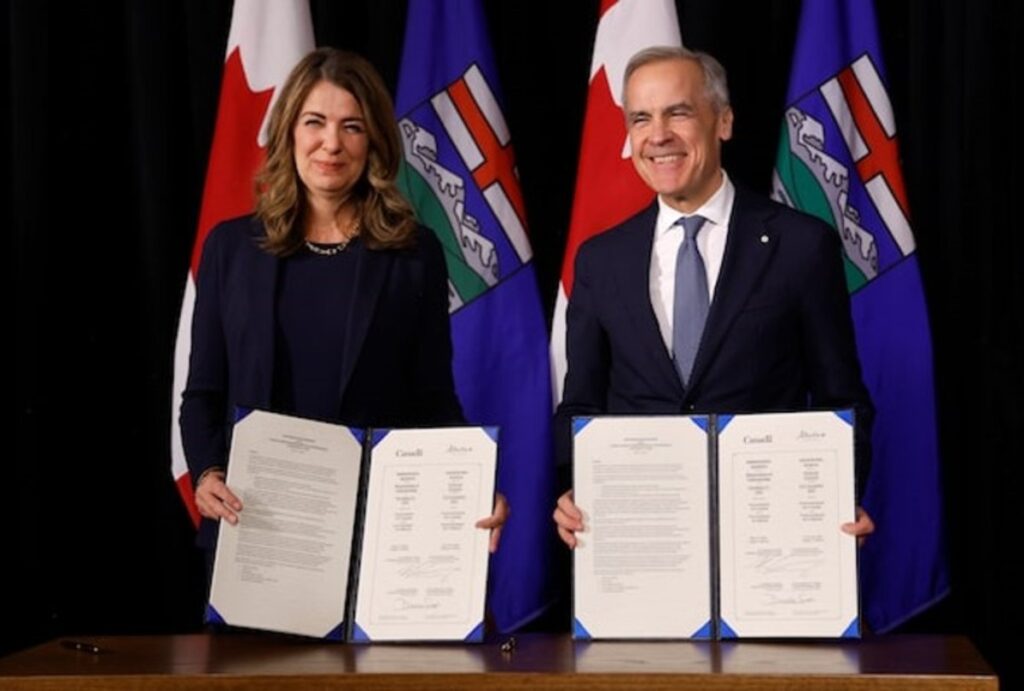
From pipe dream to a real prospect, Alberta’s ambitious proposal to see a new oil artery built to the Pacific Coast gained more traction Friday, one that could see crude flowing through a new project within eight years.
An agreement on increasing Alberta’s industrial carbon tax was signed in Calgary on Friday by Prime Minister Mark Carney and Premier Danielle Smith, which could help clear the path for a proposed bitumen pipeline to the West Coast — expected to begin operating no later than in 2033 or ’34, according to officials.
The deal helps cut through a thicket of federal regulatory and policy issues, while increasing the province’s industrial carbon price over the next 14 years to an effective rate of $130 per tonne of emissions.
Just as significant, it will put the ball back in the court of Canada’s largest oilsands producers on advancing a major carbon capture project, as the pipeline and decarbonization initiative are mutually dependent on the other being built.
Negotiations are set to ramp up between both governments and the Oil Sands Alliance to see if the companies are prepared to build the multibillion-dollar Pathways carbon capture network in northern Alberta.
“I’m very confident that a pipeline is going to be built, and the Pathways project is linked to this — that one doesn’t go ahead without the other,” Smith said in an interview Friday.
“Everybody is keen to get together and just see where the points of difference might be, and how we can bridge those. I get a real sense of goodwill as we go into these discussions.”
If built, the Pathways project would be the world’s largest global carbon capture and storage network, and “the proposed pipeline depends on that alliance,” Carney added.
Under Friday’s agreement, which solidifies details of the initial energy memorandum of understanding (MOU) signed by the two governments last November, Alberta’s industrial carbon tax will climb to an effective rate of $130 per tonne of emission by 2040.
It’s above the current rate of $95 per tonne, although below the previous federal target of reaching $170 per tonne by 2030. (Today, carbon credits trade for about $40 a tonne.)
The industrial carbon price under Alberta’s Technology, Innovation and Emissions Reduction (TIER) system will also have a price floor, expected to be $60 by the end of this decade, and reaching $110 by 2040.
The details are complex, but the direction is important.
It removes one of the most difficult issues within the initial MOU — how to best bolster Alberta’s carbon price on large industrial emitters while also creating future investment certainty.
“This MOU is fundamentally talking about the future of Canadian production, which direction and where it goes to in the world, and the future of Canadian climate ambition,” said Kevin Birn, Canadian oil markets chief analyst with S&P Global Energy.
“It’s a big deal.”
The initial energy pact last year included the federal government ditching its oilpatch emissions cap and suspending the Clean Electricity Regulations.



Alberta’s proposal for a new oil pipeline to the Pacific Coast can be submitted to the federal Major Projects Office for consideration by the end of June. No route has yet been determined, and it still needs the backing of a private sector proponent.
As part of the new deal, Canada has agreed it will pursue designating the proposal a project of national significance that can be fast-tracked for approval by Oct. 1.
If Alberta’s proposal get the necessary permissions and approvals — including conducting meaningful consultations with Indigenous communities — Ottawa intends to make “best efforts” to provide a pathway by September 2027 to enable approval to start building a new pipeline that can access markets in Asia.
“We look at this as the start of a process. We’ve created some of the necessary conditions for this to happen, but there’s a lot more work to do,” Carney told reporters.
However, the pipeline depends upon the Pathways carbon capture network finally getting a positive final investment decision from the Oil Sands Alliance, a group of five major producers, which includes Suncor Energy, Canadian Natural Resources and Cenovus Energy.
On Friday afternoon, the group put out a statement saying it’s reviewing the carbon price deal, noting it “still maintains uncompetitive costs” on the Canadian oilsands industry.
“Oil Sands Alliance is committed to advancing the Pathways carbon capture and storage project, provided the necessary regulatory and fiscal terms are in place to support the project and new oilsands growth,” group president Kendall Dilling said in a statement.
“An industrial carbon tax only adds uncompetitive costs to industry on top of the costs of a carbon capture project.”
The carbon pricing improves on earlier proposed versions, “yet still represents a unique cost to Canadian oil and natural gas producers,” Canadian Association of Petroleum Producers CEO Lisa Baiton said in a statement.
Producers have less expensive options to increase oil pipeline capacity into the United States and by optimizing the existing Trans Mountain system to the Pacific Coast, say industry investors.
A new bitumen pipeline capable of shipping one million barrels per day from Alberta to the British Columbia coast is a “pipe dream” unless it’s funded by taxpayers, said Eric Nuttall, a senior portfolio manager with Ninepoint Partners, which invests in Canadian energy producers.
“All roads lead back to the producer,” Nuttall said Thursday.
“The government of Alberta and the federal government can make and sign all the MOUs they want, but if the terms are uncompetitive in the eyes of industry, then they will simply not commit the firm barrels to the project and it’s DOA.”
Yet, Federal Natural Resources Minister Tim Hodgson said Friday that reaching an agreement on carbon pricing with Alberta was a prerequisite to starting discussions with the Oil Sands Alliance. He is confident a deal can be worked out.
“If the producers want the opportunity, and I believe it is a compelling opportunity, to get a million barrels to a West Coast egress, where we can earn a premium world price and we have the ability to sell to all of our allies . . . that is in everybody’s interest.”
Chris Varcoe is a Calgary Herald columnist.
Share This:






















On The Verge: Energy Sector Primed for New Wave of Growth – ATB Economics