


 CDN NEWS |
  US NEWS







The province sits on some 7 trillion cubic feet of natural gas, worth billions of dollars, but it banned fracking more than a decade ago
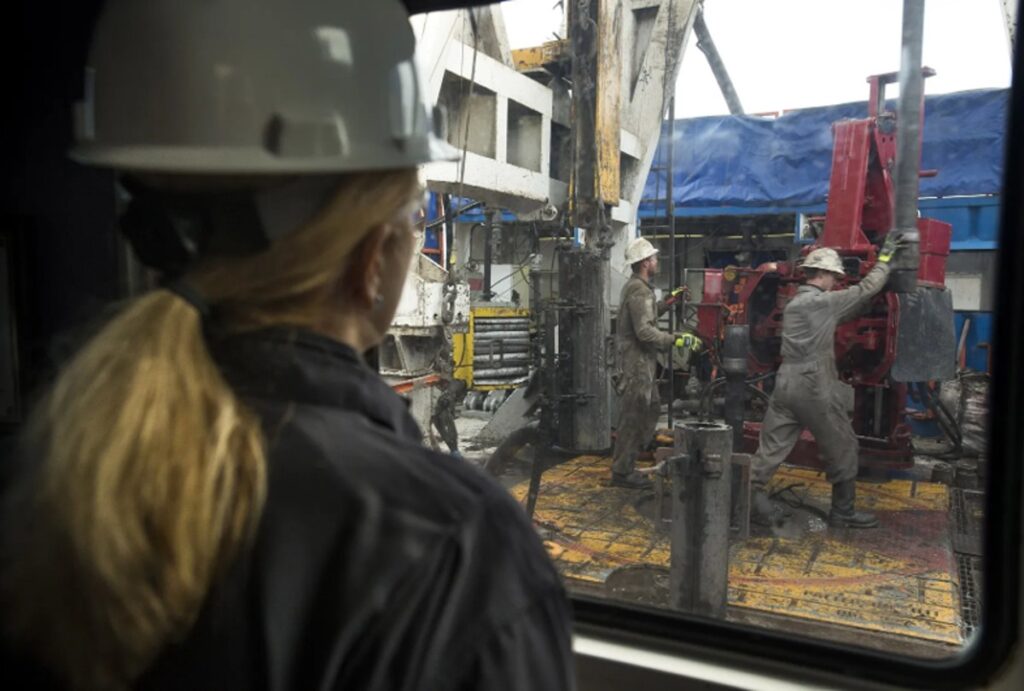
Nova Scotia sits on some seven trillion cubic feet of natural gas, worth billions of dollars, and the premier believes fracking those reserves could help build the province and country as energy powerhouses.
Tim Houston recently took to X and said global uncertainty and volatile prices make it clear the province needs to produce more energy and develop resources like wind power and natural gas reserves to help pay for services like health care and education.
“That means good jobs, stronger communities, and less dependence on the United States. Nova Scotia can be the energy superpower that helps Canada stand on its own,” he wrote on the social media site.
The Nova Scotia Onshore Petroleum Atlas, which maps geological formations that hold the greatest potential for onshore gas, estimated there is up to seven trillion cubic feet of recoverable natural gas available, primarily in two basins.
Depending on the market price per thousand cubic feet, extracting that gas would generate billions.
The province has tapped Dalhousie University to administer a $30-million program that will see university researchers and the private sector study the onshore reserves. The university will make recommendations to the province, which will then negotiate exploration agreements with companies.
The gas would be extracted through hydraulic fracturing (fracking), which involves pumping a mix of water, sand, and additives into wells at high pressure.
Calgary-based GeoGlobal Resources Inc. is one of seven energy companies expressing interest in exploring onshore natural gas in the province.
CEO Jean Paul Roy said his company has proposed drilling three wells in Nova Scotia’s Shubenacadie basin. He is optimistic there’s substantial gas underneath.
“It’s probably a $2-billion find. I’m hoping it can be very profitable,” said Roy, whose energy company has previously been engaged in the exploration and production of oil and natural gas reserves in India, Israel, and South America.
Yogi Schulz, a Calgary energy industry commentator, agrees with the potential and likes what the province is trying to achieve.
He said extracting from the untapped reserves could create jobs and energy security.
“I congratulate the premier for this U-turn and recognizing that the economic and energy security benefits far, far outweigh the minuscule risks that the opponents of hydraulic fracturing are egregiously exaggerating,” said Schulz, also a partner at Corvelle Consulting Inc., which consults oil and gas companies on information technology.
“It boggles the mind that a have-not province that struggles with unemployment would turn its back on a genuine economic opportunity to put people to work, to improve incomes, to improve government tax revenue and reduce debt,” he added. “Why would anybody turn their back on that?”
Nova Scotia was one of many provinces that banned fracking in 2014, due to environmental concerns, most notably small tremors and the potential for groundwater contamination.



Alberta and British Columbia have a long history of producing natural gas through fracking. The Houston government lifted Nova Scotia’s moratorium, taking the first step towards joining those provinces, last March.
Advocacy groups in Nova Scotia have expressed concerns. The province held public consultations last month across the area that encompasses the untapped basins. At one meeting, the non-profit Nova Scotia Fracking Resource and Action Coalition (NOFRAC) handed out pamphlets warning of earthquakes and dangers to groundwater and public health. A large percentage in the room chanted, “No frack! No frack!”
“It’s the government of Nova Scotia pretending to community consult when it isn’t,” NOFRAC member Jocelyne Marchand told The Chronicle Herald. “Our premier feels he can do whatever he wants.”
Roy, a geophysicist with decades of experience, noted that 95 per cent of wells worldwide require this technique.
“I’ve worked on onshore wells in 50 countries and 150 basins. I’ve drilled over 400 wells, including 140 in India, and most reservoirs need to be fracked. You have to open those pore throats of the rock to make the reservoir flow,” he said.
“You can’t find oil unless you drill.”
Roy firmly believes that drilling and fracking can be conducted safely and effectively because of the province’s stringent safety measures and regulations, which protect water resources and minimize environmental impact.
“Drilling for any well in Nova Scotia, you have to protect the water system and water tables. That’s the absolute, No. 1 priority,” he said.
Schulz, who has spent over four decades in the oil and natural gas industry and has advised Alberta operators, said the regulations around drilling a well emphasize the need for surface casing to protect groundwater.
“Hydraulic fracturing can cause minor localized earthquakes,” he said. “But what people don’t understand is that minor localized earthquakes occur every day naturally throughout the planet and we’re oblivious because we can’t feel them. Fracking causes similar localized, imperceptible earthquakes deep in the Earth’s crust.”
Schulz also noted that Canadian production of fossil fuels has met higher standards than most energy-producing countries.
“Certainly higher than Russia, the Middle East, South America, Africa, pick a place,” he said, noting Canada was ranked 18th out of 183 countries and territories in the 2025 Environmental, Social and Governance Index (ESG), a framework used by investors and organizations to measure sustainability, ethical impact and risk management practices beyond traditional financial metrics.
“If you choke off Canadian production, all you do is increase production elsewhere on the planet, and that production by definition is lower ESG,” Schulz said.
Schulz pointed to the positive impact fracking has had in communities in Pennsylvania that sit on the Marcellus Shale, a massive natural gas formation, compared to New York, which also sits on the same reserve but banned fracking in 2010.
“It’s had a huge economic impact on the people of Pennsylvania, while New York has had increased prices and reduced energy security,” Schulz said.
He argued that the risks associated with fracking have been misleading and are low compared to other industrial activities.
“Fracking is no different from making cement or pouring concrete or painting lines on the road,” he said. “These activities all have a certain level of risk. In the case of hydraulic fracturing, the anti-fracking forces have egregiously overstated those risks. Some of these risks are as remote as you being killed by a Martian with a ray gun in your office.”
Share This:






















INSIGHT: The Northern Shield Energy Corridor Provides Energy Security for All Canadians – Yogi Schulz