


 CDN NEWS |
  US NEWS









Expansion now seen as a question of ‘When, not if’
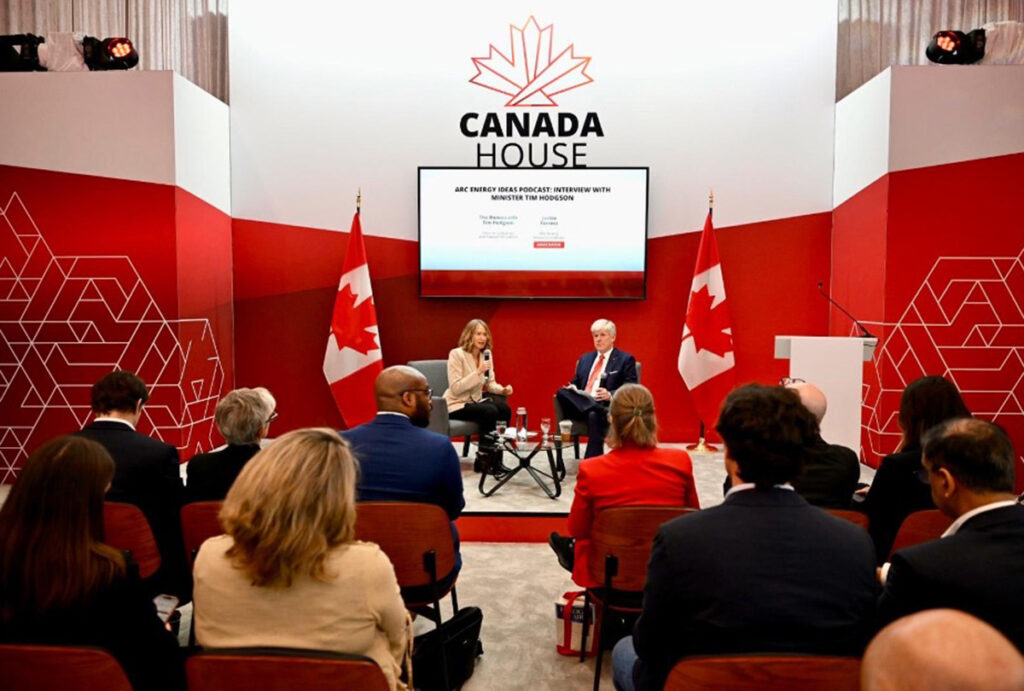
Jackie Forrest of Arc Energy Institute interviews Energy Minister Tim Hodgson at the CERAWeek 2026 conference in Texas
By Resource Works
More News and Views From Resource Works Here
LNG Canada’s partners have long been actively looking at expanding the plant at Kitimat BC to boost its output to 28 million tonnes of LNG a year from 14 million.
The war on Iran, and its impact on world energy markets and sources, have led to more hopes, and predictions, that the expansion will go ahead — with a Final Investment Decision (FID) coming this year.
The latest to push the double-up project is Tim Hodgson, federal minister of energy and natural resources, who notes that Phase Two has been referred to Ottawa’s Major Projects Office as a “project of national interest,” and says the expansion is “likely to go FID later this year.”
LNG Canada’s Phase 1 project, completed in 2025 at a cost of about $40 billion, is already exporting liquefied natural gas to Asian markets and has shipped more than 60 cargoes.
The expansion would require expanded pipeline and marine infrastructure, with construction potentially beginning in 2027 or 2028 and exports in the early 2030s.
Significant commercial milestones
LNG Canada has yet to announce a decision on Phase Two, but there have been two significant related developments:
First, TC Energy announced that Coastal GasLink (CGL) has entered into commercial agreements with LNG Canada covering the doubling of natural-gas transmission through the CGL pipeline that feeds LNG Canada.
This would mean building six more compressor stations along the pipeline, which would be necessary if LNG Canada is to proceed with Phase Two.
Said TC Energy: “This marks an important milestone in advancing Coastal GasLink Phase 2, which remains subject to Final Investment Decision (FID) by LNG Canada (and its joint-venture participants) and approvals by CGL.
“The agreements establish a comprehensive commercial framework that supports LNG Canada’s pathway to FID, including front-end engineering and design and the execution activities that would follow.”

Second, LNG Canada announced the selection of TR Canada E&C for front-end engineering design services for Phase 2 expansion of the Coastal GasLink pipeline.
“LNG Canada is working with Coastal GasLink under an integrated commercial model to advance Phase 2 planning. If approved, Phase 2 would double the pipeline’s natural gas capacity using the existing infrastructure.”
BC’s energy minister, Adrian Dix, hailed the two deals as “one more necessary step” to making LNG Canada’s second phase a reality.
And in a third move related to expansion, LNG Canada, in an application to the BC Energy Regulator to amend a waste-discharge permit, outlined some construction and dredging at its marine terminal as intended to support potential expansion of the LNG plant.
The global LNG advantage
LNG Canada’s joint-venture partners, who are eyeing the expansion, are global LNG giant Shell, Malaysian energy company Petronas, PetroChina (which has three LNG import facilities in China), Japan’s Mitsubishi Corporation, and Korea Gas Corporation (KOGAS), the world’s largest LNG importing company.
This group of overseas investors in Canadian LNG led Energy Minister Hodgson to say this: “I don’t think it’s an accident that LNG Canada One, the only LNG exporter on the West Coast of North America, has participation from Europeans, from Japanese, from Koreans, from Malaysians, from Chinese. They all understand the shipping distances. They all understand the advantage of sourcing LNG off the West Coast.”
As well, said Hodgson, “We are going to produce the lowest carbon-intensity-emission LNG in the world.”
Earlier, the federal government, talking of LNG Canada Phase 2, said: “This project will double LNG Canada’s capacity of liquefied natural gas, making it the second-largest facility of its kind in the world.
“It is expected to attract significant private-sector capital to Canada, contribute to our GDP growth, and support jobs and economic growth in local communities. It will diversify our trading partners and meet increasing global demand for secure, low-carbon energy with Canadian LNG, contributing to worldwide energy security by increasing the supply of available natural gas for Asian and European partners.
“Leveraging Canada’s sustainable advantage, emissions are projected to be 35 per cent lower than the world’s best-performing LNG facilities and 60 per cent lower than the global average.”
And Shell, in its latest outlook, sees world demand for LNG, led by Asia, increasing by 54%-68% by 2040, and 45%-85% by 2050. And that was before the war on Iran disrupted world energy supplies, and drew attention to finding new sources of energy.
All these things make expansion of LNG Canada as a ‘when, not if’ proposition.
We look forward to the final investment decision, and hope Hodgson was right on when, in a podcast with Arc Energy Institute, he called it for “later this year.”
Don MacLachlan is a writer for Resource Works, a non-partisan organization that champions responsible resource development in British Columbia and Canada. Reach him via [email protected]
Share This:























COMMENTARY – DOOMBERG – Geopolitical & Energy Predictions with Amazing Prescience – Maureen McCall