CDN NEWS |
  US NEWS









How “Clean Energy” Bulldozes What Oil Never Could
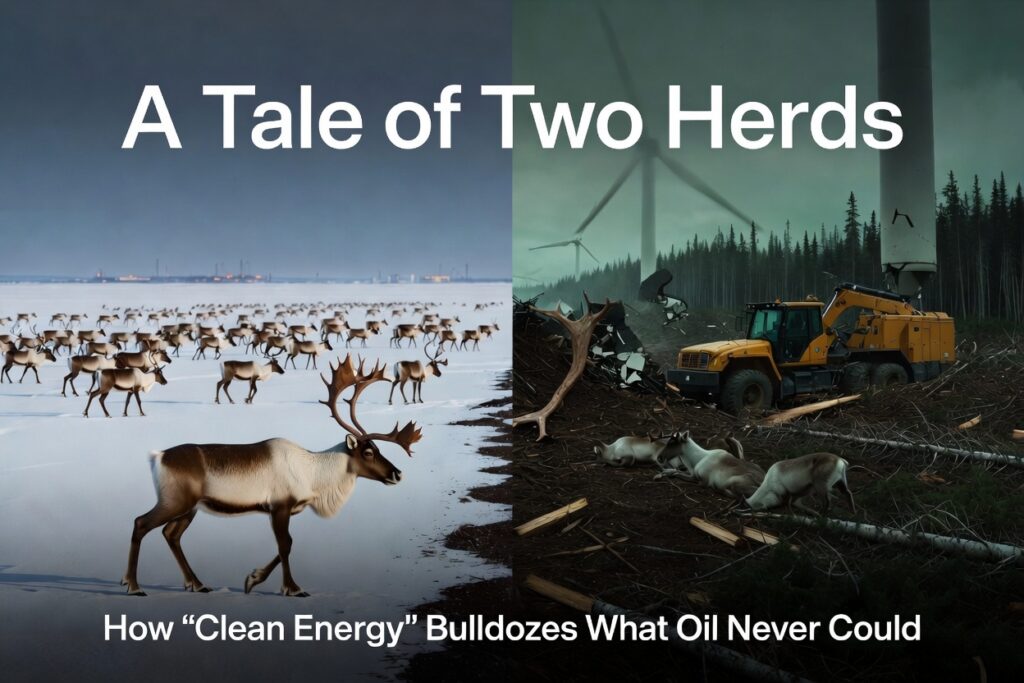
This past “Earth Day”, while many celebrated ‘clean energy,’ let’s have an honest conversation about the selective outrage and double standard of Canada’s climate movement — one that fiercely protects caribou from northern oil and gas projects, yet stands largely silent as wind turbines and industrial clearing destroy the habitat of Quebec’s critically endangered Charlevoix woodland caribou.
In Quebec’s Charlevoix region, one of Canada’s most fragile woodland caribou herds teeters on the edge of extinction. The population, which dropped to just 16 individuals before emergency penning in 2022, has edged up to 37. Yet this modest recovery now faces deliberate new destruction. The Des Neiges wind megaproject—backed by Hydro-Québec, Boralex, and Énergir—includes plans for dozens of turbines in the Charlevoix sector, with at least ten positioned in high-quality old-growth forest habitat that provincial experts explicitly identified as essential for the herd.
Quebec Ministry of the Environment specialists warned that no further habitat loss is tolerable and that “compensation” cannot replicate century-old forest stands for decades, if ever. The Bureau d’audiences publiques sur l’environnement (BAPE) urged relocating the offending turbines. The BAPE report stated explicitly: “La commission d’enquête estime que la réalisation du projet, dans sa forme actuelle, est difficilement conciliable avec les mesures requises pour rétablir la population de Caribous forestiers de Charlevoix et pour éviter l’ajout de perturbations à son habitat.”
(Author Translation: “The inquiry commission estimates that carrying out the project in its current form is hardly reconcilable with the measures required to restore the Charlevoix woodland caribou population and to avoid adding further disturbances to its habitat.”)
Despite this, the previous CAQ government under François Legault authorized clearing to begin in summer 2026—before full environmental review of one phase and well ahead of the required caribou action plan due in late 2027. SNAP Québec rightly called the move nonsensical: millions spent penning animals while governments and industry simultaneously bulldoze the habitat they need.
SNAP Québec’s director of conservation, Pier-Olivier Boudreault, was even more blunt: “Non seulement le gouvernement fait les choses à l’envers, mais il se déresponsabilise en confiant au promoteur le rétablissement d’une population d’à peine 40 individus qui est sur le respirateur artificiel.”
(Author Translation: “Not only is the government doing things backwards, but it is shirking its responsibility by entrusting the promoter with the recovery of a population of barely 40 individuals that is on life support.”)
Science on boreal caribou is unambiguous across jurisdictions: industrial disturbances—whether seismic lines for oil exploration or permanent access roads and turbine pads for wind—fragment forests, favour predators like wolves, and push disturbance levels far beyond the 35% threshold required for self-sustaining populations. In Charlevoix, existing disturbance from logging and roads already exceeds safe limits; adding irreversible wind infrastructure compounds the damage.
Now contrast this with the relentless, high-profile campaigns against any oil and gas footprint in caribou ranges farther north. In the Northwest Territories and Yukon, proposals potentially affecting barren-ground or woodland herds, especially the iconic Porcupine caribou herd, routinely unleash lawsuits, media barrages, petitions, and cross-border Indigenous-environmental alliances. Groups emphasize fragmentation, predator access via linear features, and cultural threats to Gwich’in communities. The precautionary principle is invoked without hesitation: protect sensitive habitat first, no matter the economic arguments. The double standard is even more stark when one considers that the iconic Porcupine caribou herd in the north—an estimated 143,000 animals—still triggers massive multi-group lawsuits and campaigns.
Yet when wind turbines threaten actual, measurable habitat destruction in Quebec, the national environmental movement falls strangely silent. Where are the blockades, viral petitions, or emergency press conferences demanding a halt until full approvals and genuine recovery measures are secured? Major organizations—including Equiterre, WWF-Canada, the David Suzuki Foundation, Nature Conservancy of Canada, Stand.earth, Indigenous Environmental Network, Climate Action Network Canada, and Greenpeace—have long mobilized aggressively against fossil fuel projects impacting caribou. They produce reports, support litigation, file interventions, and rally supporters when oil or gas is involved. Their near silence here is deafening.

This selective outrage suggests something deeper than oversight: an ideological predisposition that elevates the symbolic virtue of “renewable” energy above measurable wildlife outcomes. When habitat loss serves a net-zero narrative backed by provincial governments and powerful utilities, scrutiny evaporates. When the same cumulative impacts stem purportedly from hydrocarbons, every acre becomes an existential crisis. The label on the bulldozer appears to matter more than the science of fragmentation or the biology of an endangered herd even when it’s in a UNESCO biosphere site.
Boreal caribou do not distinguish between a turbine access road and a drilling road; both enable predator movement and erode refuge habitat. Old-growth forests critical for calving and winter survival cannot be fast-tracked or offset with promises. Federal assessments already flag the Charlevoix herd as facing extreme risk. Yet many national groups, quick to denounce “caribou science denial” in forestry or oil contexts, show little appetite for confronting similar denial when it arrives dressed in green.
Quebec officials and developers defend the project as vital clean energy, citing economic benefits and some Indigenous community involvement. They claim mitigation efforts and future rehabilitation. But experts, including SNAP Québec, counter that permanent industrial footprints undermine restoration pledges and that penning animals offers no long-term substitute for functional habitat. Advancing construction before approvals only reinforces perceptions of rushed, ideologically driven development.
Northern campaigns often rightly invoke Indigenous rights and caribou as cultural “lifeblood.” Those same considerations deserve equal weight in Quebec, where local voices have raised alarms. The broader silence from prominent NGOs reveals selective solidarity—vocal when the energy villain fits the anti-fossil-fuel script, muted when it does not.
This pattern undermines credibility. True environmental stewardship requires consistency: apply the same rigorous standards to wind projects eroding old-growth caribou habitat as to oil and gas proposals in the Arctic. Prioritize evidence over narrative. If decades-long restoration cannot realistically offset immediate losses, pause the turbines and restore first.
Canada’s Charlevoix caribou face documented, cumulative threats. Cherry-picking battles based on whether the project aligns with climate or net-zero ideology does the animals no favours and erodes public trust in the movement. The tale of these two herds exposes not mere policy inconsistency but a troubling willingness to subordinate real biodiversity outcomes to predetermined energy preferences.
Environmental organizations command significant mobilization power. Exercising it evenly—protesting habitat destruction in Charlevoix with the same fervour shown toward northern oil threats—would better serve their stated mandates and give beleaguered caribou a genuine chance at survival, free from activist double standards.[1]
Thanks for reading The Nemeth Report’s Substack! Subscribe for free to receive new posts and support my work.
[1] As of April 2026, prominent national groups listed above show no major campaigns or interventions specifically targeting Des Neiges wind project impacts on the Charlevoix herd, in marked contrast to their documented opposition to oil and gas developments affecting northern caribou herds.
Share This: