CDN NEWS |
  US NEWS









How a strategic shift in energy policy is positioning the nation as a clean and conventional superpower
By Ian Biana
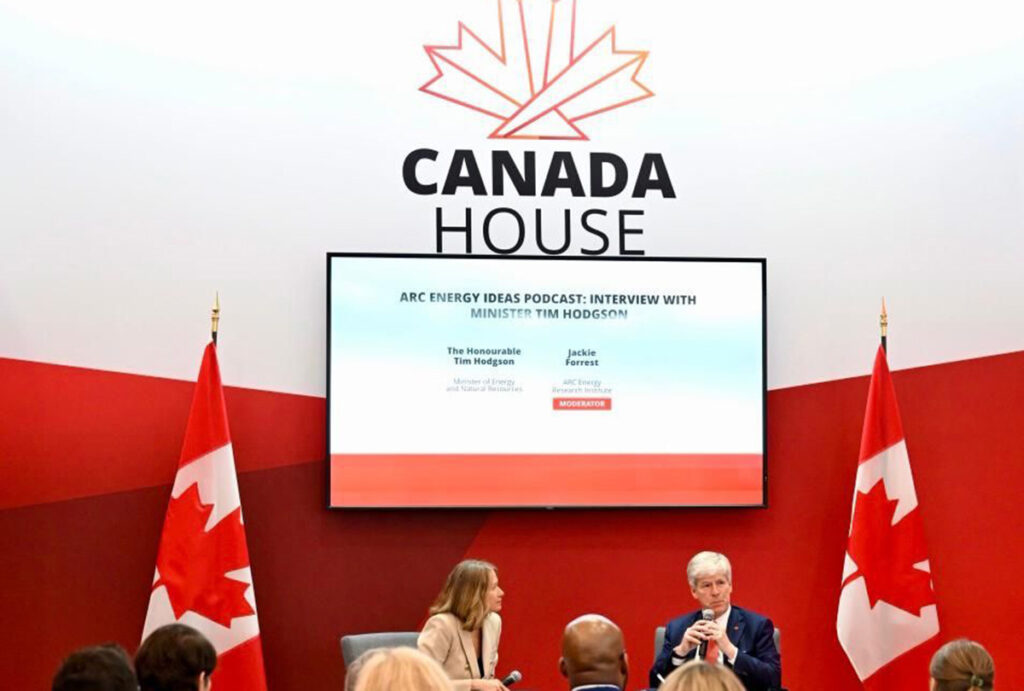
ARC Energy Ideas podcast Interview with Tim Hodgson. (Photo credit: ARC Energy Research Institute via LinkedIn)
By Resource Works
More News and Views From Resource Works Here
In a global landscape increasingly defined by geopolitical ruptures and a scramble for reliable energy, Canada is finding its moment in the sun. That was the core message from the Honourable Tim Hodgson, Minister of Energy and Natural Resources, during a recent sit-down with Jackie Forrest on the ARC Energy Ideas podcast.
Recorded at Canada House during CERAWeek in Houston, the conversation highlighted a significant pivot in how the federal government frames Canada’s role on the world stage. Hodgson didn’t mince words, describing a world where energy security has become synonymous with national security.
“We are in a different world today,” Hodgson noted, pointing to the instability in the Middle East and the hard lessons learned by European allies following the invasion of Ukraine. “The world is going to reorder. Everyone is asking the question, ‘What does energy security look like?’”
For Hodgson, the answer lies in future-proofing Canada. The phrase captures a dual-track strategy to maintain a robust conventional energy sector while aggressively building the infrastructure for a net-zero future.
The superpower ambition
The minister’s rhetoric signals an ambitious evolution. He emphasized that Canada’s path forward is not a choice between clean or conventional, but a commitment to excellence in both.
“If Canada is going to realize its potential, we need to be an energy superpower,” Hodgson said. “We need to be a clean and conventional energy superpower. It’s not one or the other, it’s both.”

This strategy involves leaning into Canada’s geographic advantages. With no maritime pinch points and shorter shipping distances to Asia compared to the U.S. Gulf Coast, Canada’s West Coast LNG projects are increasingly attractive to global partners. Hodgson confirmed that the federal government is serious about hitting targets of 50 million tonnes per annum of LNG exports by 2030, with a line of sight to doubling that by 2040.
Decarbonizing the barrel
A key pillar of future-proofing is the Pathways Alliance carbon capture and storage (CCS) project. By stripping 16 million tonnes of carbon from oil sands production annually, the project aims to ensure Canadian barrels remain competitive in a world where carbon intensity is a primary metric for investors.
“Saudi Arabia is investing hugely in carbon capture and storage. They want to future-proof their barrels too,” Hodgson observed. “It is important to future-proof our industry. It creates great jobs for Canadians.”
Hodgson argued that this technological edge doesn’t just lower emissions at home, it creates a new export market for Canadian expertise. By developing world-leading CCS and nuclear interties, Canada is essentially building a best-in-class energy suite that appeals to both the climate-conscious investor and the security-focused ally.
A new Indigenous paradigm
Perhaps the most profound shift discussed was the role of Indigenous partnerships. Hodgson moved the conversation away from viewing Indigenous engagement as a risk factor or a hurdle to be cleared. Instead, he framed it as a strategic imperative.
Drawing on his experience as former chair of Hydro One, Hodgson noted that projects no longer move forward in spite of Indigenous communities, but because of them. This equity-based model is central to the future-proofing philosophy, ensuring that the wealth generated by the energy transition is shared, thereby creating the social licence necessary for major multi-decade projects.
As the interview concluded, the takeaway was clear. Canada is no longer content to be a quiet participant in the global energy market. By leaning into its strengths as a stable, democratic, and innovative producer, the country is actively securing its place in a reordered world.
As Hodgson put it, “When we show Canadians that we’re doing the right thing and we’re developing our resources the right way, Canadians say, ‘Let’s go.’”
Ian Biana writes for the Resource Works Accelerate team and can be reached at [email protected].
Share This: