


 CDN NEWS |
  US NEWS









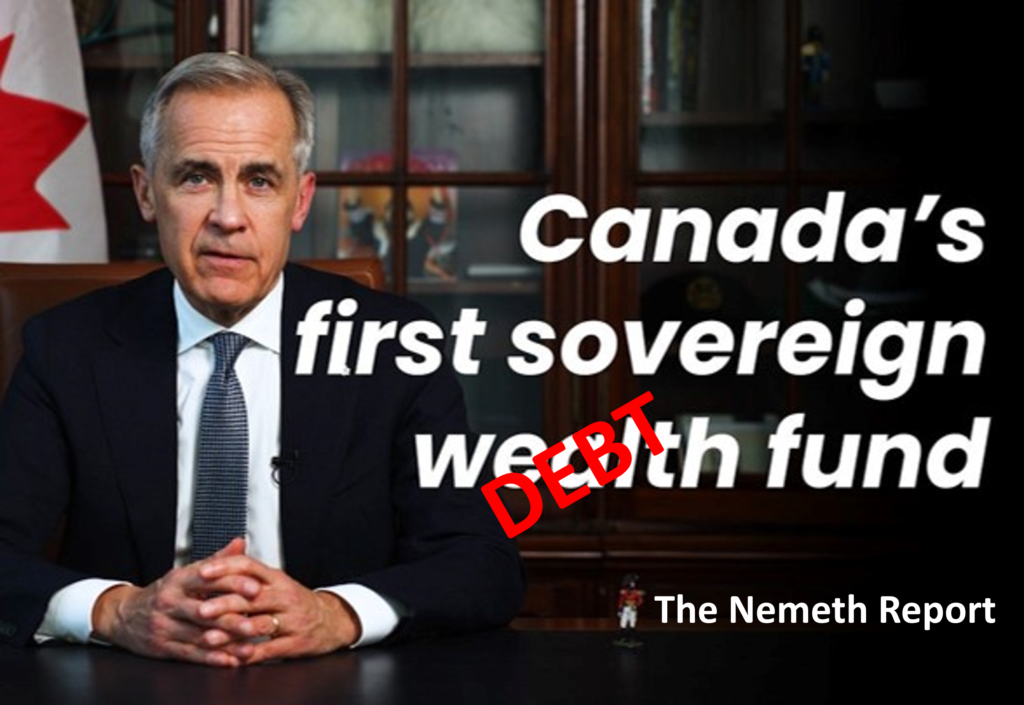
This is not a sovereign wealth fund (SWF) in any serious sense. Traditional SWFs are built from genuine surpluses — not new borrowing—and invest in foreign assets for long-term objectives. The “Canada Strong Fund” is a domestically trapped, politically motivated, potential slush fund dressed up in Norwegian clothing.
On April 27, 2026, Prime Minister Mark Carney stood at the podium in Ottawa’s Canadian Science and Technology Museum and sold Canadians a bill of goods. The “Canada Strong Fund,” he declared, would be Canada’s first national sovereign wealth fund — a vehicle to let ordinary citizens invest alongside the government and private companies in nation-building projects from energy to critical minerals. It would give “all Canadians a direct stake” in the future growing wealth for generations.
It was a masterful performance. It was also misleading.
This is not a sovereign wealth fund (SWF) in any serious sense. Traditional SWFs are built from genuine surpluses — not new borrowing—and invest in foreign assets for long-term objectives. The “Canada Strong Fund” is a domestically trapped, politically motivated, potential slush fund dressed up in Norwegian clothing. It also reveals far more about the weakness of Canada’s economy — and the nature of Carney’s new governing model — than any press release, backgrounder, or news conference admits.
Let’s be clear: Norway’s Government Pension Fund Global is the real thing. Built on actual petroleum surpluses, it invests every Krone outside Norway to prevent Dutch disease. A strict fiscal rule limits withdrawals to roughly the expected real return — about 3 percent — preserving capital and pensions for future generations. It is disciplined, global, and genuinely intergenerational.
The Canada Strong Fund is the opposite. It begins with a $25-billion federal endowment — taxpayer money or creative accounting, take your pick — and will be plowed almost entirely into Canadian projects the private sector has already decided are not bankable on commercial terms. According to Carney during press questions, it will be open to retail investors just “like buying a government bond.” That is not a sovereign wealth fund. That is a war bond with better marketing.
Yet the announcement, backgrounder, and Carney’s press conference and Q&A all make clear that key details — the product’s exact design, the Fund’s full governance, mandate, and implementation — have not been worked out. Those will come later through consultations via a new Canada Strong Fund transition office. The editors at EnergyNow.ca question the prudence of creating another fund with government debt at a time of structural deficits and compounding debt. Starting a “wealth” fund by borrowing more money is like an individual already in debt taking out another loan to invest. The risks are obvious and the precedent dangerous.
Canada does not need another one of these financing vehicles. We already have the Canada Pension Plan Investment Board, PSP Investments, the Caisse de dépôt et placement du Québec, the Canada Infrastructure Bank, the Canada Growth Fund, the Strategic Innovation Fund, the Business Development Bank of Canada, Export Development Canada, a half-dozen regional development agencies—the list goes on and on. The problem has never been a shortage of public investment vehicles. The problem is a shortage of projects that can attract private capital without government guarantees, fast-tracks, or subsidies.

As Matt Gurney recently observed, this is not a capital-access problem. It is a “we’re a bad bet” problem. Industry leaders are telling the British Financial Times that Carney’s red-tape-cutting efforts are floundering, costing the country more in lost trade than Trump’s tariffs. Forestry, oil and gas, and auto executives are frustrated. The Globe and Mail put it plainly: if an infrastructure project isn’t moving, it is usually because the private sector has deemed it economically unfeasible or too risky due to “onerous regulatory restrictions.”
We keep layering new bypasses in the Exemptocracy, like the Major Projects Office and now the Canada Strong Fund, on top of institutional (legislative, regulatory, judicial) dysfunction instead of fixing the dysfunction itself. The private sector has written Canada off. No amount of new Crown corporations will change that until the regulatory burden and policy uncertainty that make big projects unfinanceable in the first place are addressed. Vague parameters and the risk of mission creep — duplicating existing bureaucracies — only heighten the danger that funds will flow to politically favoured projects rather than genuine commercial returns.
This fits a pattern. The Fraser Institute’s 2026 analysis shows federal per-capita debt sitting at a near-record $56,432 under Carney, with further increases projected. Critics have documented the creative accounting — reclassifying operating spending as capital to flatter the deficit. The Canada Strong Fund lets the government claim it is “investing in the future” while the real fiscal position continues to deteriorate. Canadians will pay twice: once through taxes that seed the fund, and again if they are foolish enough to invest their own money in projects that may never generate a market return.
Carney’s claim that where there is “a commercial business, a commercial project that is making a profit,” it is “fair, right, just and smart for Canadians to have a share directly of those profits,” ignores a basic reality. Canadians who want exposure to mining, petroleum, data centres, advanced manufacturing, or data infrastructure projects can already invest through their RRSPs, TFSAs, or by buying shares directly in the public companies involved. In a staggering display of either ignorance or deliberate deception, the one example the Prime Minister gave at the press conference was the Port of Montreal expansion at Contrecoeur.
He said, “I’ll give an example. Expanding the Port of Montreal, the Contrecœur, will unlock new markets for thousands of Canadian businesses and create hundreds of thousands of jobs for Canadian workers. So until now, while those wider benefits flowed to the Canadian economy, flowed to our country, the financial returns of the projects themselves flowed only to those who built and ran them. That changes today.”
The thing is, the Port of Montreal is already owned by the federal government. It is a federal public asset—Canadians already “own” it through their federal taxes. Chipping in personal savings to ostensibly buy a “direct share” in something the government already owns and controls with taxpayer money changes nothing about ownership or returns. It simply moves money from one government pocket to another while asking citizens to pay twice. Either someone forgot to tell Prime Minister Carney that taxpayers already own the port, or he was deliberately misleading the public.
The fund also fits Carney’s emerging style of governance, the Exemptocracy. Carney claims the Canada Strong Fund will operate as an arm’s-length Crown corporation with independent decision-making. Yet the likelihood that its CEO and board will feature Liberal-connected figures is high — as seen with the Alto high-speed rail project between Ontario and Quebec, where one of the vice-president’s is the wife of the Federal Finance Minister! Cabinet will almost certainly “suggest” which “national interest” projects deserve priority funding, with the board dutifully considering those priorities. This raises serious questions about transparency and the vested interests of the PMO and Cabinet: who really decides, and who benefits? Will favoured projects and connected players receive special treatment and “regulatory support”? What about projects that don’t meet the criteria du jour of the PM and Cabinet – will they be stuck under the full weight of red tape and compliance costs thereby diminishing their ability to attract financing?
The government boasts that Canada is a top destination for foreign direct investment in the G7, citing AAA credit ratings, the lowest net debt-to-GDP ratio, and number-one banking stability. If that were true, why the need for yet another $25-billion taxpayer funded vehicle to coax capital into projects? The fund itself is the confession: private money is not arriving on commercial terms, so Ottawa will backstop the risk, socialize the downside, and call it patriotism.
This is not what a confident country does. A confident country attracts private capital on its own terms. It maintains fiscal discipline. It does not create new accounting streams to hide deficits and debt. It does not need to create new funds to paper over the fact that its major projects cannot stand on their own.
Carney’s Canada Strong Fund tells us the quiet part out loud: the private sector has lost faith, the fiscal cupboard is bare, and the solution is to ask Canadians to believe in the brand while the underlying weaknesses grow. That isn’t nation-building, it’s managed decline with better optics.
Share This:























THE GEOTHERMAL OPTION: B.C.’s Overlooked Firm Power Option: What the Geothermal Evidence Shows – Resource Works