CDN NEWS |
  US NEWS








by Jim Warren
Smith and Carney have more explaining to do.
Public perceptions about the value of the pipeline MOU remain mixed. True, optimism increases and pessimism declines whenever Danielle Smith provides updates on progress toward the construction of a Northern Gateway 2.0. Smith has a lot of credibility when it comes to her knowledge of conventional energy issues.
Yet, despite the comforting effects of Smith’s optimism, there are more and more reasonable people who are becoming more and more skeptical. And their concerns aren’t simply about the disruptions caused by the usual suspects who appear regularly in the mainstream media such as: Indigenous protesters, foreign-funded environmental groups, opposition by the David Eby government, and the disturbing silliness of hyper-woke judges.
More troubling are claims that the emissions reduction requirements contained in the MOU threaten the profitability of oil exporters and pipeline owners. Problematic conditions include: 1) the $130 per ton industrial carbon tax on emissions released during crude oil production which is required under the MOU; and, 2) the condition requiring oil sands companies to spend an estimated $16.5* billion to develop the Pathways Alliance carbon capture and sequestration (CCS) system.
* The figure is a cost estimate from 2023
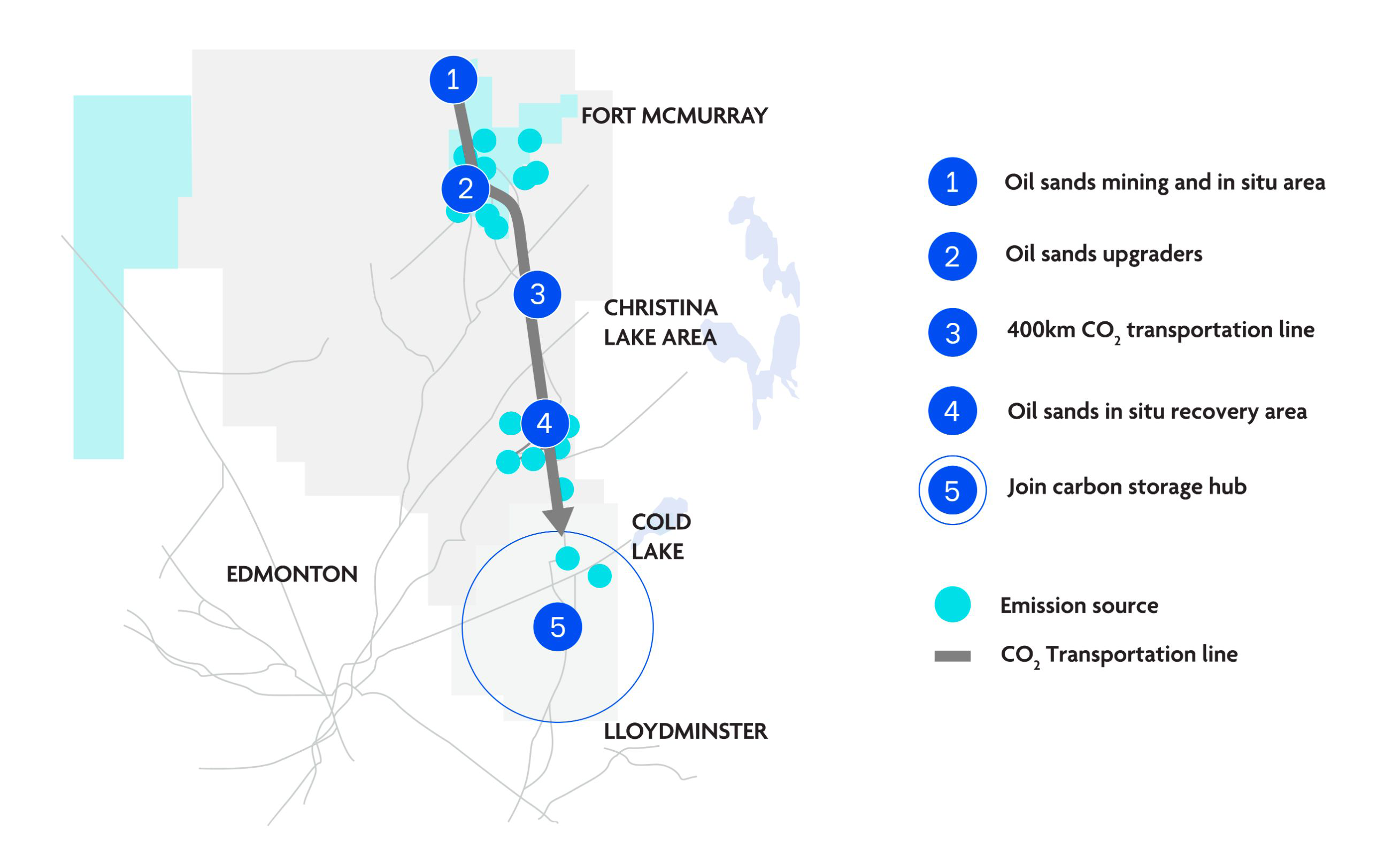
A further complication is the scale of investment capital required to build the pipeline, while at the same time constructing the Pathways Alliance project. The combined projects could require investments $40-45 billion range – possibly a tall order considering that since Justin Trudeau became PM in 2015 a half-trillion in investment capital has fled the country.
Dan McTeague, president of Canadians for Affordable Energy, is among those who claim the high cost of carbon taxes and emissions reduction via the Oil Sands Alliance project required by the MOU will harm the competitive position of Canadian oil in the international marketplace. Alberta’s producers will be saddled with costs not incurred by their major competitors. The Saudis, Russians, Iranians and Iraqis don’t handicap their producers by assessing onerous carbon taxes or insisting they build and pay for multi-billion dollar carbon sequestration systems.
Analysts critical of the MOU argue that the international price of crude oil will not compensate Canadian producers for the expense of meeting their unique emissions cutting requirements. But don’t try telling that to the environmental zealots responsible for federal energy policy. In the fantasy world inhabited by federal Liberals, international petroleum buyers will be lining up to pay a premium for Canadian crude because producing it generates fewer emissions than oil produced by our competitors.
Spoiler alert! No one familiar with how the global petroleum market works believes this.
MOU critics claim that the buying decisions of big importers are made on the basis “of price and availability.” Countries like China, India, Indonesia and South Korea will not pay a premium, when purchasing oil, simply to support the Carney government’s green agenda.
We’ve been waiting months now to get satisfactory explanations from officials familiar with the MOU about how the emissions reduction conditions can be met without jeopardizing the business case for a new pipeline. Until quite recently we’ve been hearing crickets.
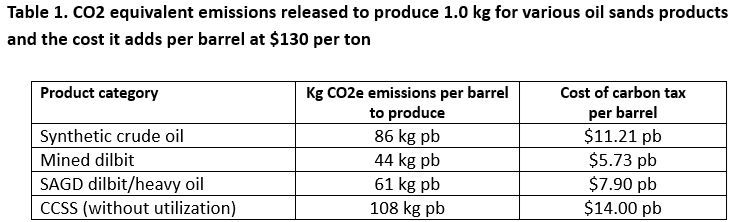
Table 1, presented at the end of this article, shows the cost of the industrial carbon tax required under the MOU. The table indicates that a $130 per ton carbon tax would increase production costs by $5.73 pb for mined diluted bitumen (WCS dilbit) and up to $14 pb for WCS dilbit that has gone through the CCS process.
At first glance the cost figures appear prohibitive. One of the data points foreshadows an outcome that is both expensive and odd. Oil producers who have invested in synthetic crude production technology and processing facilities as a way to increase the value of the petroleum they produce, might notice that when the carbon tax is applied, the premium they receive for synthetic crude over the market price for mined WCS dilbit falls from $9.53 pb to just $3.87 pb.



Anomalies like the synthetic crude premium reduction along with the many additional threats posed by required cost increases leaves us with a lot of questions that the MOU doesn’t answer. Yet, it is likely people familiar with the discussions that occurred when the MOU was being developed and in subsequent rounds of negotiations and information sharing could explain how and why the added costs will or won’t be reduced by other factors identified in the document.
There are indeed conditions presented in the MOU which could potentially compensate oil producers for the sections of the document imposing price increases. For example, administration of the $130 per ton carbon tax will be handled under Alberta’s Tier program which provides credits and tax relief for companies engaged in emissions reduction. Additionally, the MOU allows oil companies to utilize CO2 captured by the Pathways project for enhanced oil recovery. The additional production and revenues thus derived would presumably provide a return on the investment required to build the Alliance system, and
Complex negotiations between governments involving controversial topics and conflicting objectives rarely occur in full public view. But, there is no reason to prevent the release of general explanatory information about how the MOU will, or will not, affect the competitive position of Alberta’s oil producers and the province’s GDP. As things stand, to be adequately informed one needs to be personally involved in the intergovernmental discussions or know the secret handshake before you get to peek under the hood.
Surely people can be provided with answers to many of the questions arising from some of the contradictory and confusing information presented in the MOU, without revealing state secrets. Skepticism could be reduced by providing people with clear explanations that show whether or not production cost increases required under certain sections of the MOU can be reduced by virtue of measures that appear elsewhere in the document.
If reasonably convincing explanations cannot be provided without making changes to the MOU, critics who claim the document, as currently conceived, isn’t worth the paper it’s written on could be right. Indeed, it seems eminently reasonable to expect that if some of the less desirable conditions are or could be up for renegotiation the public should be allowed to know about it.
Kendall Dilling, head of the Oil Sands Alliance, recently took a big step forward in support of greater transparency. In a February 20th interview with the Financial Post, Dilling revealed there are indeed ongoing negotiations underway, dealing with the challenges the MOU represents for the petroleum sector. He forthrightly admitted concerns about the potential for increasing production costs to harm the competitive position of Canadian petroleum exporters. But he also indicated that there are lots of levers available to governments which could be employed to reduce production costs for the industry.
We need to see more of that kind of information communicated to the public.
Alberta’s UCP government recently launched an informational website for Alberta’s West Coast Pipeline (https://www.alberta.ca/west-coast-oil-pipeline). That too could be a step in the right direction. It could be a great vehicle for explaining how it might be possible to meet the various demands placed on the industry and the people of Alberta—without ruining the competitive position of our exporters.
Unfortunately, the website doesn’t provide information that might reduce skepticism about the commercial viability of the pipeline project. It is not an entire waste of cyberspace. But it could certainly be better.
Sources: Hwang, Celina & Kevin Brin (2023, August 8). Canadian oil sands continue their trend of GHG intensity reductions in 2022—down 23% since 2009. S &P Global
https://www.spglobal.com/energy/en/research-analytics/canadian-oil-sands-continue-their-trend-of-ghg-intensity
Oil Sands Magazine (2021, March18). Oil sands emissions by extraction method: busting myths on GHG intensity
https://www.oilsandsmagazine.com/news/2021/3/18/oil-sands-emissions-by-extraction-busting-myths-on-ghg-intensity

*price advantage #1 is for the eight-month average price (June 2025–Jan. 2026) for synthetic crude. It accounts for the differential but does not include a the cost of the $130 per ton industrial carbon tax
**price advantage #2 is for the eight-month average price (June 2025–Jan. 2026) for synthetic crude. It accounts for the differential plus the cost of the $130 per ton industrial carbon tax.
Estimates are derived from the sources for Table 1 above and eight monthly price snapshots for Syncrude Sweet Premium crude and Western Canadian Select (WCS) crude from June 2025 to January 2026 as posted on https://oilprice.com/oil-price-charts/block/1
-30-
Share This: