CDN NEWS |
  US NEWS









Canadians and the rest of the world are still suffering from poor judgement on the importance of natural gas.
By Geoff Russ
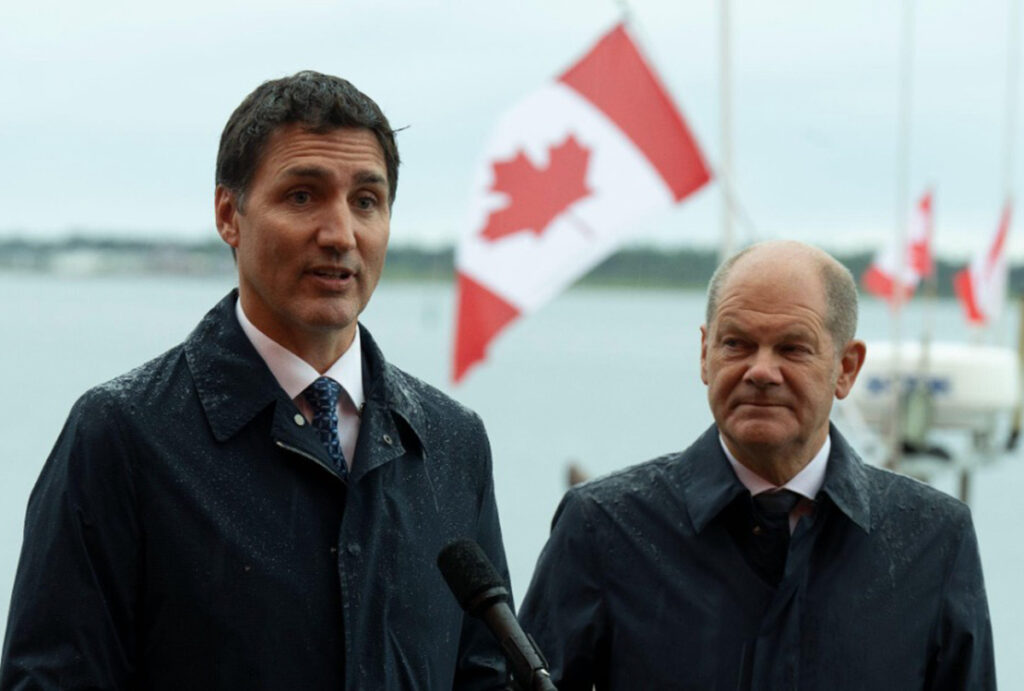
German Chancellor Olaf Scholz looks on as Canadian Prime Minister Justin Trudeau responds to a question during joint media availability on Tuesday, August 23, 2022 in Stephenville, Newfoundland and Labrador. THE CANADIAN PRESS/Adrian Wyld.
By Resource Works
More News and Views From Resource Works Here
As missiles hit Gulf energy infrastructure and gas prices lurch upward, one of the most consequential Canadian policy judgments of recent years looks worse by the day.
This month, Iranian strikes had inflicted extensive damage on Qatar’s Ras Laffan complex, the site of the world’s largest LNG export plant. Seventeen per cent of the country’s LNG export capacity has been knocked out, with repairs expected to take three to five years. European gas futures surged by as much as 35 per cent in a day. LNG prices could move above US$26 per million British thermal units in the coming weeks, with some analysts warning of prices above US$30 or even US$40 if the Strait of Hormuz remains disrupted for months.
Ras Laffan accounted for 19 per cent of global LNG exports in 2025, according to Bloomberg’s shipping data, and its cargoes supplied more than one-fifth of total gas consumption in India, Taiwan and Pakistan. Damage on that scale does not stay in Qatar. It ripples through utility bills, industrial costs and inflation from Europe to Asia.

The cost of political hesitation
That is why Justin Trudeau’s August 2022 statement that there had “never been a strong business case” for LNG exports to Germany continues to be revealed as a disastrous misreading of the moment. He made the remark while hosting then-German Chancellor Olaf Scholz, who had come to Canada in search of alternatives to Russian gas after Moscow’s invasion of Ukraine. Germany was in an energy crisis, restarting coal plants and hunting for supply, but Ottawa still hesitated.
The years since have not vindicated that caution. Germany has since built four LNG terminals, Europe’s winter LNG imports climbed near record levels, and Canada’s first cargo from LNG Canada in Kitimat did not sail until July 2025. By then, allies had already signed contracts with Qatar, the United States and Australia.
Now Ottawa has reversed course. In Berlin last August, Natural Resources Minister Tim Hodgson stated that German companies were interested in Canadian LNG and that buyers were prepared to use West Coast supply to serve German needs.
Subsidizing EVs over market demand
Canada’s policy contrast is hard to ignore. While Ottawa dismissed LNG’s market case, governments committed more than $52 billion since 2019 to subsidize EV plants and supply chains, according to the Macdonald-Laurier Institute. Yet that strategy has already shown strain through delays, cancellations and corporate reversals. The Stellantis decision to move Jeep production from Brampton to Illinois, despite massive public backing for EV battery manufacturing, exposed the weakness of trying to build an industry by subsidy first and market demand second.
The clear market case for LNG
LNG, by contrast, has never lacked customers. It lacked political confidence and permitting speed. TC Energy chief executive François Poirier has said that shorter approval timelines would make Canada far more competitive, especially as buyers look for supply that avoids chokepoints such as Hormuz. The Canada Energy Regulator now projects natural gas production rising to 27 billion cubic feet per day by 2050 under its baseline scenario, up 48 per cent from 2024, with LNG exports making up 20 to 25 per cent of total production.
The lesson should be obvious by now. Canada spent years doubting an industry its allies needed and global markets were prepared to pay for, while lavishing public money on an EV strategy whose economics depended on political fashion in Washington and on consumer demand that never fully arrived. The price of that error is now being paid by households abroad, by allies scrambling for fuel, and by Canadians who are only beginning to grasp how expensive energy misjudgement can be.
Geoff Russ is a writer for Resource Works, a non-partisan organization that champions responsible resource development in British Columbia and Canada. Reach Geoff at [email protected].
Share This: