CDN NEWS |
  US NEWS







Europe, India and Asia seen among big future buyers
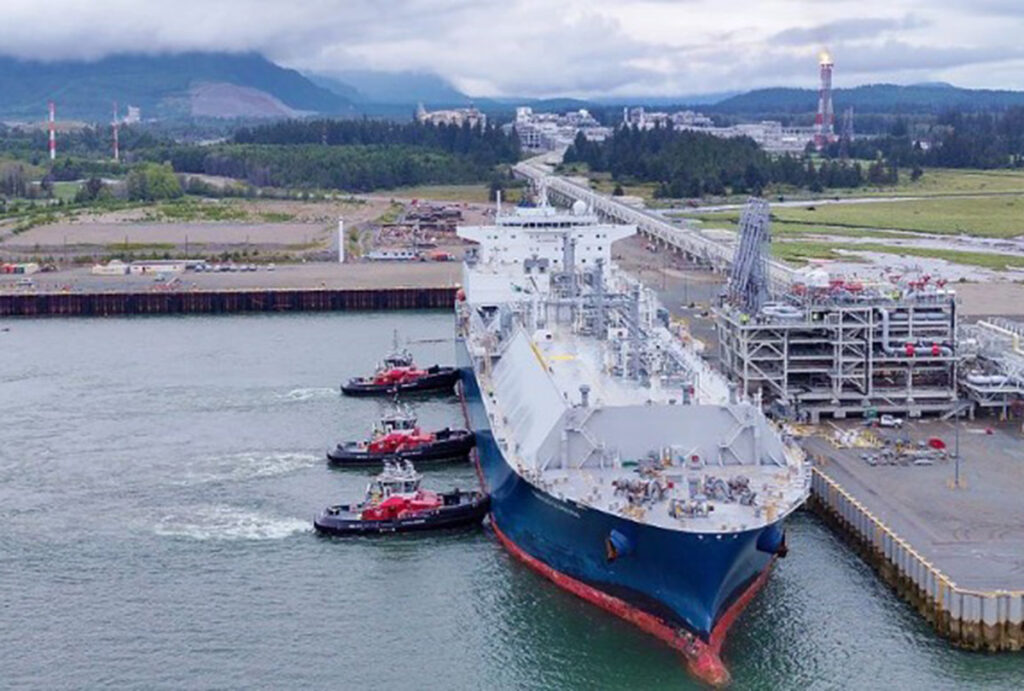
LNG carrier GasLog Glasgow arriving to load the first export cargo from LNG Canada. It then sailed for South Korea on July 1, 2025.
The US-Israel attacks on Iran created instant chaos in the world of liquefied natural gas.
- Qatar, the world’s second largest exporter of LNG (after the US) shut down production following Iranian drone strikes on its facilities, reducing near-term global supply by almost a fifth.
- The threat of Iranian action left dozens of LNG carriers and oil tankers stranded or hampered in the Strait of Hormuz between Iran and Oman.
- The price of natural gas in Europe shot up by 30% and more.
- The ship-charter rates for LNG carriers also boomed by 30% and 40%.
- And US LNG exporters looked to supply more of world demand for LNG — profitably.
How long negative market impacts continue is anyone’s guess. US President Donald Trump spoke of the strikes on Iran continuing for another “four to five weeks, but we have capability to go far longer than that.”
If and when the LNG market does settle down, what can we expect?
LNG glut questioned
Looking at the long term, opponents of LNG development had been crowing at the prospect of a glut in world supply, and delighting at the prospect of LNG companies thus losing money — and the energy race.
But the conflict in the Middle East and the shutdown of Qatar’s Ras Laffan LNG hub rapidly shifted expectations from a looming LNG oversupply to potential tightness in global gas markets.
For example, analysts at Morgan Stanley, the global financial services firm, said that if the outage in Qatar extends beyond one month, this “quickly brings a deficit” to the markets.
Long before that, other professional world market-watchers forecast an over-supply of LNG developing (likely later this year) reducing prices for the product — but they also saw those reduced prices as increasing demand in the world marketplace.
Kpler Insight, for example, expects cheaper LNG to result in “opportunistic consumption” in Asia and Europe. It sees LNG demand rising by 14% in Europe and by 22% in India, driven in India largely by industrial fuel-switching (from coal). Pakistan and Bangladesh are also seen as bigger buyers of cheaper LNG.
And cheaper LNG from the US could help Europe wean itself further off Russian gas and LNG.
Shell CEO Wael Sawan says abundance of gas will likely create new pockets of demand in price sensitive markets.
Wood Mackenzie’s latest Horizons report says the new wave of LNG supply could reverse a decade of European industrial decline, cutting annual energy costs by almost $63 billion (Canadian dollars) by 2032 and delivering cumulative savings of $290 billion.
The Oxford Institute for Energy Studies (OIES) has estimated global LNG prices could fall from a long-term average of US$8 per million British Thermal Units to US$6 as a result of all the new LNG coming onto world markets.
LNG helps switch from coal
The OIES says cheaper LNG “could become seriously competitive with coal,” and thus could accelerate a switch from coal to natural-gas power in Asia. Then that, it says, would create new longer-term demand for LNG.
The US Energy Information Administration (EIA) forecasts a drop in domestic prices this year, but sees recovery in 2027: “We forecast annual average spot prices will decrease by 2% in 2026 and then increase by 33% in 2027.”
(Strangely, the EIA sees domestic gas consumption in the US declining this year, despite all the reports, including its own, of much increased use of natural gas to provide the electricity demanded by Artificial Intelligence data centres.)



Along with record exports of US LNG, the US sees Ukraine as a new customer, now that the new Fiscal Year 2026 National Defense Authorization Bill increases lending authority from $60 billion to $205 billion to finance energy exports.
(Though China, in a tariff fight with the US, has been boosting domestic production of natural gas and reducing imports of US LNG.)
The ‘mirage’ narrative vs. global reality
One green group in Canada happily speaks of “Canada’s LNG Mirage” and insists that “Canada is attempting to enter a market that is already full” and that therefore “Canadian LNG plants face a clear risk of both fiscal and physical stranding.”
It adds: “Under conditions of sustained LNG oversupply, rapid global deployment of solar and batteries, and rising financing costs for fossil infrastructure, most proposed Canadian LNG capacity will not be built. Some of what is built will still become stranded.”
But the Oxford Institute says: “Lower coal-plant capacity, higher electricity demand, and the forecast lower gas prices of $6 per MMBTU will contribute to sustaining gas demand in the power-generation sector in the coming years, even alongside the rapid growth of renewables.”
And although renewable energies are on the rise, the International Energy Agency sees fossil fuels still providing 42% of electricity generation in 2035, down from 58% today.
Canada on the move
Meanwhile, AltaGas of Calgary says it has already won a meaningful foothold in the Chinese propane market in less than a year and sees more opportunity ahead. AltaGas now supplies six per cent of China’s propane imports, 14 per cent of South Korea’s supply and 11 per cent of Japan’s.
LNG Canada, which began export shipments from Kitimat BC last July, awaits a decision from its partners on Phase 2 expansion, which would double its output to 28 million tonnes a year. Petronas says it hopes for a decision in the third quarter of this year.
The Ksi Lisims LNG project in northern BC, involving the Nisga’a Nation, is at work on the PRGT pipeline that will feed it, and looks for a final investment decision soon. Ksi Lisims would produce 12 million tonnes of LNG a year.
The Haisla Nation’s Cedar LNG project at Kitimat is under construction, with a target in-service date of late 2028 for production of 3 million tonnes a year.
Woodfibre LNG is under construction on Howe Sound near Vancouver, and so is the natural-gas pipeline extension to supply it. Woodfibre will be “the world’s first net-zero LNG export facility,” and will produce approximately 2.1 million tonnes of LNG per year, starting in 2027.
Fortis BC is working on expansion of its Tilbury LNG plant in Delta BC, and an associated marine terminal.
The timing of these projects fits nicely with the expectation of increased demand for LNG after the 2026 glut fades away.
Our Resource Works CEO, Stewart Muir, called the Montney gas reserves “the crown jewel of the British Columbia economy” and added:
”The Montney is real. The Asian demand is real. . . .B.C.’s Pacific location gives Canadian exporters a genuine structural advantage over Gulf Coast competitors. The resource, the geography, and the market are all present.”
All in all, then, LNG — and Canadian LNG — is far from a mirage.
Don MacLachlan is a writer for Resource Works, a non-partisan organization that champions responsible resource development in British Columbia and Canada. Reach Don at [email protected].
Share This: